

For Denver homeowners, the best move isn’t browsing carpet stores in Richmond VA — it’s hiring a local installer who knows your home, your climate, and your subfloor. Leonardosflooringcorp has served the greater Denver metro for over 10 years, backed by many five-star reviews. A single room of carpet can typically be installed in 2–8 hours, while whole-home projects range from 2–5 days depending on scope. Tile takes longer, because mortar and grout require 24–48 hours to cure. To get started, call or request a free estimate online — have your room dimensions and a rough budget ready.
Table of Contents
- What drives flooring costs in the Denver area?
- What should a flooring contract include?
- How do you evaluate local flooring installers?
- Questions to ask before you hire
- Red flags to watch for
- Payment options and financing
- Key Takeaways
- Why local experience matters more than you’d think
- Get a free estimate from Leonardosflooringcorp
- Sources used in this article
What drives flooring costs in the Denver area?
Material choice is the biggest lever. Denver-area installed prices vary widely depending on the type of flooring, material quality, and installation complexity. Subfloor condition matters just as much — a damaged or uneven subfloor adds prep labor before a single plank goes down. Room layout, furniture moving, and demo of existing flooring all factor in too. Contractors typically handle removal and disposal of old material, but that work adds time and cost, especially for glued-down tile or sheet vinyl.
What should a flooring contract include?
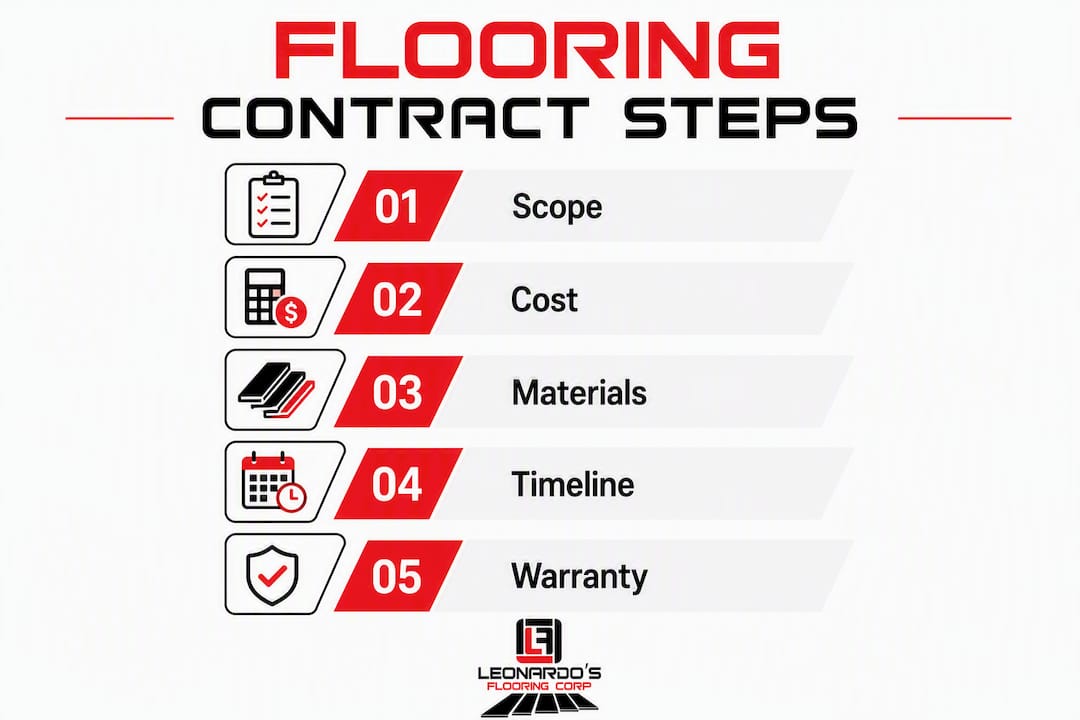
A solid contract protects you from scope creep and surprise charges. Every written agreement should specify the scope of work, materials listed by brand and SKU, total price, payment schedule, start and completion dates, a change-order procedure, and warranty terms. Verbal promises disappear fast. If a contractor can’t name the exact product going into your home, that’s a problem before the job even starts. A floor installation warranty should cover both materials and workmanship separately.
How do you evaluate local flooring installers?
Start with reviews, but read them critically. Volume and recency both matter — many five-star reviews over a decade tells a different story than 12 reviews from one month. Look for manufacturer certifications like NWFA for hardwood or CTEF/CTI for tile. Ask whether the company handles the full job: subfloor prep, demo, installation, and finishing carpentry like baseboards. A contractor who subcontracts every phase is harder to hold accountable. Matching flooring type to your traffic levels is something an experienced local installer can advise on directly.

Questions to ask before you hire
Effective vetting comes down to five direct questions: Do you carry general liability insurance and workers’ comp? Will you do a moisture test and subfloor assessment before installation? Can you provide the brand and SKU for every material in the quote? What’s your warranty on labor? Can you share references from recent local projects? Colorado doesn’t require a state-level residential flooring license, so insurance and references carry more weight than a license number.
Red flags to watch for
Walk away if a contractor demands full payment upfront, can’t produce a written contract, or quotes a price without seeing the space. Vague material descriptions (“standard carpet pad”) with no brand or spec are a warning sign. So is pressure to sign same-day. A reputable installer will want to assess your subfloor — anyone who skips that step is cutting corners that show up later.
Payment options and financing
Most reputable contractors structure payments in milestones: a deposit to secure the date, a progress payment at material delivery, and a final payment after walkthrough. Some installers offer financing through third-party lenders. Ask upfront what options are available and confirm the terms in writing before signing. If your project involves a contractor lien, Virginia lien waiver documentation is a useful reference for understanding your paperwork rights.
Key Takeaways
Hiring a local Denver installer with a written contract, verified insurance, and a pre-install site assessment is the most reliable path to a floor that lasts.
| Point | Details |
|---|---|
| Timeline varies by material | Carpet installs in 2–8 hours per room; tile requires 24–48 hours extra for mortar and grout curing. |
| Cost range is wide | Carpet and hardwood installation costs vary significantly based on material and other factors in Denver. |
| Contract must name materials | Require brand and SKU in writing — not just “carpet” or “tile.” |
| Insurance over license | Colorado has no residential flooring license requirement; verify general liability and workers’ comp instead. |
| Leonardosflooringcorp | 10+ years in Denver, many five-star reviews, full-service from subfloor prep to warranty documentation. |
Why local experience matters more than you’d think
The conventional advice is to get three quotes and pick the middle one. That misses the point entirely. Denver’s high-altitude, low-humidity climate dries out wood products faster than most of the country, which means acclimation periods aren’t optional — they’re what separates a floor that stays flat from one that gaps or cups within a year. An installer who’s worked in Denver homes understands this. One who hasn’t may skip it.
Moisture testing before installation is a professional standard, not an upsell. A contractor who skips a preconstruction site assessment — checking substrate condition, moisture levels, and traffic patterns — is setting you up for premature failure. The contract should reflect that assessment: scope, SKU-level materials, milestone payments, and warranty terms all in writing.
Pro Tip: Structure payments as deposit + progress payment at material delivery + final after walkthrough. Never pay 100% upfront, and never release the final payment before you’ve walked the finished floor yourself.
Get a free estimate from Leonardosflooringcorp

Leonardosflooringcorp gives Denver homeowners and commercial property owners a direct path from estimate to finished floor, with no subcontracting surprises and no vague material specs. Ten-plus years of local installs, many five-star reviews, and the ability to handle everything from subfloor prep to hardwood floor installation in one crew.
Before your estimate, have these ready: room dimensions or photos, your preferred material (or a shortlist), your budget range, preferred start dates, and any known moisture issues or existing floor photos. Request your on-site estimate at leonardosflooringcorp.com/flooring-installation.
Sources used in this article
| Material | Typical install timeline | Primary cost drivers |
|---|---|---|
| Carpet | 2–8 hrs per room; 2–5 days whole-home | Material grade, pad, subfloor prep, demo |
| LVP | several days | Subfloor leveling, layout complexity |
| Engineered hardwood | several days + 48-hr acclimation | Acclimation, moisture testing, nail vs. float |
| Tile | 4–6 days incl. cure time | Mortar, grout, substrate prep, layout |
| Solid hardwood | several days plus acclimation | Nail-down labor, acclimation, subfloor flatness |
Colorado has no state-level residential flooring contractor license requirement. Verify general liability insurance and workers’ compensation directly with your installer before signing. Additional guidance: Colorado Concrete Repair — questions to ask before signing.