
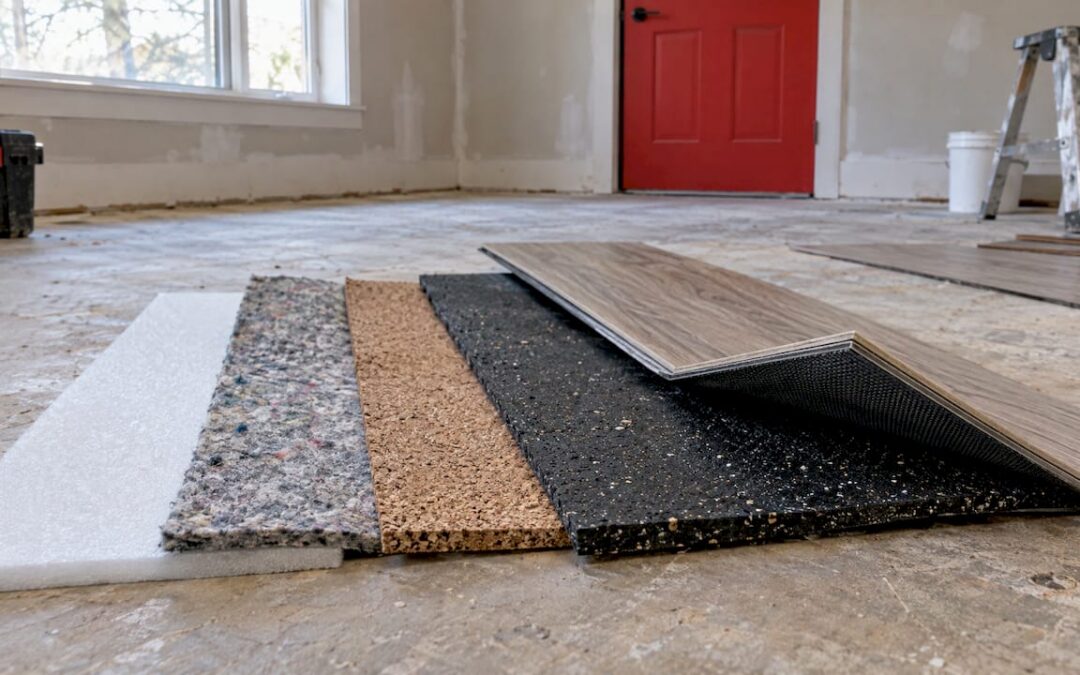
Most luxury vinyl plank (LVP) sold today either has a pad attached to the back or is made to go down with no pad at all, so the best underlayment is often none. When a separate layer is right, it is a thin, dense one, and it has to be the one your plank manufacturer approves. Pick the wrong one and you can void the warranty or end up with planks that dent, gap or separate. At Leonardo’s Flooring Corp we have installed floors across the Denver metro for over 10 years, and the underlayment question starts with your plank and your subfloor, not with a product list.
What are the key takeaways for LVP underlayment?
- The key takeaways for LVP underlayment are: always check your plank's back first, as attached pads often eliminate the need for a second underlayment. Glue-down and loose-lay LVP also typically require no additional underlayment. For bare-back click LVP over wood, a thin, dense pad (1-1.5 mm) may be needed if approved by the manufacturer. Over concrete, especially in Colorado basements, moisture control is crucial, and the slab must be tested. Avoid soft, thick foam under vinyl plank, as it can cause dents and damage locking edges, with many manufacturers prohibiting it. Always follow your plank’s installation guide, as it dictates warranty coverage.
Table of Contents
- Do you need underlayment for LVP at all?
- Can you lay LVP directly on a subfloor?
- The main LVP underlayment options
- What goes between vinyl plank and concrete
- Choosing underlayment for sound and comfort
- Radiant heat and other special cases
- A short checklist before you buy underlayment
- How we approach it
- Get the floor and the layers under it right
- FAQ
- Sources
Do you need underlayment for LVP at all?
Often you do not. The reason is that rigid-core LVP (the kind with a stone or wood-plastic composite core) is built as a complete system. Many planks ship with a foam or cork pad already bonded to the back. Adding a second layer can undercut the engineering.
Calcore’s LVP installation guide states that no additional underlayment should be used under its LVP and LVT, and that soft underlayments and soft substrates reduce the product’s ability to resist indentations. Architessa’s guide goes further and prohibits installing over rolled or panel-type foam, rubber, cork or other soft pads.
Here is the quick sorting rule, by plank type:
| Your LVP | Separate underlayment? |
|---|---|
| Attached pad, over a wood subfloor | No |
| Attached pad, over concrete | Only a 6-mil poly film if the maker requires it |
| Bare-back click LVP | Sometimes: a thin, dense pad the maker approves |
| Glue-down LVP | No, it bonds directly to a prepared subfloor |
| Loose-lay LVP | No |
The sticking point is the first column. If you cannot tell which plank you have, look at the carton label or the installation sheet, or ask your installer before the materials are ordered. You can read more about plank construction in our guide to what LVP flooring is.
Can you lay LVP directly on a subfloor?
Yes, when the subfloor is ready for it. Vinyl is thin and follows whatever is beneath it, so the subfloor does the real work. Manufacturers set the conditions.
For wood subfloors, Metroflor’s guide asks for a surface flat within 3/16 inch over a 10-foot span, wood moisture content of 14% or less, and underlayment-grade panels at least 1/4 inch thick that are smooth and resist indentation. Flexco specifies wood substrates built to ASTM F1482 with a double layer at least 1 inch thick in total, moisture content not above 8%, and room conditions between 60 and 85°F and 40 to 60% relative humidity.
For concrete, the slab must be fully cured and dry. Lions Floor’s guide asks for new slabs at least six weeks old before glue-down work.
Three things commonly go wrong with a bare subfloor:
- Ridges and dips. Old adhesive, patch lumps and seams telegraph through vinyl and show as ridges, or stress click joints until they separate.
- Squeaks and movement. Loose plywood or planks moving under the floor wear the locking edges.
- Moisture. Slabs and crawlspace-adjacent floors can pass moisture upward.
Subfloor preparation is one of the services we install under every floor we put down, and it is where most of the quality of an LVP job is decided.
The main LVP underlayment options
When your plank maker does allow a separate layer, these are the families you will see. They differ in thickness, sound control and moisture handling.
Dense foam (IXPE and similar)
Thin, closed-cell cross-linked foam, usually 1 to 2 mm, is the common choice for bare-back click LVP because it is firm enough not to flex under the locking edges. Some versions carry a built-in vapor film for use over concrete. This type is the usual answer when a maker says a pad is optional but allowed, and it stays under the 2.5 mm ceiling that Flexco sets for any sound-deadening underlayment under its LVP.
Fiber and foam combination products
Some underlayments are made specifically for luxury vinyl. QuietWalk LV, for example, is a 1.4 mm recycled-fiber underlayment with an attached vapor barrier, rated IIC 70 and STC 62, and designed for floating and glue-down vinyl plank as well as laminate. (IIC and STC are lab ratings for impact noise and airborne sound. Higher numbers mean quieter.) Its maker’s comparison page lists a concrete moisture allowance of up to 6 lb per 1,000 sq ft per 24 hours.
Cork and cork-foam blends
Cork-based pads are thicker and better at sound and warmth. Eco Cork Foam’s Premium Plus is a 1/8-inch blend of cork and cross-linked foam with a built-in 6-mil vapor barrier, rated up to IIC 76, and listed for vinyl plank 5 mm or thicker. Thicker pads suit some floors but not others, which is why the maker’s approval matters.
Rubber and latex sheet
Sheet membranes in rubber or latex are the heavy option for sound control. Protecto Wrap’s Whisper Mat LVT, a latex rubber membrane, lists IIC 73 and STC 63 over concrete with a ceiling below. That kind of rating matters mainly for condos, townhomes and upper floors where an HOA or building rule sets a sound target.
Moisture-control underlayments for commercial or damp-prone floors
Some high-density underlayments are made for demanding spaces. Metropolitan Systems’ Complete AMB data sheet describes a commercial-grade acoustical underlay with moisture control up to 100% RH, approved for rigid-core and glue-down applications over OSB, gypsum underlayment, APA subfloors and concrete.
What goes between vinyl plank and concrete
Concrete is where underlayment decisions matter most, and Colorado homes have a lot of it: basements, garages converted to living space, and slab-on-grade ranch houses.
Concrete never fully stops moving water vapor. A floating vinyl floor traps it, which can lead to odor, mildew or adhesive failure. Manufacturers therefore ask for two things.
1. A moisture test before installation. The two standard methods are the calcium chloride test (ASTM F1869) and in-slab relative humidity probes (ASTM F2170). Limits vary by brand:
- Calcore’s underlayment is approved over concrete with emission not above 3 lb per 1,000 sq ft per 24 hours per ASTM F1869.
- EverStep’s glue-down guidelines call for no more than 3 lb on the F1869 test and no more than 80% RH on the F2170 test.
- Architessa asks for F2170 testing and a consultation when readings exceed 80% RH.
Because the numbers differ, your plank’s own sheet is the one that counts. If a slab reads too high, a moisture-mitigating coating is the usual fix, and we explain it in our piece on vapor barrier epoxy and why to test first.
2. A vapor barrier where required. SAR’s TriCore instructions, for example, require a 6-mil polyethylene vapor barrier on all concrete. Some underlayments bond that film to the pad, so you do not lay it separately. Eco Cork Foam says its bonded 6-mil barrier removes the need for a separate one.
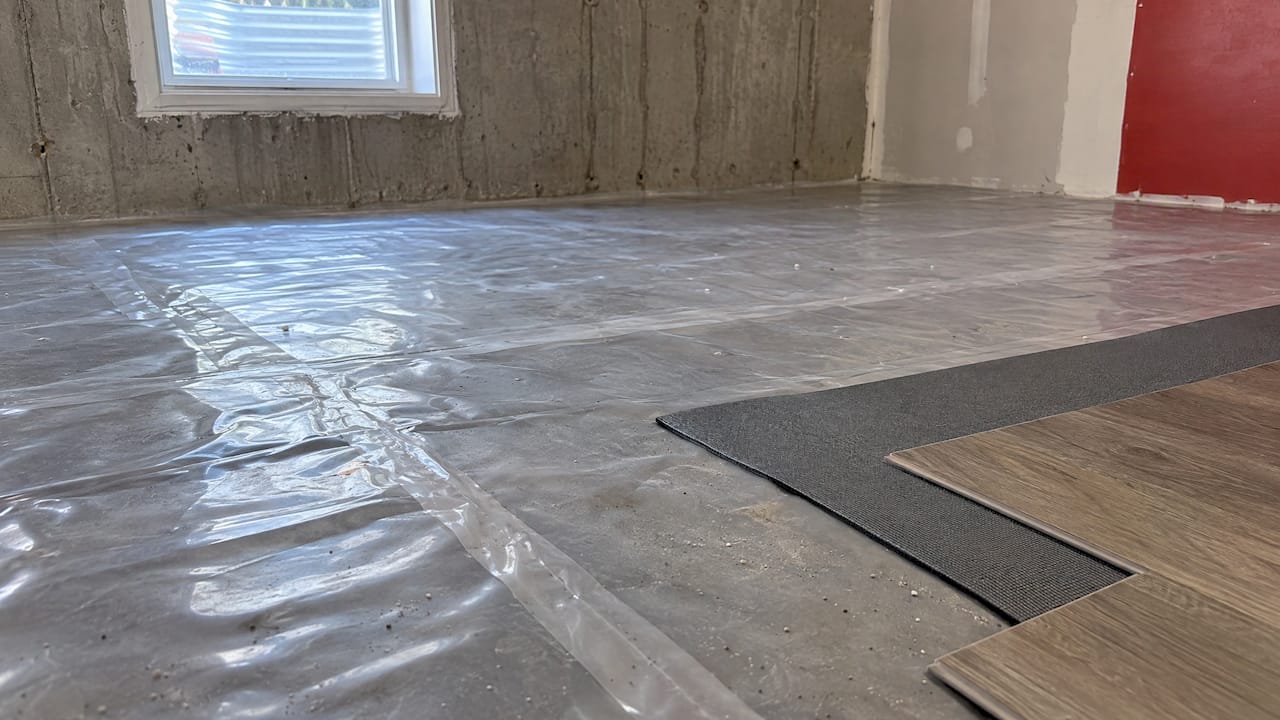
If your floor is in a basement, plan for this before choosing a plank. In bathrooms and other wet rooms the same logic applies, with extra attention to leveling and acclimation, which we cover in our guide to LVP in bathrooms.
Choosing underlayment for sound and comfort
People usually ask about underlayment for two reasons: they want a quieter floor, or a softer one underfoot. Both are reasonable goals, with one catch. Softness is exactly what vinyl plank does not tolerate well.
Floor Freight’s explainer notes that a second underlayment under an attached-pad floor is allowed in residential use only if it is no thicker than 3 mm, and that lab tests show no added acoustic benefit, while soft pads can weaken the locking system.
What that means in practice:
- Condo, townhome or upstairs room with a sound rule: use a product with a published IIC/STC rating that your plank maker accepts, and confirm the requirement in writing with your HOA.
- Cold basement slab: a pad with a built-in vapor barrier and some R-value helps. QuietWalk LV lists an R-value of 0.528 and Eco Cork Foam lists 0.48, as published by their makers.
- Comfort underfoot generally: choose a thicker plank or a plank with an attached pad rather than stacking a soft layer underneath.
Radiant heat and other special cases
If your floor has in-floor heating, the rules tighten. SAR’s instructions state that for radiant-heated floors, moisture must stay at or under 3 lb per 1,000 sq ft per 24 hours or 75% RH for warranty coverage, and the system must be off for 24 hours before and after installation. EverStep and Lions Floor both cap radiant surface temperature at 85°F (29°C). Pads that insulate heavily can work against heat transfer, so choose only what your plank maker lists for radiant use.
Also allow time for materials to settle. Calcore requires its underlayment to acclimate at least 24 hours before installation.
A short checklist before you buy underlayment
- Find the plank’s installation guide and read the underlayment section.
- Note whether the plank has an attached pad.
- Identify the subfloor: wood, plywood or OSB, concrete, or an old floor covering.
- For concrete, get a moisture test result in writing.
- Check flatness: 3/16 inch over 10 feet is a common limit.
- Confirm the underlayment is on the plank maker’s approved list. An unapproved pad can void the warranty.
- Check any HOA or building sound requirement.
Leaving out step 6 is the most expensive mistake. A pad that is slightly cheaper or softer can cost you the warranty on the entire floor.
How does Leonardo's Flooring Corp approach LVP underlayment and installation?
Our work covers vinyl flooring installation and subfloor preparation for homes and businesses across the Denver metro, from Aurora and Centennial to Boulder and Castle Rock. When you hire us for vinyl floor installation, we tailor the project to your needs, budget and timeline, with honest pricing and no hidden fees. Kitchens bring their own questions about spills and appliances, which we cover in our vinyl plank kitchen guide.
Our view
After more than a decade of installing floors, we find the underlayment question is rarely about the underlayment. It is about the subfloor. A thin, dense pad on a flat, dry, clean subfloor will outlast a thick, expensive pad on a floor that is wavy or damp.
That is why we treat subfloor preparation as part of the flooring job, not an add-on. We would rather spend the time at the start, leveling, fixing loose panels and confirming the slab is ready, than have you call us in two years about gapping planks.
We also follow your plank manufacturer’s guide. It keeps your warranty intact and keeps the floor performing as designed. If the guide says no separate pad, we use none. If it calls for a specific product, we use that one.
Jim
How can Leonardo's Flooring Corp ensure your LVP underlayment and installation are done right?
If you are planning vinyl plank in a Denver-area home or business and want the underlayment, subfloor and installation handled together, see our flooring services. We install vinyl, laminate, hardwood, tile and epoxy floors, and our work is backed by 125+ five-star reviews.
Tell us the room, the plank you have chosen and what is under it, and we will build the project around your budget and schedule.
FAQ
Should there be underlayment under LVP flooring?
Only when your plank maker calls for it. Planks with attached pads, glue-down LVP and loose-lay LVP need none. Bare-back click LVP over concrete usually needs a vapor barrier, and sometimes a thin, dense pad that the maker approves.
What is the best underlayment for LVP?
The best one is the product your plank manufacturer approves. In general that means a thin, dense layer, about 1 to 2 mm, with a vapor barrier over concrete. Thick, soft foam is the type to avoid, because it can dent the floor and weaken the click joints.
What should I put between vinyl plank and concrete?
First, a moisture test on the slab. Then, if your plank’s guide requires it, a 6-mil polyethylene film or an underlayment with a vapor barrier attached. Test limits vary by brand, so use the numbers in your plank’s installation guide.
Can you lay LVP directly on a subfloor?
Yes, when the subfloor is flat, clean, dry and sound. A common flatness limit is 3/16 inch over 10 feet, and wood subfloors need to meet moisture and thickness requirements. Ridges, loose panels and damp concrete are the usual causes of failures.
Sources
- LVP / LVT Installation Guide, Calcore
- Calcore underlayment specifications
- Architessa LVP installation guide
- Metroflor Artistek installation guide
- Flexco LVT and LVP installation guide
- Lions Floor glue-down LVP guide
- QuietWalk LV, MP Global Products
- Compare Underlayments, MP Global Products
- Eco Cork Foam Premium Plus underlayment
- Protecto Wrap flooring underlayments brochure
- Complete AMB product data sheet, Metropolitan Systems
- EverStep LVP glue-down guidelines
- SAR TriCore installation instructions
- Attached underlayment explained, Floor Freight