
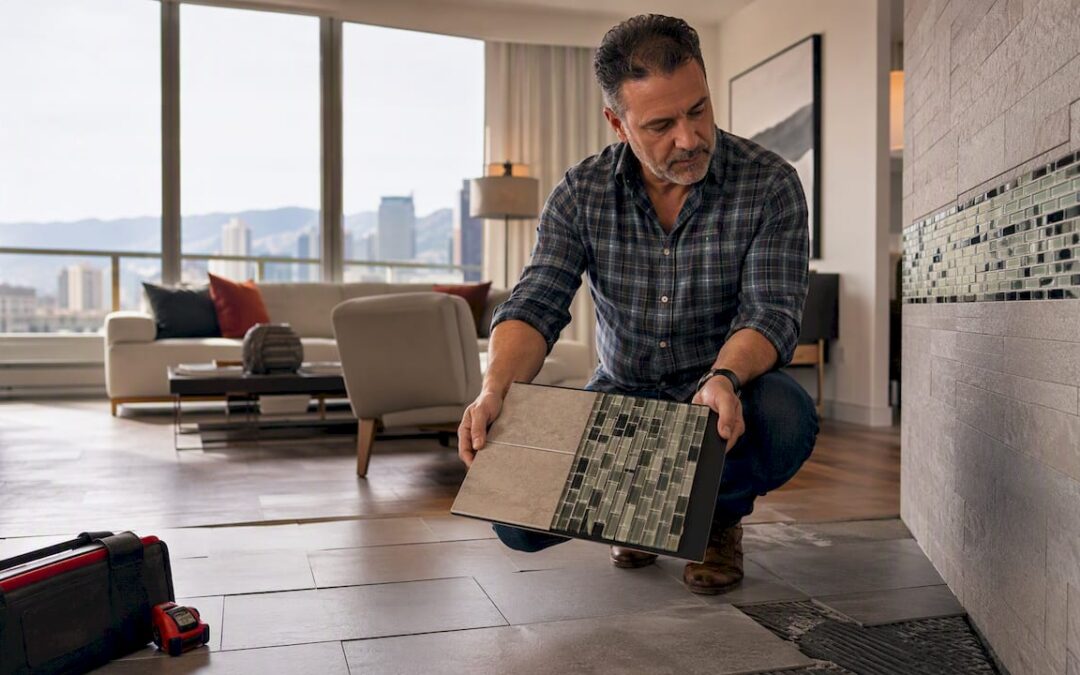
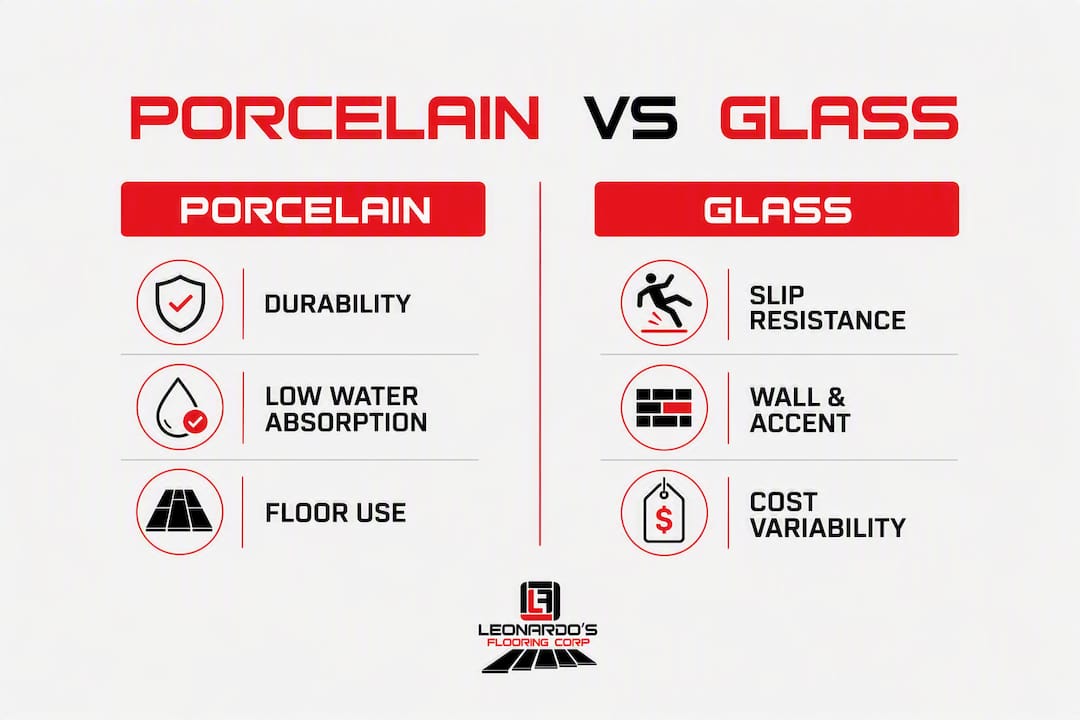
For Denver floors, choose porcelain. For accents, backsplashes, and small wet-area mosaics, glass earns its place. That’s the short answer, and it holds across residential kitchens, commercial lobbies, and everything in between. The Tile Council of North America (TCNA) sets the bar clearly: porcelain must absorb less than 0.5% water, which is why it handles Denver’s freeze-thaw cycles and heavy foot traffic without complaint. Glass can look stunning, but most glossy glass tiles measure a wet coefficient of friction around 0.30, well below the TCNA-required DCOF minimum of 0.42 for level interior floors. Leonardosflooringcorp handles on-site subfloor inspections, product recommendations, written estimates, and workmanship warranties for both materials across the greater Denver area.
- Porcelain: best for full-field floors, commercial spaces, entryways, and wet areas
- Glass: best for accent walls, backsplashes, shower niches, and decorative mosaics
- Safety standard: DCOF ≥ 0.42 required for any walkable floor surface (TCNA/ANSI A326.3)
Table of Contents
- How do porcelain and glass tile actually compare for Denver projects?
- Do Denver commercial tile projects require permits?
- Key Takeaways
- What Denver installers know that spec sheets don’t tell you
- Leonardosflooringcorp handles Denver tile projects from inspection to warranty
- Authoritative references for tile standards and local requirements
How do porcelain and glass tile actually compare for Denver projects?
The table below covers the decision dimensions that matter most for local residential and commercial installs.
| Dimension | Porcelain | Glass |
|---|---|---|
| Best for (use-case) | Full-field floors, commercial, wet areas | Accents, backsplashes, mosaics, niches |
| Durability / traffic | High-traffic rated; resists chips and cracks | Fragile under impact; not suited for heavy traffic |
| Water resistance | <0.5% absorption; freeze-thaw safe | Non-porous; excellent stain resistance |
| Slip resistance (DCOF) | Textured options easily meet ≥ 0.42 | Glossy tiles often ~0.30; floor-rated textured glass can reach 0.45–0.50 |
| Maintenance / grout | Standard cement grout acceptable | Epoxy grout required to prevent staining and mold |
| Installation complexity | Subfloor deflection L/360; standard thinset | Subfloor deflection L/720; white polymer-modified thinset; size limits apply |
| Typical cost drivers | Material grade, format size, substrate repairs | Higher material cost; specialty lead times; epoxy grout adds labor |
| Recommended sizes / placement | — | 3" or smaller for floors unless floor-rated; larger formats for walls only |
Porcelain’s climate advantage in Denver. At elevation, with temperature swings that can exceed 50°F in a single day, a tile’s moisture behavior matters. Porcelain’s near-zero absorption rate keeps it stable through repeated freeze-thaw cycles, whether it’s an outdoor patio, a mudroom, or a commercial entry. Glass, being non-porous, also resists moisture absorption, but its brittleness under thermal stress and impact makes it a poor candidate for high-traffic floor fields.
When glass actually works on floors. Floor-rated textured glass with a certified DCOF of 0.45–0.50 exists, and small mosaics with wider grout joints do improve traction. The grout joint itself becomes the traction surface. The catch: you must verify the manufacturer’s floor rating in writing before specifying it, and the subfloor must meet the tighter L/720 deflection standard rather than the L/360 typical for ceramic. One dropped cast-iron pan can crack a glass tile that would leave porcelain unmarked.
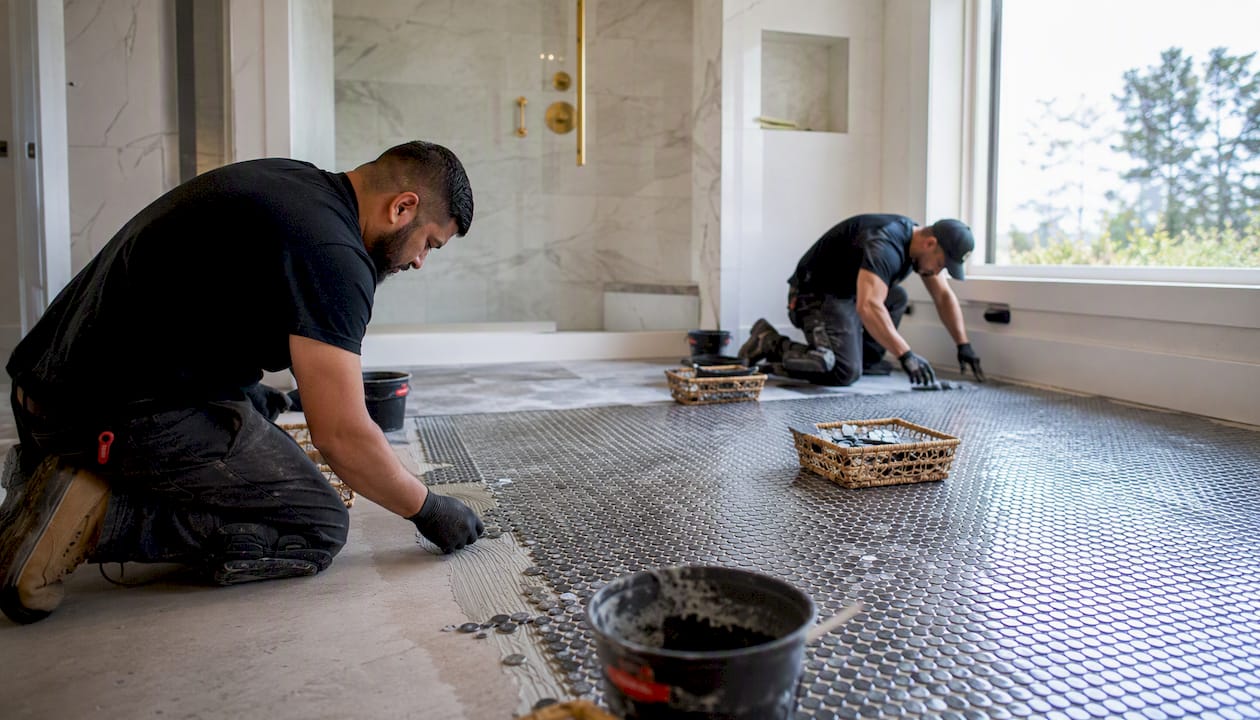
Cost picture. Glass mosaic tile runs roughly $8–$15 per square foot at entry level, $18–$40 mid-tier, and $50–$250 for premium specialty blends. Porcelain generally starts lower and scales with format and finish. Factor in epoxy grout labor, specialty thinset, and any subfloor leveling work, and glass installations consistently cost more per square foot installed than comparable porcelain.
Pro Tip: Always request the manufacturer’s DCOF test report for any glass tile you’re considering for a floor. A sales sheet that says “floor-rated” without an attached ANSI A326.3 test result is not sufficient documentation.
Porcelain’s ability to mimic stone or concrete gives Denver homeowners the aesthetic flexibility of high-end materials without the maintenance burden. If you love the look of a glass interior feature, consider how glass works as a design element in adjacent spaces, then bring that luminous quality into your tile project through a glass accent strip or mosaic niche rather than a full floor field.
Do Denver commercial tile projects require permits?
For most commercial tile installations in Denver, a building permit is required when the work involves structural changes, waterproofing systems, or alterations to a public-use space. Straightforward tile replacement on an existing, sound subfloor in a private commercial space typically does not trigger a permit, but any work that touches a shower pan, a floor drain, or a public corridor may. Denver Community Planning and Development (CPD) handles permit applications through the Denver ePlans portal. Steps for commercial projects:
- Confirm scope with CPD. Call or submit a pre-application inquiry to determine whether your specific project requires a permit based on occupancy type and scope of work.
- Prepare documentation. For permitted work, you’ll need floor plans showing tile layout, waterproofing details, and subfloor specifications.
- Submit through ePlans. Denver’s electronic permit system accepts commercial applications online; review times vary by project complexity.
- Schedule inspections. Waterproofing and subfloor inspections typically occur before tile is set; a final inspection closes the permit.
- Retain records. Keep permit numbers and inspection sign-offs with your project file; commercial property managers need these for lease renewals and insurance documentation.
Residential tile projects in Denver rarely require a permit unless structural work is involved. When in doubt, ask your installer. Leonardosflooringcorp coordinates permit inquiries as part of the project scoping process.
Key Takeaways
Porcelain is the right choice for Denver floors; glass belongs on walls, accents, and mosaics where slip safety and impact risk are not factors.
| Point | Details |
|---|---|
| Porcelain for floors | Water absorption <0.5% makes porcelain the durable, freeze-thaw-safe choice for any walkable Denver surface. |
| Glass for accents only | Restrict glass to walls, backsplashes, and mosaics; most glossy glass tiles measure ~0.30 DCOF, below the 0.42 minimum. |
| Epoxy grout for glass | Standard cement grout fails over time on glass mosaics; specify epoxy grout to prevent staining and microbial growth. |
| Verify DCOF in writing | Request the ANSI A326.3 test report from the supplier before approving any glass tile for a floor application. |
| Leonardosflooringcorp | Provides on-site subfloor inspection, DCOF verification support, and written workmanship warranties for Denver tile projects. |
What Denver installers know that spec sheets don’t tell you
The most common failure mode in glass tile installations isn’t the glass itself. It’s the subfloor. A deflection tolerance of L/720 sounds like a specification detail, but in practice it means a subfloor that feels perfectly solid underfoot can still flex enough to crack glass tiles over time. Porcelain tolerates L/360, which most Denver homes already meet. Glass demands twice the rigidity, and that often means sistering joists or adding a layer of cement board before a single tile goes down.
For commercial lobbies, I’d specify large-format porcelain every time. For residential shower walls and niches, glass mosaics are genuinely beautiful and practical when installed correctly. Shower floors are porcelain, full stop. The durability advantage in wet, high-traffic areas is simply too significant to argue against.
Three things every homeowner or property manager should require in a written estimate:
- Subfloor deflection test results or a written statement of compliance with L/360 (porcelain) or L/720 (glass)
- DCOF test report for any tile specified for a floor surface
- Written workmanship warranty covering both materials and installation labor
If an installer can’t produce those three items before the project starts, that’s the signal to keep looking.
Leonardosflooringcorp handles Denver tile projects from inspection to warranty
Denver tile projects go sideways when the subfloor gets skipped and the spec sheet goes unread. Leonardosflooringcorp starts every project with an on-site inspection and measurement, reviews DCOF documentation for any glass tile under consideration, and delivers a written scope with timeline and cost drivers before work begins.
With 10+ years serving the greater Denver metro, 125+ five-star reviews, and a Home Depot Contractor partnership, Leonardosflooringcorp brings the full installation stack: subfloor preparation, thinset and epoxy grout selection, tile installation, and a written workmanship warranty. Whether you’re tiling a commercial lobby with large-format porcelain or adding a glass mosaic accent to a residential shower niche, the process starts the same way. Request your on-site estimate through the tile floor installation service page and get a written scope before any material is ordered.
Authoritative references for tile standards and local requirements
- Leonardosflooringcorp: Tile Floor Installation, Denver — local installer contact, on-site estimates, and project portfolio
| Resource | What it covers |
|---|---|
| TCNA porcelain water-absorption standard | <0.5% absorption threshold; porcelain classification |
| ANSI A326.3 DCOF standard | Minimum 0.42 DCOF for level interior floors |
| TCNA glass mosaic installation standard | Epoxy grout requirement; installation method guidance |
| Interstyle Glass installation guidelines | 3" size limit for floor use; floor-rated product criteria |
| Denver CPD ePlans portal | Commercial permit submission and inspection scheduling |