
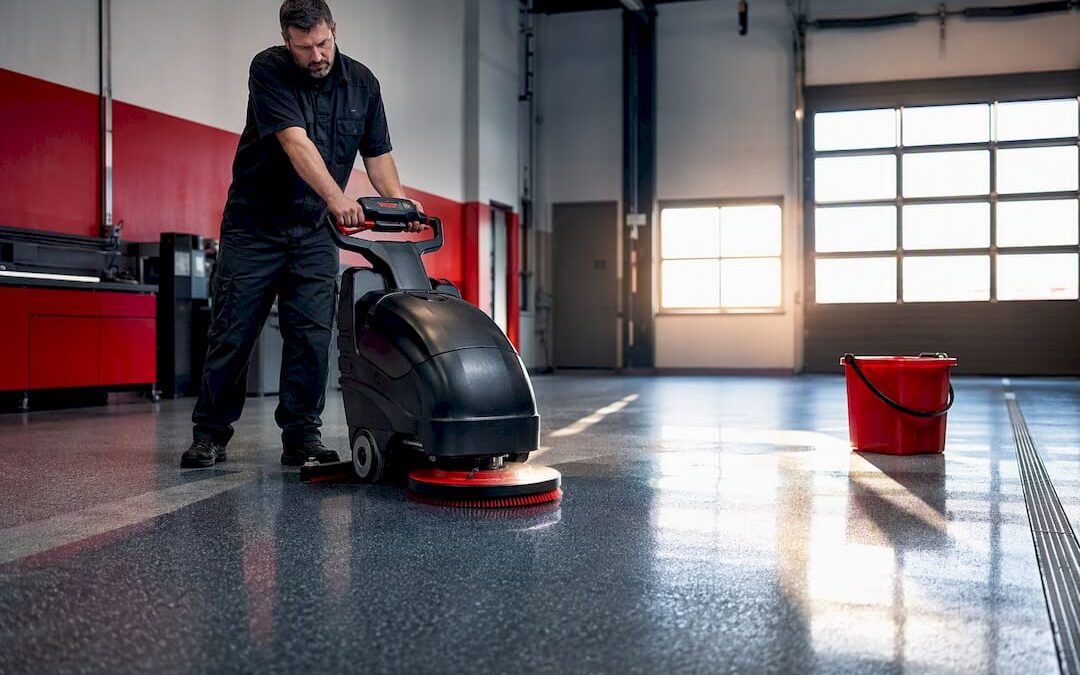
Daily removal of grit is the single habit that determines how long an epoxy floor lasts, since dust mopping stops roughly 80% of premature coating wear before it starts. Pair that with manufacturer-approved neutral cleaners within a safe pH range, and you have the core of a working maintenance program. Skip either one, and you risk a costly recoat bill. Keep a written approved-cleaner list and SDS log on hand, since it’s the fastest way to prove what went on your floor and when.
TL;DR:
- Regular dust mopping prevents roughly 80% of premature epoxy coating wear, making daily grit removal essential for extending floor lifespan.
- Use manufacturer-approved neutral cleaners within pH 6 to 9 and avoid harsh acids, alkalis, or solvent-based products to prevent chemical damage.
- Non-abrasive, manufacturer-rated pads and low-pressure equipment are critical to avoid micro-scratches and moisture intrusion that shorten epoxy durability.
- Promptly remove oil, rust, or paint stains with appropriate neutral or mild cleaners, and seek professional help for deep or stubborn discoloration.
- Implement a documented maintenance schedule with visual inspections and moisture testing every few months to prevent undetectable damage that leads to costly recoats or replacement.
Table of Contents
- What Does a Proper Epoxy Floor Maintenance Schedule Look Like?
- What Cleaners Are Safe for Epoxy, and Which Ones Ruin It?
- Which Equipment and Pads Actually Protect the Coating?
- How Do You Remove Oil, Rust, and Paint Stains From Epoxy?
- When Does Epoxy Need a Recoat Instead of a Cleaning Fix?
- What Mistakes Quietly Shorten an Epoxy Floor’s Life?
- When Should You Call a Flooring Contractor for Epoxy Repair?
- Where This Guidance Comes From
- Sources
What Does a Proper Epoxy Floor Maintenance Schedule Look Like?
Most coating failures trace back to a schedule that exists in someone’s head instead of on paper. A written cadence, posted where custodial staff can see it, turns epoxy floor maintenance from guesswork into a repeatable process you can audit.
- Daily. Dust-mop or sweep every trafficked area to pull grit off the surface before it gets ground into the topcoat. This single step prevents the majority of abrasive wear over the coating’s life.
- Weekly. Damp-mop smaller spaces or run an auto-scrubber with a neutral cleaner and white non-abrasive pad on larger floors. This lifts oils and residue that dry-mopping leaves behind.
- Monthly. Walk the floor under raking light (a light held low and angled across the surface) to spot dulling, hairline cracks, or early delamination that’s invisible under normal overhead lighting. Follow up with a targeted deep clean on any areas showing buildup.
- Quarterly. Check slip resistance in high-traffic zones, review your inspection logs for recurring problem spots, and increase frequency in any area that’s showing wear faster than the rest of the building.
Sherwin-Williams recommends a five-step cleaning process, sweeping, applying cleaner, agitating, letting it dwell, then removing it, and notes that the right tools shift depending on whether you’re cleaning a 400-square-foot break room or a 40,000-square-foot warehouse floor. Loading docks and forklift lanes earn a tighter schedule than a lobby that sees foot traffic twice a day.
What Cleaners Are Safe for Epoxy, and Which Ones Ruin It?
Epoxy coatings tolerate a narrow chemical window. Manufacturer-verified neutral cleaners in the pH 6 to 9 range clean without breaking down the resin’s surface chemistry. Push outside that band in either direction and you start etching the topcoat, dulling the gloss, and creating microscopic pathways for moisture and staining agents to work their way in.
Improper cleaners applied above pH 11 or below pH 3.5 can chemically damage epoxy, and ServiceMaster Clean notes that forcing a premature recoat on a large commercial floor can run $40,000 or more.
Avoid these categories entirely unless a manufacturer explicitly clears them for your specific system:
- Vinegar and citrus-based cleaners (both acidic enough to etch the surface over repeated use)
- Chlorine bleach and other high-pH strippers
- Solvent-based degreasers not labeled for epoxy compatibility
- Ammonia-heavy glass or all-purpose cleaners
Before anything new goes into a mop bucket, pull the product’s safety data sheet and cross-check it against your coating manufacturer’s approved list. Nilfisk’s guidance for commercial and industrial epoxy floors echoes the same warning: harsh chemicals shorten coating life even when they look effective in the short term. Document every approval in writing so a well-meaning staff member doesn’t undo it three months later with something grabbed off a store shelf.
Which Equipment and Pads Actually Protect the Coating?
The tool matters as much as the cleaner. Medium or hard scrub pads feel like they’re doing a better job, but they leave behind cumulative micro-scratches that build into a hazy, dull finish over months of use. Stick with white or other manufacturer-rated non-abrasive pads for routine scrubbing.
- Auto-scrubbers with vacuum recovery for large open floors, so dirty solution never sits and dries on the surface
- Microfiber flat mops for daily and weekly work in smaller rooms
- Squeegees and wet vacuums to pull standing water off the floor immediately after cleaning
- A low-pressure setting if pressure washing is used at all, since high-pressure water can drive moisture beneath the coating at seams and joints
Pro Tip: Before committing to a new pad or brush, test it on a hidden corner of the floor first. Run ten passes and check for a dull halo under raking light. If you see one, that pad is too aggressive for daily use, no matter what the label promises.
Euclid Chemical’s maintenance guidance caps pressure washers around 1,000 psi for many coating systems, and that ceiling matters most on textured floors where grit hides in the profile. Smooth epoxy responds well to a standard auto-scrubber; textured or anti-slip finishes need slower passes and sometimes a stiffer (but still non-abrasive) brush to work solution into the texture without leaving residue behind.
How Do You Remove Oil, Rust, and Paint Stains From Epoxy?
Fast action beats aggressive chemicals every time. A contaminant sitting for an hour is far easier to lift than one that’s had a weekend to soak in.
- Contain and blot first. Absorb liquid contaminants immediately with an absorbent pad rather than spreading them with a mop.
- Apply a neutral degreaser for oil and grease, let it dwell per the label, then agitate with a white pad and rinse thoroughly.
- Use a mild lactic-acid cleaner for rust spots, which lifts iron staining without the etching risk of stronger acids.
- Scrape mechanically for dried paint or adhesive, using a plastic scraper rather than metal, then follow with a neutral cleaner pass.
- Call a contractor if a stain has penetrated below the topcoat or left visible discoloration after cleaning. That usually signals the coating itself has been compromised, not just the surface.
When Does Epoxy Need a Recoat Instead of a Cleaning Fix?
Wear that no amount of cleaning will fix shows up in a few predictable patterns: delamination (the topcoat lifting from the substrate), wear-through to the primer in high-traffic lanes, chemical staining that won’t lift, and cracking along control joints. Each points to a different root cause, from moisture trapped under the slab to years of grit abrasion nobody addressed.
Recoating is a mechanical job, not a chemical one. Skipping the diamond-grinding or prep-pad step before a new topcoat goes down guarantees the new coating delaminates within a year or two. Timing depends on traffic, not the calendar.
| Inspection or task | Typical frequency | Trigger for action |
|---|---|---|
| Moisture testing (ASTM standard) | Before any recoat | Elevated vapor emission readings |
| Raking-light visual inspection | Monthly | Dulling, haze, hairline cracking |
| Slip-resistance testing | Quarterly | Values below site safety threshold |
| Recoat (heavy traffic) | Every 2 to 5 years | Visible wear-through to primer |
| Full replacement | Several years | Widespread delamination |
Slip-resistance testing follows the same logic as ASTM’s broader D6962 standard for walkway friction, giving you a number instead of a hunch when deciding whether a floor is still safe. Log every finding. A contractor scoping a recoat works faster and quotes more accurately with two years of inspection notes than with a verbal “it’s gotten worse.”
What Mistakes Quietly Shorten an Epoxy Floor’s Life?
The costliest errors are rarely dramatic. They’re small, repeated decisions that compound over a year or two.
- Letting staff choose cleaners ad hoc instead of enforcing a single approved-cleaner list tied to SDS records
- Using colored or worn pads that grind grit into the surface instead of lifting it
- Leaving standing water after mopping instead of squeegeeing or wet-vacuuming it up
- Pressure-washing at full force near seams and joints, which pushes moisture under the coating
Post the approved-cleaner list at the janitorial closet, color-code pads by task, and put someone on a monthly audit calendar. A one-page SOP prevents most of this from ever becoming a problem.
When Should You Call a Flooring Contractor for Epoxy Repair?
A professional inspection measures key indicators like moisture, adhesion, and coating thickness to guide repair decisions. If you’re seeing delamination, exposed primer, or staining that keeps returning no matter what you clean with, a contractor visit typically costs less than watching the damage spread. Leonardosflooringcorp has spent over a decade handling exactly these calls for Denver-area properties, and the earlier that inspection happens, the smaller the eventual repair.
— Jim
Where This Guidance Comes From
This routine draws on manufacturer and trade sources rather than guesswork. Sherwin-Williams and Nilfisk supply the cleaning-process fundamentals, Opora’s field guide covers task frequency and recoat logic, Euclid Chemical’s maintenance guide details equipment limits, and ServiceMaster Clean lays out the financial stakes of getting it wrong. Homeowners weighing garage-floor upkeep can also check this epoxy garage floor maintenance guide for residential-scale tips.
Sources
- Epoxy-coated concrete floor care playbook — Opora (2026-06-06)
- Your Epoxy Floor Is Not Indestructible — ServiceMaster Clean (2026)
- General floor care, cleaning and maintenance guide — Sherwin-Williams
- How to clean epoxy floors in commercial or industrial settings — Nilfisk (2024)