
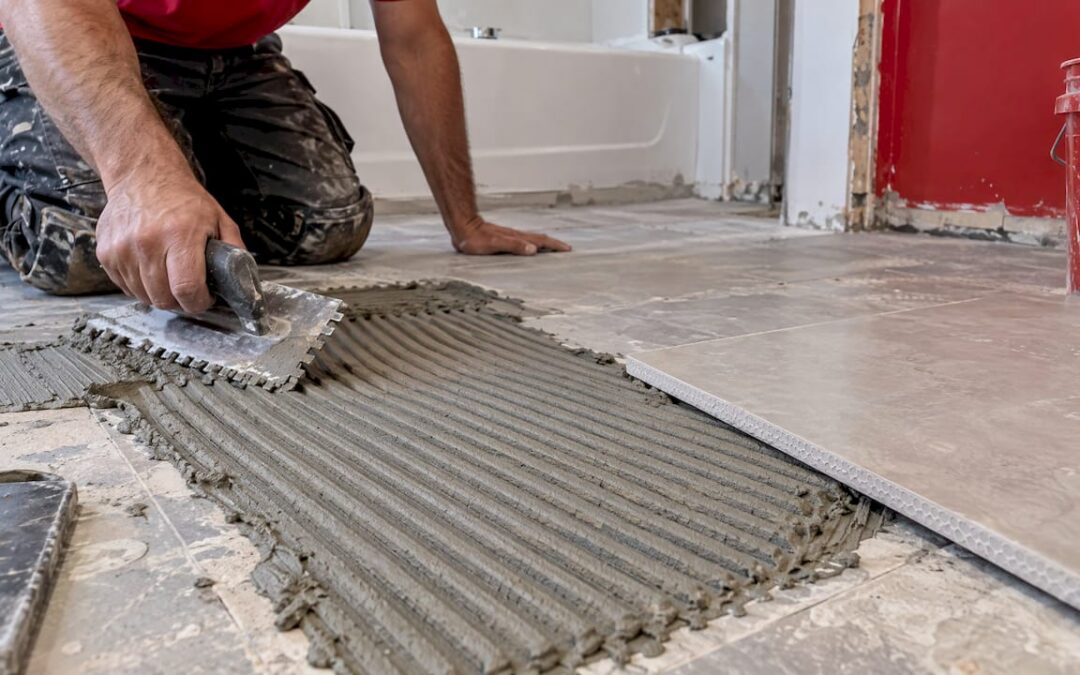
Modified thinset is portland cement mortar with polymers added. Unmodified thinset, also called dry-set mortar, is cement, sand and a water-retention agent with no polymer. Neither is better in every case. The right one depends on what is under the tile, what the tile is made of and whether a membrane sits between them. Over plywood, with porcelain or with large tile, modified is usually the call. Over concrete with an uncoupling membrane, unmodified is usually the one the manufacturer specifies.
Below, we explain what each mortar is, how the polymers change its behavior, and how to match the mortar to the job. We also cover the Schluter DITRA question that comes up constantly, because it is where the wrong choice causes the most trouble.
TL;DR
- Unmodified (dry-set) thinset is cement, fine sand and a water-retention agent. Modified thinset adds a polymer, usually latex, for better adhesion and flexibility.
- Modified is the common choice over plywood or OSB, with low-porosity tile such as porcelain, and in many heated-floor installs.
- Unmodified is often required over uncoupling membranes on concrete, because modified mortar can stay wet too long when trapped between two dense layers.
- The membrane or tile system manufacturer’s instructions decide the mortar. Following them also protects the warranty.
- Mortar choice is one decision inside a bigger system of subfloor, moisture control and layout. A professional installer weighs all of it together.
Table of Contents
- What thinset actually is
- Modified vs unmodified thinset at a glance
- What polymers change
- Match the mortar to the substrate
- The DITRA question: what happens with modified thinset over an uncoupling membrane
- Heated floors
- Are thinset mortars waterproof?
- Thinset vs tile adhesive
- A quick decision guide
- Common mistakes
- Have us handle the tile
- FAQ
- Sources
What thinset actually is
Thinset is the bonding layer between your substrate and your tile. The Tile Council of North America (TCNA) describes it as a blend of cement, very finely graded sand and a water-retention compound that lets the cement hydrate properly. Hydration is the key word. Cement does not “dry” into strength like paint. It reacts with water and gains strength as that reaction proceeds.
That is why the water-retention compound matters. Without it, the substrate or the tile would pull water out of the mix before the cement finished reacting, and the bond would be weak.
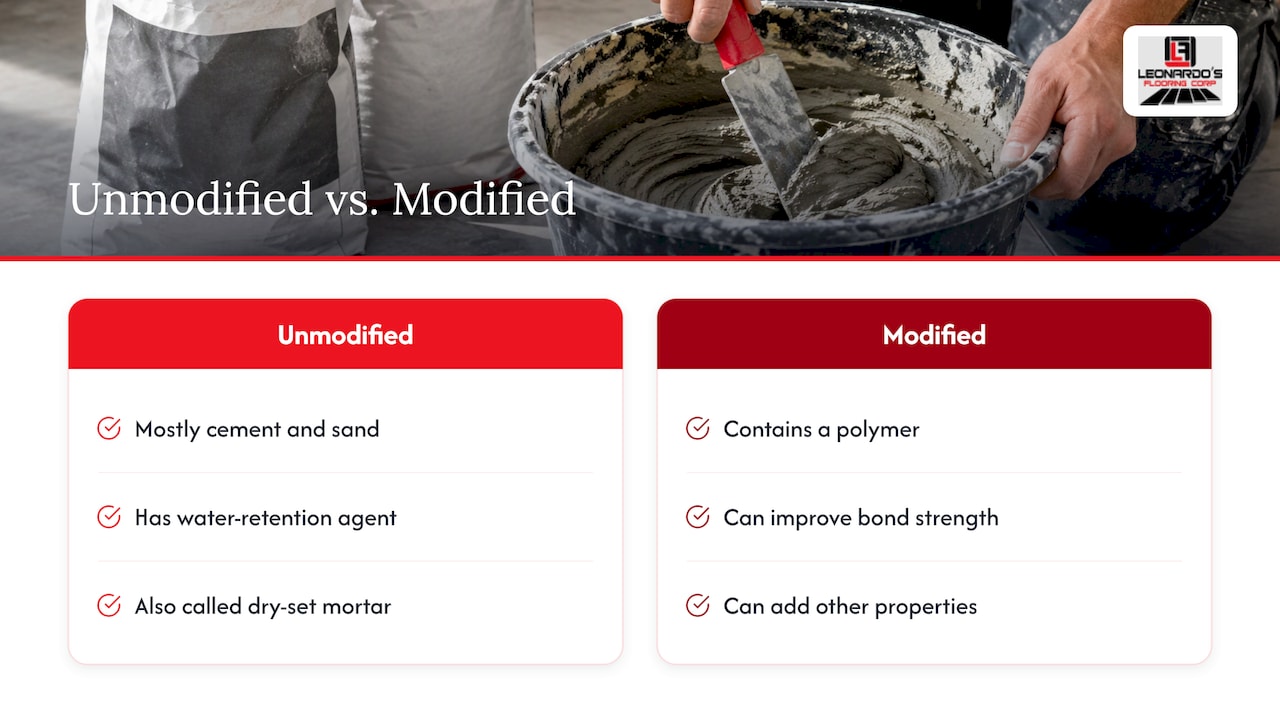
Schluter’s technical FAQ puts the split simply: dry-set mortar is mostly cement, sand and a water-retention agent, and is also called unmodified mortar. Modified mortar contains a polymer that can improve bond strength and add other properties.
Modified vs unmodified thinset at a glance
| Unmodified (dry-set) | Modified (polymer) | |
|---|---|---|
| Main ingredients | Cement, sand, water-retention agent | Same, plus a polymer such as latex |
| Common ANSI standard | A118.1 | A118.4, A118.11, A118.15 |
| Polymer source | None | Powder in the bag or liquid additive |
| Bond to low-porosity tile | Relies more on the tile surface | Generally stronger |
| Flexibility | Rigid | More flexible, depending on polymer |
| Cure behavior | Hydrates with water in the mix, dries predictably between porous layers | Can set more slowly where it cannot breathe |
| Typical use | Over concrete, with uncoupling membranes | Over plywood or OSB, porcelain, glass, many wall and floor installs |
The standards come from Schluter’s guidance on identifying the mortar type: unmodified thinset is identified with ANSI A118.1, and modified thinsets with ANSI A118.4, A118.11 or A118.15. Modified products carry their polymers either as powder in the bag or as a liquid additive used in place of some or all of the mixing water. Check the bag. The standard is printed on it.
What polymers change
Polymer additives are what separate the two products, and they do several things.
Adhesion and flexibility
TCNA notes that polymers can give improved adhesion and flexibility, freeze/thaw resistance, or enough elasticity to act as an anti-fracture membrane. Some polymers can also make the cement waterproof. TCNA adds that the many types of polymer-modified thinset let a specifier match the mortar’s properties to the project’s requirements.
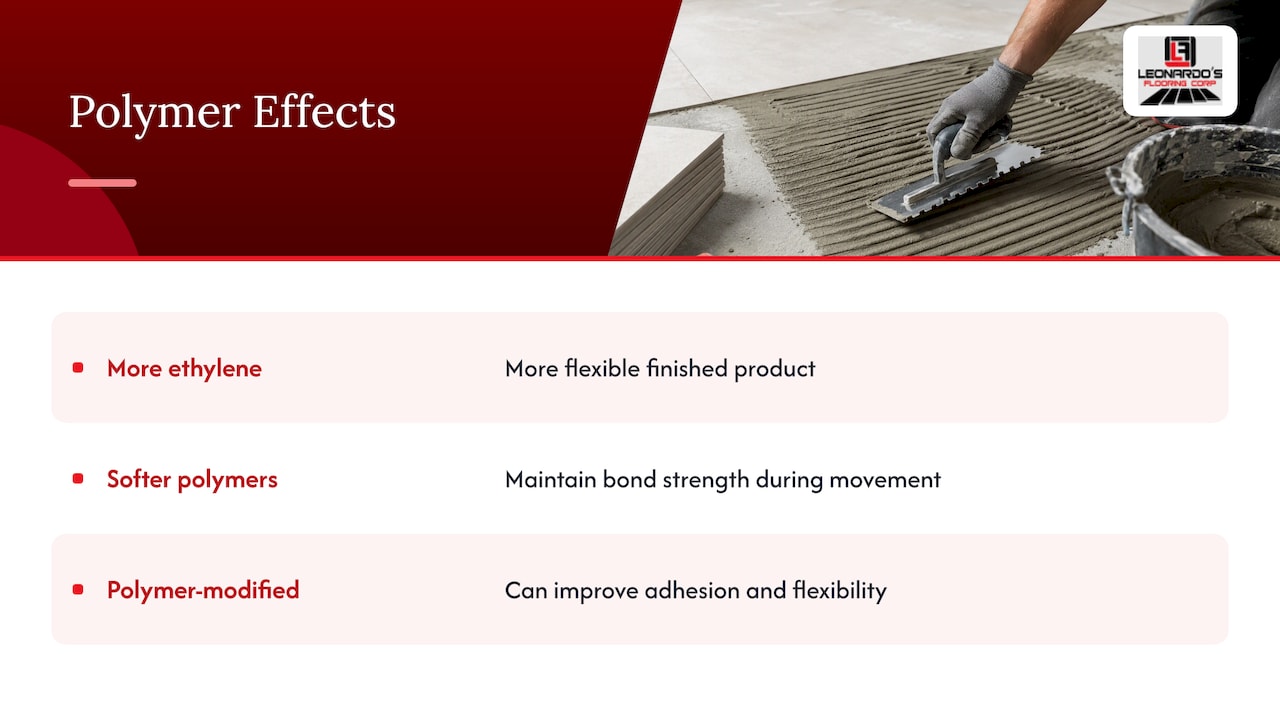
Not all polymers behave alike. According to the Materials and Methods Standards Association, at the same cement-to-polymer ratio, a polymer with more ethylene produces a more flexible finished product. Softer polymers can keep bond strength while allowing small movement relative to the substrate. This is one reason two bags labeled “modified” can perform differently.
Working time and conditions
Journal of Light Construction reports that latex and polymer additives improve adhesion, reduce water absorption, increase bond strength and improve resistance to shock and impact. They also give installers more latitude in installation time, working conditions and temperature. For a crew tiling a large room, that extra margin is practical, not theoretical.
The trade-off: moisture and set time
The same source explains that latex can slow hydration. Where modified thinset sits between two layers that do not let water out, such as an uncoupling membrane below and dense porcelain above, it may set less readily than dry-set mortar. That can affect when the floor can be walked on or grouted. In wet areas, latex may also leach into grout joints.
This is a property of the product used in a particular setting, not a flaw. It is the reason the setting decides the mortar.
Match the mortar to the substrate
The substrate is the first question. Here is how it usually plays out.
Over plywood or OSB
Wood moves with humidity and temperature, and it is absorbent. Modified thinset is the usual answer because of its flexibility and stronger bond. Schluter’s own guidance for its DITRA membrane calls for modified mortar meeting ANSI A118.11 over plywood or OSB.
In Colorado, many older Denver-area homes have wood-framed floors, and the subfloor condition matters as much as the mortar. Flat, sound, properly fastened plywood is the foundation for everything above it. Our subfloor preparation work exists for exactly this reason: the best thinset cannot make up for a subfloor that flexes or sits out of flat.
Over concrete
Concrete is stable and, once cured, not subject to the same movement as wood. With an uncoupling membrane on top, the same Schluter guidance points to unmodified mortar meeting ANSI A118.1 over concrete or gypsum. Basement slabs add a moisture question that has nothing to do with thinset type. If you are planning tile over a basement slab, our moisture-first plan for tiling a basement slab walks through what to settle before any mortar goes down.
With porcelain, glass and other dense tile
Porcelain has very low porosity, so there is little for mortar to grip mechanically. One tile guide explains that polymer-modified thinset fills the gap between a low-porosity tile back and the cement matrix, forming a flexible adhesive film that bonds without relying on mechanical keying into tile pores. That is why modified thinset is the typical pick for porcelain.
Glass tile and some specialty installations may call for other products, such as two-part epoxy mortar (ANSI A118.3), which is used where chemical resistance matters. Follow the tile maker’s instructions for those.
Large-format tile
Bigger tile means more area that must be fully supported, and flatness becomes critical. Mortar type is part of the answer, but so are trowel size, back-buttering and substrate flatness. For how flatness shows up in the finished floor, see our guide to lippage standards.
The DITRA question: what happens with modified thinset over an uncoupling membrane
This is the most common search behind the keyword, and it deserves a direct answer.
Uncoupling membranes like Schluter DITRA are impervious. So is porcelain. Mortar trapped between two impervious layers cannot air-dry. Schluter’s installation handbook explains that modified thinset used there can extend and make unpredictable the cure time, because the mortar cannot release moisture. The manufacturer specifies unmodified mortar, or its own specific modified blends, to keep hydration and strength gain consistent.
So is Schluter thinset modified or unmodified? Both exist. The mortar depends on what is below the membrane:
| Installation | Mortar the manufacturer specifies |
|---|---|
| DITRA over plywood or OSB | Modified, ANSI A118.11 |
| DITRA over concrete or gypsum | Unmodified, ANSI A118.1 |
| DITRA-HEAT over plywood or OSB | Latex portland cement mortar, ANSI A118.11 |
| DITRA-HEAT over concrete | Unmodified, ANSI A118.1 |
Those are from Schluter’s mortar-type FAQ and its DITRA-HEAT installation guide. Notice the pattern: the mortar that bonds the membrane to the substrate is chosen for that substrate. The layer of mortar above the membrane that holds the tile has its own instructions in the same documents, so read them for your specific product and tile.
The logic of picking by manufacturer instruction is covered well in this explanation of mortar selection for uncoupling membranes, including how specifications connect to warranty.
Heated floors
Radiant tile floors add heat cycling, which asks more of the bond line. The Ceramic Tile Foundation notes that TCNA guidelines emphasize following the membrane manufacturer’s instructions for mortar selection, since that system approach is critical to the manufacturer’s warranty. In practice that means:
- Identify the heating system and any membrane it uses.
- Read the mortar requirement for your substrate in that system’s installation guide.
- Confirm the tile maker’s requirements for the tile you chose.
- Buy the mortar that satisfies all three, and keep the bag’s ANSI marking in mind.
If the heating system’s guide says modified over wood and unmodified over concrete, as DITRA-HEAT does, that is the answer for that job, whatever a forum thread says.
Are thinset mortars waterproof?
Neither type should be treated as a waterproofing layer by itself. Cement mortar is not a waterproof barrier, and TCNA notes only that some polymers can make the cement waterproof. Showers and wet areas need a proper waterproofing system, and the installer’s job is to build that system correctly and then choose compatible mortar.
Thinset vs tile adhesive
Tile adhesive, often called mastic, is a different product from thinset. According to CUSTOM Building Products, thinset bond strength is less affected by water than ceramic tile adhesive. Its example is OmniGrip, with a dry shear strength of 760 psi against 145 psi wet. The same page says ceramic tile adhesives usually need at least 24 hours before grouting, and longer over dense or impervious materials, in high humidity, below 60°F, or with tile larger than 6 by 6 inches.
For floors and wet areas, thinset is the standard bonding choice. We lay out the reasoning in mastic vs thinset.
A quick decision guide
- Check the manufacturer’s instructions first. If you are using an uncoupling membrane, heating system or waterproofing system, its guide overrides general rules.
- Check the substrate. Wood-based: modified. Concrete with a membrane: often unmodified, as specified.
- Check the tile. Porcelain and other dense tile: modified is typical, unless a membrane instruction says otherwise.
- Check the room. Wet areas, heated floors and basements each add requirements beyond the mortar.
- Check the bag. Look for the ANSI standard: A118.1 is unmodified, and A118.4, A118.11 and A118.15 are modified.
Common mistakes
- Picking by price or habit. “Modified is always better” is the most common error, and the DITRA case shows why it fails.
- Mixing a liquid polymer into a bag that is already modified. Modified products contain polymers either in the bag or in a liquid additive. Follow the label rather than stacking both.
- Grouting too soon. Slower-setting mortar in a tight assembly needs more time before grout. The wait depends on the product and conditions.
- Ignoring flatness. Mortar does not fix an uneven subfloor. It highlights it.
- Skipping the warranty paperwork. Membrane and heating system warranties depend on using the specified mortar.
Our perspective
When homeowners ask us modified or unmodified, the honest answer is that it is rarely the first question. The first question is what the tile is going onto: a wood subfloor that moves, a concrete slab that may have moisture, or an older floor that needs leveling.
We tailor every project to the property, the budget and the timeline, and that starts with reading the system as a whole. The membrane, the substrate, the tile and the room all point toward a mortar. When we follow the manufacturer’s instructions for that combination, we are protecting both the floor and the warranty behind it.
That is also why we put so much weight on subfloor preparation. A well-prepared surface lets the right thinset do its job, and it is how we aim to install it right the first time, treating every floor like it is going into our own home.
Jim
Have us handle the tile
Choosing mortar is one decision among dozens in a tile project. If you would rather have it settled by a crew that handles tile floor installation and subfloor preparation across the Denver metro, see our tile floor installation services. We install for both residential and commercial properties, and we tailor each project to your needs, budget and timeline.
You can also browse everything we do on our services page, or start from our flooring installation overview.
FAQ
What is the difference between modified and unmodified thinset?
Unmodified thinset is cement, fine sand and a water-retention agent. Modified thinset has the same base plus a polymer, often latex, added in the bag or as a liquid. The polymer can improve adhesion and flexibility, and it changes how the mortar cures.
Can I use modified thinset over DITRA?
It depends on the substrate. Schluter specifies modified mortar meeting ANSI A118.11 over plywood or OSB, and unmodified mortar meeting ANSI A118.1 over concrete or gypsum. Modified mortar used where it cannot dry can have a long and unpredictable cure, so follow the manufacturer’s instructions.
Is modified thinset better for porcelain tile?
Usually, yes. Porcelain is dense and low in porosity, and polymer-modified thinset forms a flexible adhesive film that bonds well to it. If a membrane or heating system sits underneath, its mortar instructions come first.
Is thinset waterproof?
No type of thinset should be relied on as the waterproofing layer. Some polymers can make cement waterproof, but showers and wet areas need a dedicated waterproofing system. Mortar is then chosen to be compatible with that system.
Should I use tile adhesive or thinset?
For floors and wet areas, thinset is the standard choice. Manufacturer data shows thinset bond strength is less affected by water than tile adhesive, and adhesive generally needs longer before grouting on dense materials or in humid conditions.
Sources
- Schluter: difference between modified and unmodified thin-set
- Schluter: how to tell if thin-set is modified or unmodified
- Schluter: thin-set mortar type for DITRA
- Schluter DITRA Installation Handbook
- Schluter DITRA-HEAT Installation Guide
- Tile Council of North America: dryset mortar
- Materials and Methods Standards Association bulletin
- Journal of Light Construction: modified vs. unmodified thinset
- Ceramic Tile Foundation: tile with electrical radiant heating
- CUSTOM Building Products FAQ
- Tile thinset guide