
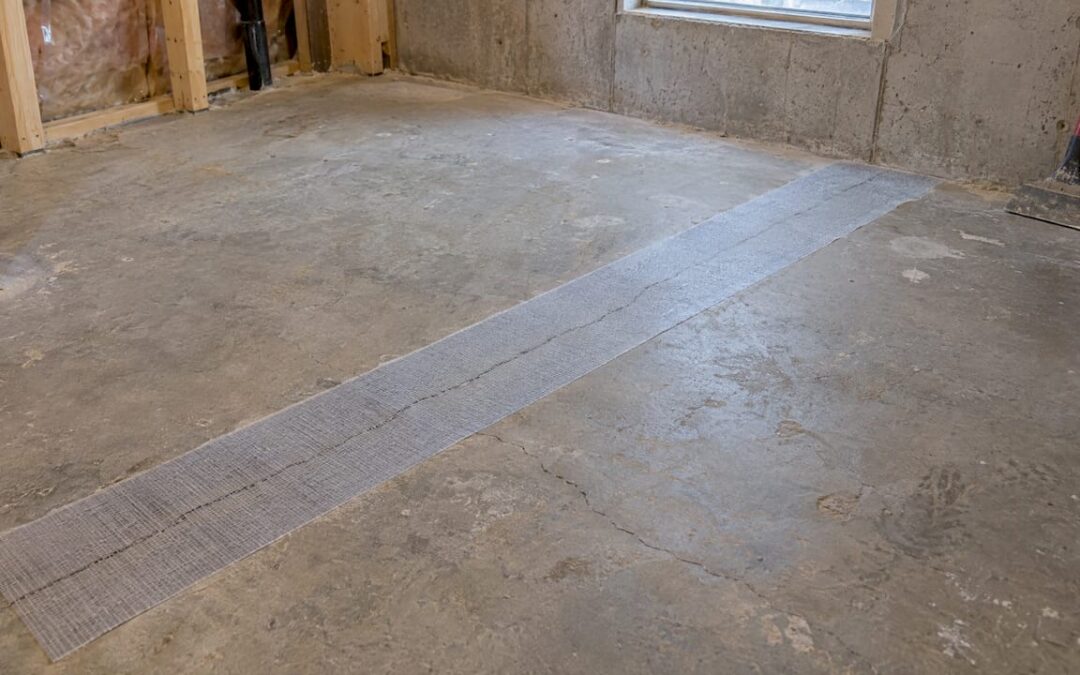
You can tile over a cracked concrete slab only if the crack is a stable shrinkage crack that moves side to side and not up and down. Those get filled and covered with a crack-isolation membrane before tile goes down. Any crack where one edge sits higher than the other points to a slab problem that tile will not hide, and it needs a structural engineer first. Sorting your cracks into those two groups is the whole job, and our crew in the Denver area can walk the slab with you and do the subfloor preparation and tile installation once it passes.
What are the key takeaways for tiling over cracked concrete?
- Cracks with no vertical movement can usually be isolated with a membrane that meets ANSI A118.12, the industry standard for crack-isolation products.
- Cracks where one side is higher than the other, or cracks wider than about 1/8 inch, call for a structural engineer before any tile.
- Fill the crack, extend the membrane well past both sides, and never bridge a control joint with tile or grout.
- Outdoors in Colorado, freeze-thaw cycles make the membrane, mortar and tile choice matter even more.
- Cure time, moisture, flatness and temperature all have to be right before the first tile is set.
Table of Contents
- Why cracks come back through tile
- Step 1: Decide which kind of crack you have
- Step 2: Check the slab before you touch the crack
- Step 3: Fill and isolate the crack
- Step 4: Keep movement joints in the tile
- Tiling cracked concrete outdoors in Colorado
- When to wait
- Get the slab assessed and the tile installed right
- FAQ
- Sources
Why cracks come back through tile
Concrete shrinks as it cures and keeps expanding and contracting with temperature and moisture for the rest of its life. Tile and thinset are rigid. When the slab underneath moves, the tile above has nowhere to go, so the crack shows up in the tile and grout lines, often within the first year.
The Ceramic Tile Association’s guidance is blunt: ceramic tile or stone cannot go over cracked concrete without repairs or additional protection, or the cracks will continue through the tiles. The Tile Council of North America (TCNA), the group that publishes the industry’s installation handbook, adds that even small shrinkage cracks can stay active as the slab cures. That is why the fix is not just filling the crack with patch and tiling over it.
Step 1: Decide which kind of crack you have
There are two kinds, and they get completely different treatment.
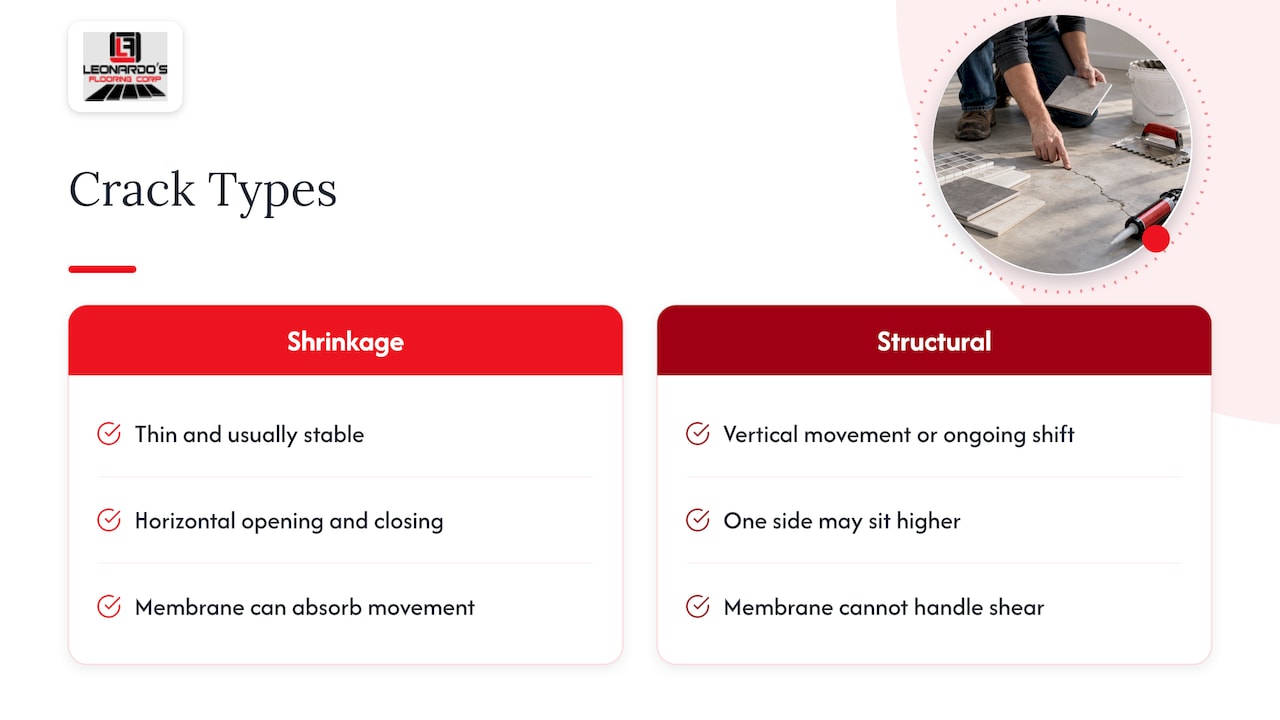
Shrinkage cracks are thin and usually stable. They move horizontally, opening and closing slightly. A membrane can absorb that.
Structural cracks involve vertical movement: one side of the crack is higher than the other, or it is shifting over time. Causes include expansive clay, poorly compacted fill or an incorrectly poured slab. A membrane cannot handle that kind of shear.
The straightedge check
Lay a straightedge or a long level across the crack and look for a gap on one side, or run a fingertip across and feel for a step. The NTCA Technical Team, writing in TileLetter in January 2026, says any crack with vertical movement is structural and cannot be tiled over, even with a membrane. If you cannot tell whether a crack is active, the same guidance recommends further evaluation or a structural engineer.
Width matters too
LATICRETE’s technical design manual notes that shrinkage cracks generally do not exceed 1/8 inch (3 mm) in width. It also states there is no tile installation method for cracks wider than that, or for cracks with differential vertical movement. Those need the cause found and corrected, with an engineer involved before any repair or tile.
A rough field sort:
| What you see | Likely type | Next step |
|---|---|---|
| Hairline to about 1/8 in., flat on both sides | Shrinkage | Fill and isolate with a membrane |
| Any height difference across the crack | Structural | Structural engineer before tiling |
| Crack wider than 1/8 in. | Not a simple shrinkage crack | Find the cause, engineer review |
| Crack that keeps growing or reappears after patching | Active | Engineer review |
| Many hairline cracks across the floor | Shrinkage, widespread | Membrane over the whole floor |
Even with the right method, some slabs cannot be controlled because of the soil beneath them or how they were poured. Fine Homebuilding’s Tom Meehan says he proceeds only with an engineer’s approval when slab strength or stability is in doubt. That is the right standard for any contractor.
Step 2: Check the slab before you touch the crack
A stable crack still will not save a slab that is wet, contaminated or uneven. These are the conditions manufacturers and installers set.
Cure and moisture. New concrete should cure at least 28 days at 70°F and be dry, free of standing water and contaminants, according to a LATICRETE-based porcelain installation checklist. Some membrane makers allow shorter cures: Merkrete’s data sheet for its crack membrane calls for a minimum of 14 days, so always follow the product you are actually using. For a basement slab, moisture is the first question; see our moisture-first plan for tiling a basement slab.
Surface contamination. Curing compounds on existing concrete prevent mortar from bonding and must be removed by mechanical cleaning and profiling. Weak, powdery surface cement (laitance) can be found by scraping with a razor blade. If it scratches or powders, TEC’s exterior installation guide says it should be removed before tiling. Oil, grease, wax, paint, old adhesives and sealers all have to go as well.
Flatness. TEC’s guide requires flatness within 1/4 inch in 10 feet for tile with edges under 15 inches, and 1/8 inch in 10 feet for larger tile, corrected with a compatible patching compound. Large-format tile is the least forgiving. Our guide to tile lippage standards explains what uneven edges look like and how much is acceptable.
Temperature. Merkrete’s sheet lists surfaces between 40°F and 95°F for its membrane, and the product needs protection from rain for at least 24 hours at 70°F. That matters in Denver shoulder seasons when overnight lows drop.
This is where hiring a flooring contractor pays off. Subfloor preparation is one of the services we do alongside tile installation, so the grinding, patching and leveling are handled before tile goes down and not left to chance.
Step 3: Fill and isolate the crack
Once the crack is confirmed stable and the slab is sound, the repair has two parts.
- Pre-fill the crack. Merkrete’s data sheet requires cracks, cold joints and control joints to be pre-filled with thinset, an approved caulk, urethane or 100% solids silicone before the membrane goes on. Triton’s installation guide has you fill cracks up to 1/8 inch with its liquid membrane.
- Apply the membrane well beyond the crack. TEC recommends extending the membrane at least 12 inches or 1.5 tile widths on each side, whichever is greater. Meehan’s sheet-membrane approach goes at least two tile widths each side and rolls the sheet with a 75-pound roller to push out air pockets. When a slab has many cracks, he covers the whole floor.
- Use the right product. Look for ANSI A118.12 on the label. USG’s liquid membrane, for example, protects up to 1/8 inch over non-structural cracks at 30 mils dry thickness. Sika’s U.S. page specifies a 30 mil wet-film first coat for its liquid system. Thickness is a measured spec, not a guess, which is why a thin brushed-on coat fails.
- Do not use roofing paper. The Ceramic Tile Association notes it does not meet the ANSI standard and is known to fail.
- Cure the membrane as directed, then set tile with the thinset the membrane maker approves.
The common failure at each step is the same: skipping the pre-fill, undersizing the membrane strip, or rushing the cure because the tile is already in the garage.
Step 4: Keep movement joints in the tile
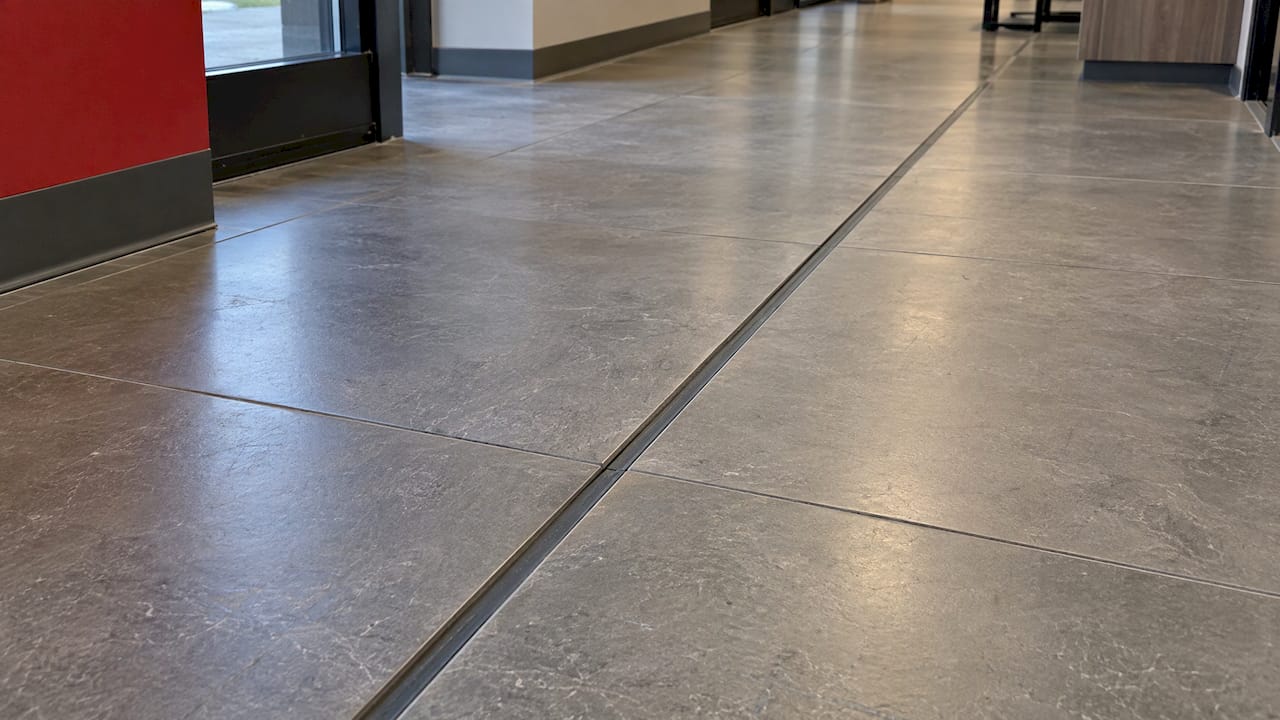
A membrane handles small, stable cracks. It does not replace movement joints. TCNA calls the belief that anti-fracture membranes let you eliminate movement joints a frequent misconception: soft joints must stay in the tilework.
The January 2026 TileLetter guidance, following TCNA detail EJ171, says control joints and cold joints in the slab cannot be bridged. They must be carried up through the tile as flexible movement joints. Joints also belong at perimeters and transitions, and in the field every 25 feet, or every 12 feet for interior tile in direct sunlight. Near a crack, TEC recommends a flexible elastomeric joint material in the joints closest to the crack instead of rigid grout.
We cover this in detail in four installer rules for tile expansion joints, and in how baseboards meet a tile floor without locking the floor in.
Tiling cracked concrete outdoors in Colorado
Patios, porches and garage entries are where cracked slabs and Denver-area weather collide. TEC’s guide explains that freeze-thaw cycling changes moisture levels so substrates, adhesives and tile expand, contract and crack. Crack-isolation and waterproofing membranes help keep in-plane cracks from showing through, and that matters most in freeze-thaw conditions.
What that means for an exterior job:
- Mortar: TEC recommends polymer-modified mortar meeting ANSI A118.15 for exteriors and says mastic should never be used outdoors. Our mastic vs thinset explainer shows why.
- Slope: exterior floors need slope for drainage, and on-grade slabs benefit from gravel or other drainage below, especially where snow, ice and de-icing chemicals are in play.
- Tile: choose tile rated for exterior use with a slip-resistant surface. Our Denver patio tile guide covers porcelain selection and prep. If you are weighing natural materials for a garden or terrace, handmade Impruneta terracotta tiles show the kind of material worth checking against the slab’s condition before ordering.
- Mortar coverage: voids under tile collect water that freezes and lifts it, so full coverage matters.
- Timing: do not set tile in cold snaps. Most thinset and membrane data sheets set minimum temperatures, and Front Range weather can swing 40 degrees in a day.
When to wait
Hold off if any of these is true:
- The slab is newly poured and has not cured for the time your membrane and mortar require.
- A moisture test shows moisture coming up through the slab, or there is standing water.
- A crack shows any height difference, or it is wider than about 1/8 inch.
- The surface is dusty, sealed, painted or covered with curing compound.
- The floor is outside your flatness tolerance.
Waiting a few weeks or paying for an engineer’s opinion costs far less than pulling up a failed tile floor.
What we tell Denver homeowners about cracked slabs
Most calls about cracked concrete start with the question, “Can you just tile over it?” Our answer is that the crack decides, not the tile. We look at whether the crack is flat across, how wide it is, what the slab sits on and whether the room is inside or outside.
We tailor each project to your needs, budget and timeline, with honest pricing and no hidden fees. For a cracked slab, that means we tell you plainly if a membrane will do the job, and if it will not, we say so before any tile is ordered.
Good tile work is mostly what happens before the tile: subfloor preparation, flatness, crack treatment and movement joints. We treat every floor like it is going into our own home, and that is where we put the care.
Jim
Get the slab assessed and the tile installed right
If you have a cracked slab in the Denver metro, from Aurora and Centennial to Arvada, Lakewood, Boulder or Castle Rock, our team handles tile floor installation and subfloor preparation for homes and commercial properties. With more than 10 years serving the area and 125+ five-star reviews, we plan the prep and the install together so the crack work, leveling and tile all fit one schedule. Tell us what you see in the slab and we will take it from there.

See everything we install on our services page, or start from leonardosflooringcorp.com.
FAQ
Can you tile over a cracked concrete slab?
Yes, when the crack is a stable shrinkage crack with no vertical movement. It is filled and covered with an ANSI A118.12 crack-isolation membrane before tiling. Structural cracks, where one side sits higher than the other, need a structural engineer first.
Can I just fill the crack with patch and tile over it?
No. Filling is only the first step. Because concrete keeps moving slightly, the crack tends to telegraph through rigid tile and grout unless a membrane covers it and extends at least 12 inches or 1.5 tile widths on both sides, as TEC recommends.
Does a membrane mean I can skip movement joints?
No. TCNA states that anti-fracture membranes do not replace movement joints. Joints at perimeters, transitions and over slab control joints stay in the tile layout, filled with flexible material and not grout.
Can I tile a cracked patio in Colorado?
Often yes, if the cracks are stable, the slab drains and the materials are exterior-rated. That means polymer-modified mortar, a crack-isolation membrane and slip-resistant exterior tile, installed in suitable temperatures. A contractor should check slope and slab condition first.
Sources
- Should I use any kind of underlayment on cracked slab? (Ceramic Tile Association)
- Crack Isolation / Suppression / Anti-fracture Membrane (TCNA)
- Understanding joints and cracks leads to effective treatment (TileLetter)
- Mass Transit Ceramic Tile and Stone Technical Design Manual (LATICRETE)
- Tiling over a Cracked Concrete Slab (Fine Homebuilding)
- Porcelain large format tile installation checklist
- Fracture Guard data sheet (Merkrete)
- Exterior Installation Guide R0920 (TEC)
- Treatment of individual concrete cracks (TEC)
- Durock Liquid Waterproofing and Crack Isolation Membrane (USG)
- Crack Isolation (Sika USA)