
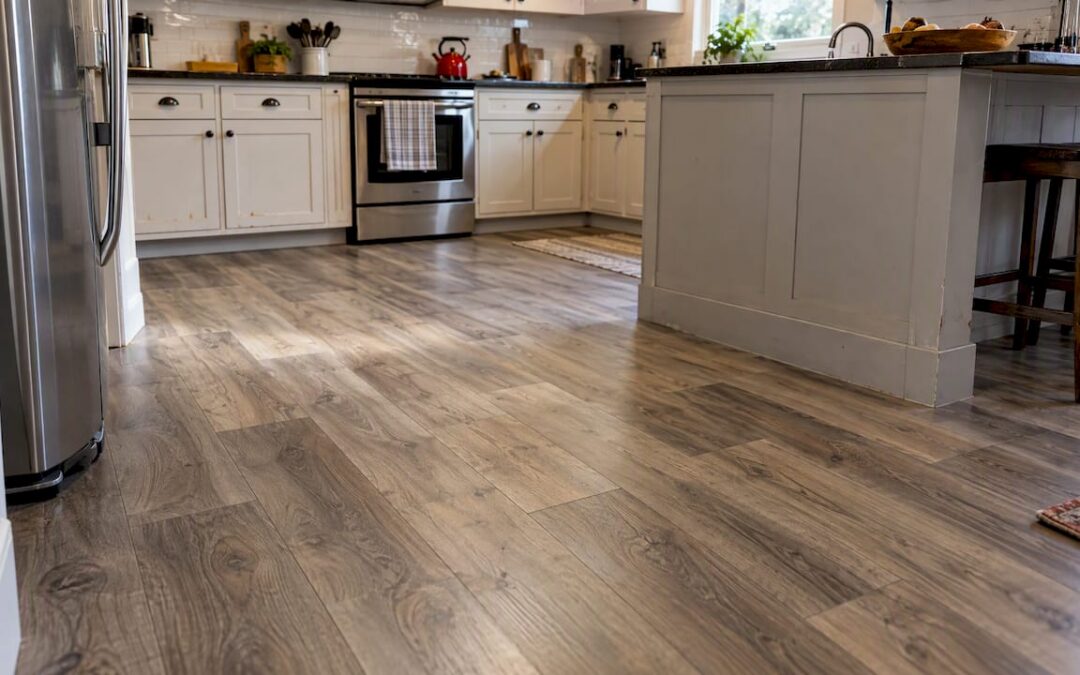
Vinyl plank is one of the most practical kitchen floors you can choose. It resists scratches and spills, feels softer and warmer underfoot than tile, and costs less than most of the alternatives. It is not maintenance-free or magically waterproof, though. How well it performs depends on the product you pick, how flat and dry the subfloor is, and how carefully the seams and edges are handled. This guide walks through each of those points so you can decide with real information.
TL;DR
- Luxury vinyl plank (LVP) suits busy kitchens: it is slip- and scratch-resistant and comfortable to stand on.
- The planks themselves handle water well. The risk is at the seams and edges, where water can reach the subfloor over time.
- Tile lasts a long time and is hard to beat for heat and moisture, but it is colder, harder underfoot, and usually a bigger project.
- Subfloor condition decides whether a vinyl floor looks good in year one and year ten. Check moisture and flatness before you buy planks.
- In the Denver metro, a local installer can inspect your subfloor and quote the whole job, from prep to trim.
Table of Contents
- What vinyl plank is, and why it works in kitchens
- How waterproof is vinyl plank in a kitchen?
- Vinyl plank vs. kitchen tile
- Can mold grow under vinyl plank?
- The subfloor decides how the floor performs
- How to choose the right vinyl plank for your kitchen
- Caring for a vinyl kitchen floor
- Our perspective on vinyl plank in kitchens
- Get your kitchen floor installed right
- FAQ
- Sources
What vinyl plank is, and why it works in kitchens
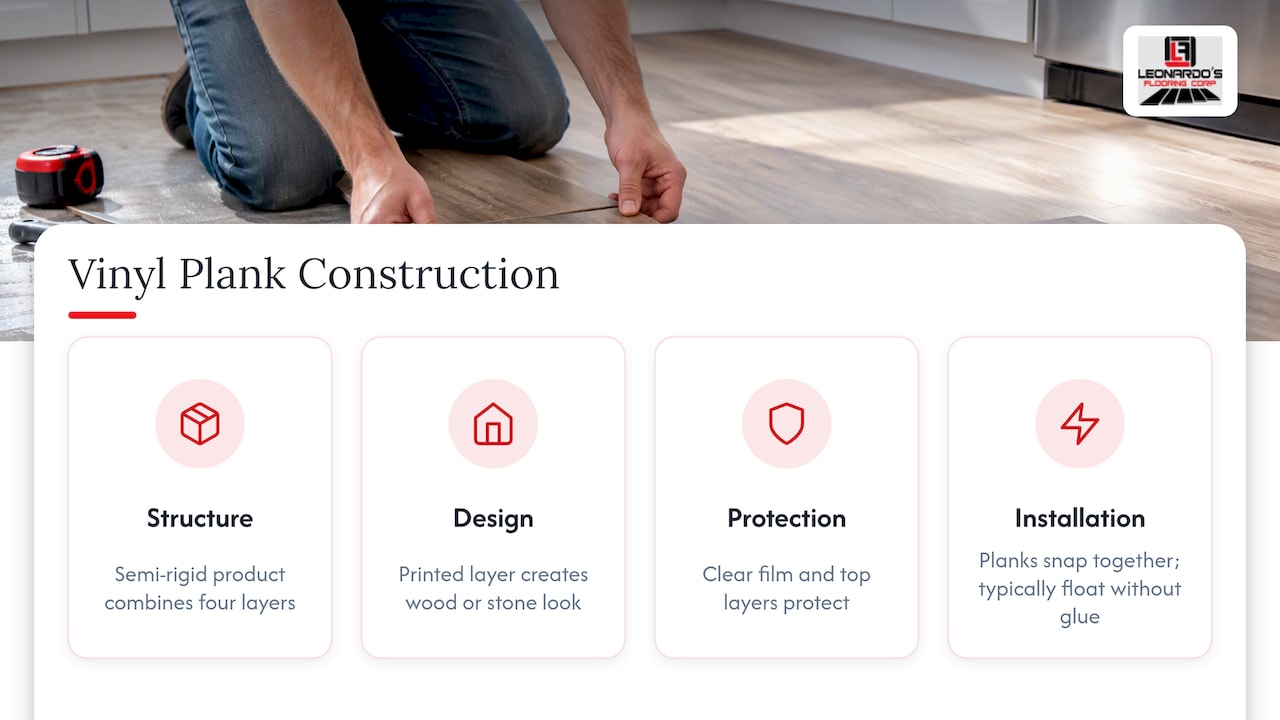
Luxury vinyl plank is a semi-rigid, multi-layer product. According to The Spruce, it combines a backing layer, a printed design layer, a clear film layer, and an aluminum oxide top layer. The printed layer is what gives LVP its convincing wood or stone look. The clear and top layers do the protecting.
That construction explains why kitchens are such a natural fit. A kitchen floor takes dropped pans, chair legs, pet nails, spilled juice, and hours of standing. Vinyl handles all of it without needing to be sealed or refinished the way a wood floor does.
Most LVP also uses a click-lock system. The same Spruce review notes that the planks snap together and are typically installed as a floating floor, without glue. That is why vinyl plank has a reputation as DIY-friendly. In a kitchen, though, a floating floor still has to sit on a flat, dry base and fit tightly around cabinets, appliances, and thresholds, which is where professional installation earns its keep. If you want a broader primer on the product, our luxury vinyl plank buyer’s guide covers constructions and terms in more depth.
How waterproof is vinyl plank in a kitchen?
This is the question most people are really asking when they search for waterproof kitchen flooring options, and the honest answer has two parts.
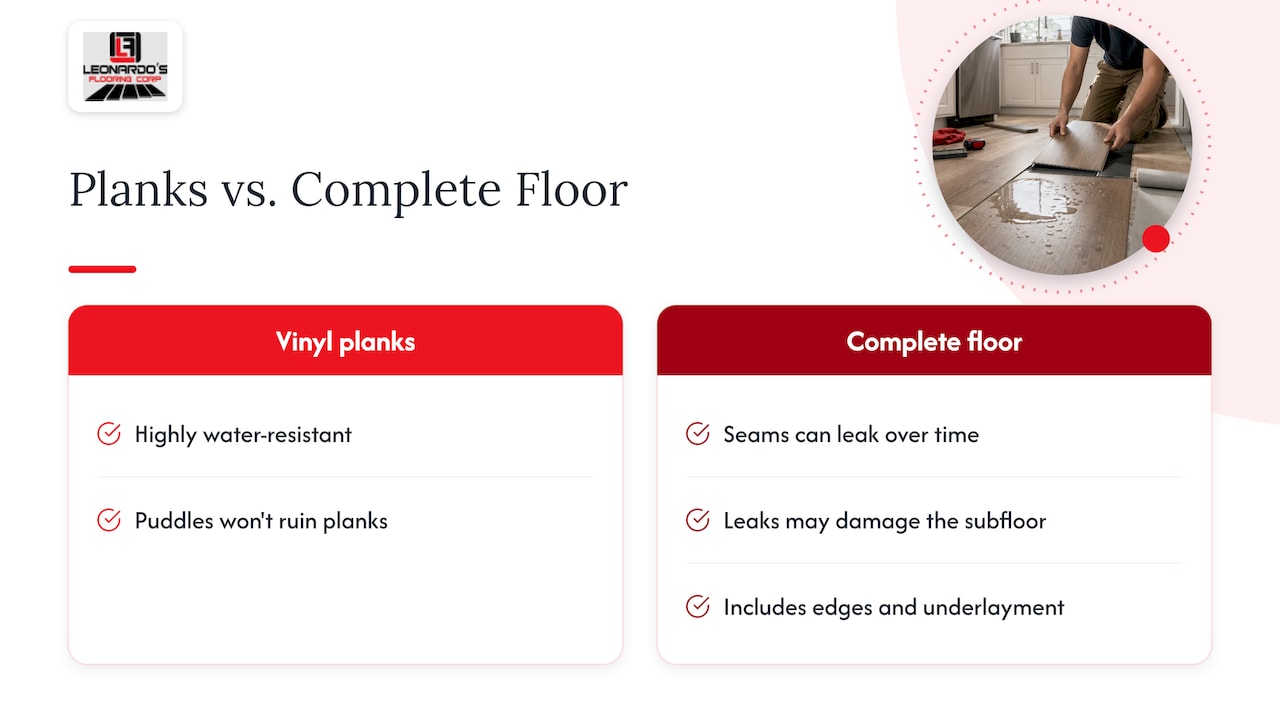
The material is very water-resistant. A USA Today guide to kitchen flooring describes LVP as highly water-resistant, but warns that its seams can leak over time and lead to subfloor damage. In other words, a puddle from a dishwasher hose will not ruin a vinyl plank. But if water sits in a seam long enough, or runs under the floor from a failed supply line or a leaking refrigerator line, it can reach the subfloor and stay there.
That is the practical difference between “waterproof planks” and a “waterproof floor.” The planks resist water. The floor is a system: planks, seams, edges, the underlayment, and the subfloor below. If you want to see how we think about waterproof vinyl in general, read why waterproof vinyl plank makes sense for many homes.
Where kitchen floors actually get wet
A few spots take most of the abuse:
- In front of the sink and dishwasher, where splashes and drips repeat daily.
- Around the refrigerator, especially if it has a water line or ice maker.
- Under the dishwasher and sink cabinet, where slow leaks can go unnoticed.
- At doorways to the patio or garage, where wet shoes and snowmelt come in. In Colorado winters, that is a real factor.
If you see water, wipe it up the same day. Treat a recurring leak as a plumbing job first and a flooring question second.
Other waterproof kitchen flooring options
Vinyl is not the only choice, and some alternatives are poor fits. The Building America Solution Center, a U.S. Department of Energy program, notes that hardwood is generally not rated for excessive, repeated water exposure, and that laminate can swell or buckle when it is saturated or sits in standing water. That does not rule out either one in every kitchen, but it does mean they need more caution around sinks and dishwashers.
In practice, the options for a wet-prone kitchen break down like this:
- Vinyl plank: very water-resistant planks, with the seams as the weak point.
- Tile (porcelain or ceramic): the tile does not absorb much water, but grout lines need sealing and upkeep.
- Sheet vinyl: fewer seams, a more utilitarian look.
- Epoxy coating: a seamless surface, more common in garages and commercial spaces than in home kitchens, though it can work for the right design.
- Hardwood or laminate: beautiful and popular, but the least forgiving of standing water.
Vinyl plank vs. kitchen tile
The “kitchen tile vs vinyl” question comes up in almost every kitchen remodel. Neither wins on every count, so here is how they compare on what matters day to day.
| Factor | Vinyl plank (LVP) | Ceramic or porcelain tile |
|---|---|---|
| Feel underfoot | Softer and warmer | Hard and cold |
| Scratch and slip resistance | Slip- and scratch-resistant | Durable, but can be slick when wet depending on the finish |
| Water handling | Planks resist water; seams are the weak point | Tile resists water; grout needs sealing |
| Dropped dishes | Gives a little | Dishes break; heavy items can crack tile |
| Installation | Often faster, typically floating | More involved: setting, grouting, curing |
| Repair | Replace individual planks | Replace individual tiles, matching grout is the hard part |
| Upfront cost | Generally lower | Generally higher |
The comfort and durability points above come from the same USA Today kitchen flooring guide, which calls LVP a great option for busy kitchens because it is slip- and scratch-resistant, holds up to foot traffic, and is softer and warmer underfoot than ceramic tile. The article also quotes a flooring expert who calls LVP a “game-changer” for kitchens, since it balances upfront cost, durability, and water resistance.
The cost row deserves one caution. Prices for both materials swing widely with product grade, layout, subfloor repair, and your local labor market. We do not publish flat prices for either, because a kitchen with a level subfloor and a simple layout is a very different job from one with an uneven slab and an island. The reliable way to compare is to get a written quote for each material on your actual kitchen.
When tile is the better call
Tile makes sense if you want a floor that will outlast the rest of the kitchen, if you love the look of stone or patterned tile, or if your kitchen has radiant heat and you want a hard surface that conducts it well. It also suits homeowners who do not mind cold, hard feet and want something that shrugs off heat and moisture.
When vinyl plank is the better call
Vinyl is the stronger pick if you stand and cook for long stretches, have kids or pets, want a quieter and warmer floor, or are working to a budget and a tighter timeline. It also works well when you want one continuous look from the kitchen into a dining area or hallway. For households with young kids, our roundup of family-friendly flooring solutions shows how different materials hold up. And if scratches are your worry, see our guide to scratch-resistant flooring types.
Can mold grow under vinyl plank?
It can, if moisture gets trapped. Vinyl itself does not feed mold, but a wet subfloor under a sealed-off plank floor dries slowly. Mold needs moisture and something to grow on, and the wood subfloor, underlayment, or adhesive residue can supply the second part.
The EPA’s guidance on water-damaged buildings recommends cleaning hard surfaces such as vinyl with water and mild detergent, letting them dry, and checking that the underflooring is dry. That last step matters most for plank floors. A surface that looks dry can sit on a subfloor that is not.
Here is what that means in a kitchen:
- Fix the source first. A slow leak under the sink or behind the refrigerator will defeat any floor.
- After a spill or leak, check below. If water got under the planks, lift them and dry the subfloor rather than waiting to see if a problem appears.
- Watch for warning signs. A musty smell, planks that lift or gap, or staining near seams point to moisture underneath.
- Do not seal moisture in. If the subfloor is damp at installation, wait until it dries or deal with the cause.
Ventilation and sealing
The EPA’s remodeling and indoor air quality guidance adds two useful points for kitchens. It says a typical range hood should be sized to exhaust 100 cubic feet per minute (cfm), which helps move cooking moisture out of the house. It also says that to reduce the potential for microbial growth in the joints of hard surfaces installed near water sources, you should seal the entire surface. For a vinyl floor, that is a reason to take transitions, edges at the sink base, and perimeter gaps seriously rather than leaving them to chance.
If you are weighing vinyl for a below-grade space instead, read our piece on vinyl plank for basements, where moisture matters even more.
The subfloor decides how the floor performs
People spend weeks choosing a plank color and ten minutes thinking about what is under it. It should be the other way around.
A floating vinyl floor copies whatever is below it. Dips, humps, loose boards, or debris telegraph through the planks and can stress the click-lock joints, which is how gaps and peaking start. Before any kitchen vinyl goes down, a good installer checks:
- Flatness. Low and high spots get ground, patched, or leveled.
- Moisture. Concrete slabs and wood subfloors both need to be dry. Consumer Reports advises using an underlayment with moisture protection when you install hardwood over a concrete subfloor, and the same thinking applies to any floor over a slab: you must know what the base is doing before you cover it.
- Soundness. Squeaky, loose, or water-stained plywood gets repaired or replaced.
- Old flooring. Sometimes old vinyl or tile can stay under the new floor. Sometimes it has to come out. That depends on its condition and thickness.
- Fixtures. Where the dishwasher, refrigerator, and cabinets sit determines how and where the floor ends and how much can be removed.
Subfloor preparation is a service we offer on its own, and it is often the difference between a kitchen floor that looks great for years and one that fails at the first seam. Some products also use adhesive rather than a floating installation; our article on the role of floor adhesive in vinyl flooring explains when that applies.
Details people forget
- Appliance clearance. Will the dishwasher and refrigerator still slide out over the new floor height? Mention it before the job starts.
- Transitions. Where the kitchen meets another room, you need a clean threshold or a continuous layout.
- Baseboards and quarter-round. Trim hides the expansion gap at the walls and finishes the job. Pulling and reinstalling baseboards is easier than it sounds when done carefully, and we handle that finish carpentry as part of installation.
- Expansion gaps. A floating floor needs room to move with temperature and humidity, which Colorado’s dry climate and seasonal swings make worth planning for.
How to choose the right vinyl plank for your kitchen
Not every plank is the same, and the product page rarely tells the full story. When you compare products, look at these things.
- Construction. Ask whether it is a rigid core or a flexible one, and how thick it is. A firmer core tends to bridge small subfloor imperfections better and resist denting under heavy appliances.
- Wear layer. A thicker clear protective layer generally means better resistance to scuffs and scratches. Compare manufacturers’ stated wear-layer ratings rather than marketing terms like “commercial grade.”
- Waterproof claim. Read what the warranty actually covers. Some cover the planks only, not the subfloor or leaks from appliances.
- Warranty for residential kitchen use. Confirm it applies to kitchens and to professional or floating installation.
- Finish and look. Embossed textures hide scratches and crumbs better than glossy flat finishes. Mid-tone, matte patterns show less dirt than very light or very dark floors.
- Plank width and layout. Wide planks look modern, and long runs make a small kitchen feel larger. They also show subfloor flaws more, so prep matters more.
Caring for a vinyl kitchen floor
Upkeep is simple, which is much of the appeal.
- Sweep or vacuum (with the beater bar off) regularly to remove grit that scuffs the surface.
- Mop with a damp mop and a cleaner approved by the manufacturer. Avoid soaking the floor.
- Wipe spills promptly, especially near seams.
- Put felt pads under chair and table legs, and use a protective surface when moving appliances.
- Place mats in front of the sink and range, and an entry mat at exterior doors.
- Follow the warranty’s cleaning instructions, since harsh products can void coverage.
Our perspective on vinyl plank in kitchens
We install flooring across the Denver metro, and kitchens are where we see the biggest gap between what a customer expects and what the floor needs. Homeowners often come in with a plank they like and a plan to “just go over” what is there. Our advice is almost always the same: choose the floor second and the subfloor first.
For most families, we think vinyl plank is the right kitchen floor. It is comfortable, forgiving, and easy to live with, and the price makes sense for a room that takes a beating. We would steer you to tile if you want the longest possible lifespan, or toward another material if your kitchen design leans one way. We would rather tell you that up front than sell you the wrong floor.
What we care about most is not the plank. It is the details nobody photographs: a flat base, tight seams around the sink and refrigerator, clean trim, and a floor that is still tight when the first winter comes through. We treat every floor as if it were going into our own home, and every project is tailored to your needs, budget, and timeline.
— Jim
Get your kitchen floor installed right
If you are in Denver, Aurora, Lakewood, Arvada, Centennial, Highlands Ranch, Castle Rock, Thornton, Westminster, Boulder, or Littleton, Leonardo’s Flooring Corp can look at your kitchen, check the subfloor, and walk you through the options. We have served the Denver area for over 10 years, and our 125+ five-star reviews come from people who wanted the work done honestly and done right.

Our vinyl flooring installation service covers the whole job: subfloor preparation, plank installation, baseboards, and quarter-round trim. If tile is on your shortlist, we also do tile floor installation, so you can compare quotes for both materials from one contractor. You can browse everything we do on our services page and ask for a quote for your kitchen.
FAQ
Is vinyl plank a good choice for a kitchen?
Yes, for most kitchens. It resists scratches and slipping, handles heavy foot traffic, and is softer and warmer underfoot than ceramic tile, according to USA Today’s kitchen flooring guide. The main caution is that its seams can let water through over time, so subfloor preparation and careful installation matter.
Is vinyl plank flooring really waterproof?
The planks themselves are highly water-resistant, but a floor made of planks is only as waterproof as its seams and edges. Water that gets under the planks can reach the subfloor and cause damage. Wipe spills quickly and fix leaks at the source rather than relying on the label.
Can mold grow under vinyl plank flooring?
It can if moisture is trapped beneath the floor, since a damp subfloor dries slowly under sealed planks. After any water event, the EPA says to clean hard surfaces like vinyl with mild detergent, let them dry, and check that the underflooring is dry. If you notice a musty smell or lifting planks, have an installer or a mold professional take a look.
Is vinyl plank or tile better for a kitchen?
It depends on your priorities. Vinyl is warmer, softer, and generally cheaper and quicker to install, while tile is very durable and handles heat well but is harder and colder underfoot. The best way to decide is to price both for your actual kitchen.
Can vinyl plank go over my existing kitchen floor?
Sometimes. The old floor has to be flat, solid, dry, and the right thickness for the new one. An installer should inspect it before you buy materials, because covering a damaged or uneven floor usually shows up as gaps and peaking later.
Sources
- Vinyl Plank Flooring Review: Pros and Cons, The Spruce
- Best flooring for kitchens: Pros and cons of each type, USA Today
- Water-Resistant Flooring, Building America Solution Center
- Mold Remediation in Schools and Commercial Buildings, EPA
- Remodeling Your Home and Indoor Air Quality, EPA
- Flooring Buying Guide, Consumer Reports