
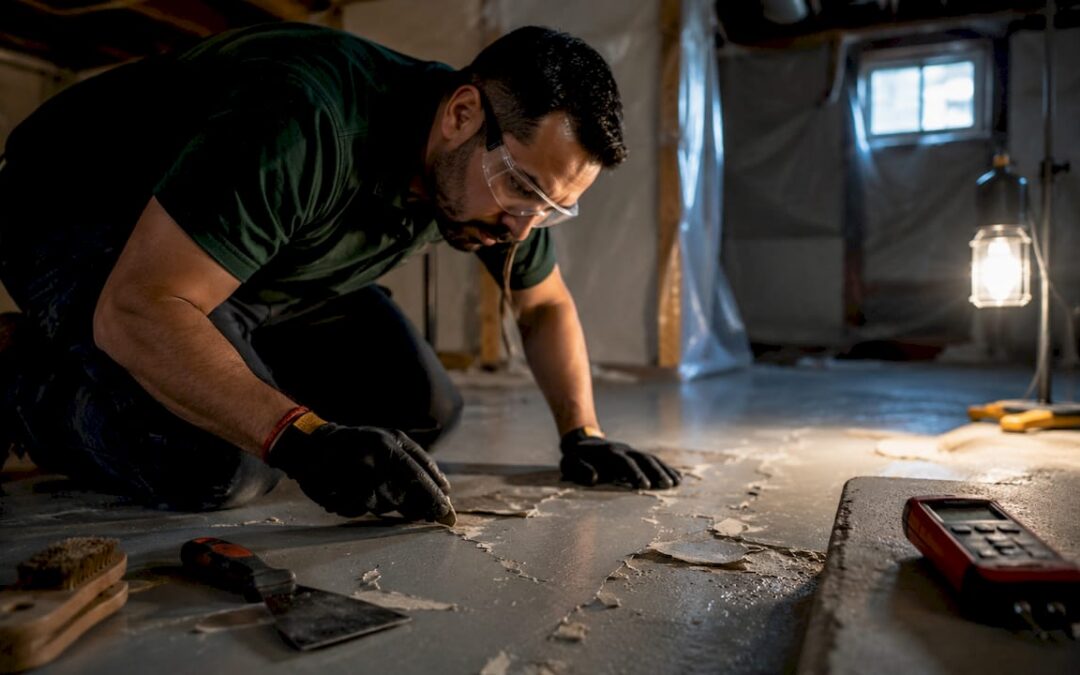
Epoxy floor peeling is defined as adhesion failure between the epoxy coating and the concrete substrate beneath it. The industry term for this failure is delamination, and it almost never happens because the product is defective. Epoxy floor failure traces back to the substrate, not the coating itself. The three primary causes are moisture vapor emission from the concrete slab, surface contamination, and errors made during mixing or application. Understanding why epoxy floors peel gives you the information to prevent it from happening in the first place.
Why epoxy floors peel: the role of moisture vapor
Moisture is the single most destructive force acting on an epoxy coating. Concrete is porous by nature, and it transmits moisture vapor continuously upward through the slab. When that vapor reaches the underside of the epoxy film, it creates osmotic pressure. That pressure pushes the coating away from the concrete, and the result is bubbling, lifting, and eventually full delamination.
Moisture vapor emission above 80% relative humidity inside the slab is the primary driver of epoxy coating delamination. That threshold matters because most standard epoxy systems are not designed to withstand sustained vapor pressure above it. Basements and slab-on-grade floors are especially vulnerable because ground moisture migrates directly into the concrete from below.
The industry standard for measuring this risk is ASTM F2170, which uses in-situ probes inserted into the slab to measure internal relative humidity. A surface moisture test alone is not enough. The slab can feel dry on top while carrying dangerous vapor levels deeper inside.
Skipping moisture testing before epoxy application is the single fastest path to a failed floor. A slab that reads dry on the surface can still carry enough internal vapor pressure to lift a coating within weeks of installation. ASTM F2170 testing is not optional on any serious project.
Signs that moisture is causing your epoxy to lift include:
- Bubbles or blisters appearing weeks after installation
- Peeling concentrated near exterior walls or drains
- Lifting that worsens in spring or after heavy rain
- A hollow sound when you tap the peeling area
If vapor levels exceed the threshold, a moisture mitigation system must go down before the epoxy. Skipping that step guarantees failure regardless of how good the coating is.
How does surface preparation cause epoxy peeling?
Surface preparation is where most epoxy projects succeed or fail before a single drop of coating is applied. 80% of industrial epoxy floor failures trace back to inadequate surface preparation, particularly insufficient mechanical profiling and unresolved contaminants. That number reflects a consistent pattern: owners and contractors underestimate how much the substrate condition controls the outcome.
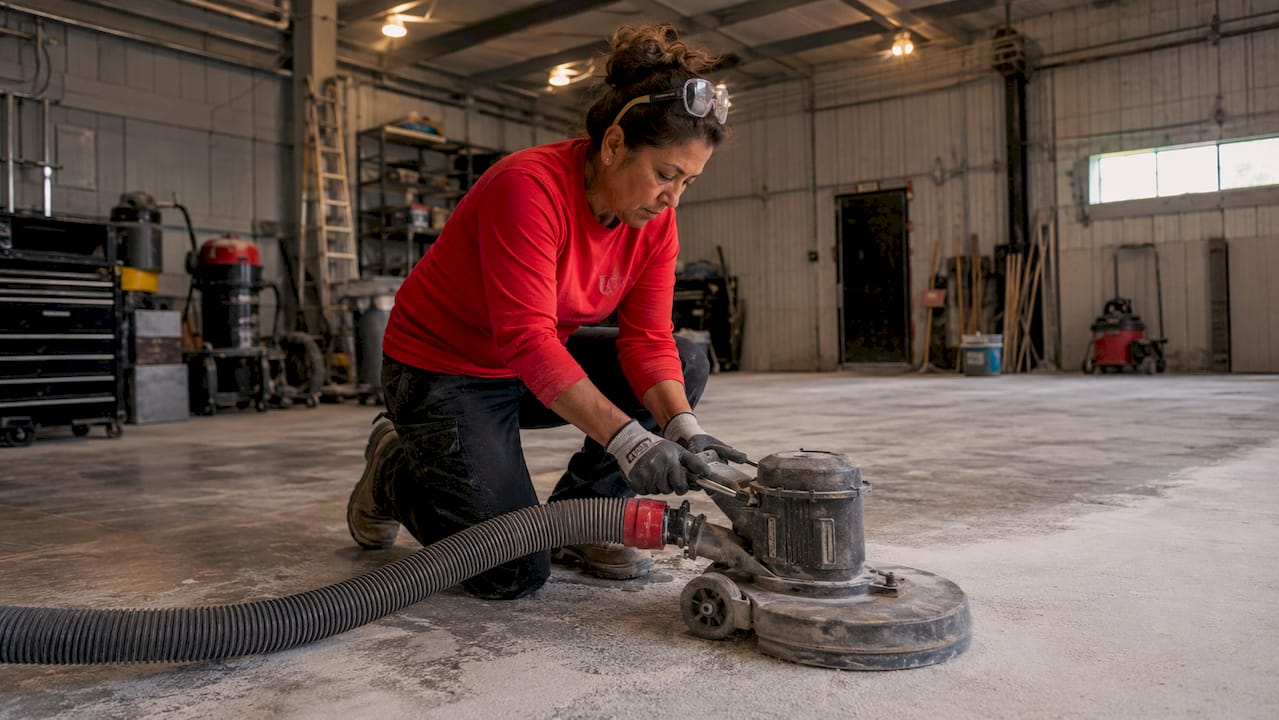
Epoxy does not bond to a smooth, sealed, or contaminated surface. It bonds to clean, open, profiled concrete. The ICRI (International Concrete Repair Institute) surface profile guidelines define the texture level required for different coating systems. Most epoxy applications require a CSP (Concrete Surface Profile) of 3 to 5, which is achieved through mechanical methods.
The three accepted mechanical preparation methods are:
- Diamond grinding. A walk-behind grinder with diamond-segment tooling removes laitance (the weak surface layer of concrete), opens the pores, and creates a consistent texture. This is the most common method for residential and light commercial work.
- Shot blasting. A self-contained machine propels steel shot at the floor at high velocity, then recaptures it. Shot blasting creates a more aggressive profile and works well on large commercial or industrial slabs.
- Scarification. Rotating cutting wheels remove material aggressively. Scarification is used when the surface has heavy coatings, thick contamination, or significant damage.
Contaminants including oils, curing compounds, silicone, mold releases, and residual dust prevent epoxy from bonding to concrete and lead to early peeling failures. Even a floor that looks clean can carry invisible oil residue from machinery or vehicles. After mechanical preparation, the floor must be vacuumed thoroughly and inspected before any coating goes down.
Applying epoxy over sealed concrete is another common mistake. Many decorative concrete sealers are invisible, and installers sometimes apply epoxy directly over them without realizing the sealer is blocking adhesion. The epoxy bonds to the sealer, not the concrete, and the whole system peels as a unit.
Pro Tip: After mechanical preparation, pour a small amount of water on the floor. If it beads up, the surface is still contaminated or sealed. If it absorbs immediately, the concrete is open and ready for coating.
Skipping the primer coat is a related error. A penetrating epoxy primer fills the pores of the concrete and creates a chemical bridge between the substrate and the topcoat. Without it, the topcoat sits on the surface rather than bonding into it. For epoxy floor adhesion to hold long-term, primer is not optional.
What mixing and application errors cause epoxy to lift?
Two-component epoxy systems consist of a resin (Part A) and a hardener (Part B). These two components must be combined at the exact ratio specified by the manufacturer. Deviating from that ratio by as little as 5% to 10% reduces crosslink density, which weakens the cured film and increases peeling risk. A film that has not fully crosslinked remains soft, flexible, and poorly bonded.
Temperature and humidity during application have an equally direct effect on cure quality. Applying epoxy outside the manufacturer’s recommended temperature and humidity range results in poor curing and adhesion. Most epoxy systems require an ambient temperature between 50°F and 90°F and a relative humidity below 85%. Cold slabs slow the cure dramatically. Hot slabs shorten the pot life, sometimes to the point where the material begins to gel before it is fully spread.
Common application errors that lead to peeling include:
- Incorrect mix ratio. Measuring by volume instead of weight, or estimating rather than measuring, introduces ratio errors.
- Exceeding pot life. Once mixed, epoxy begins to cure. Applying material that has already started to gel produces a weak, poorly bonded film.
- Applying too thin. An underthick coat does not develop full film strength and is more vulnerable to mechanical stress.
- Applying in direct sunlight. Solar heat raises the slab temperature rapidly, causing the epoxy to cure too fast and trap air bubbles.
Pro Tip: Always measure epoxy components by weight using a digital scale, not by volume using graduated containers. Weight measurement eliminates the air-gap errors that volume measurement introduces and keeps your ratio accurate.
Thermal expansion differences between epoxy and concrete also contribute to delamination over time. Epoxy has a higher coefficient of thermal expansion than concrete. That means the coating expands and contracts more than the slab beneath it with every temperature cycle. Over months and years, those repeated shear stresses at the interface accumulate and eventually cause the bond to fail, particularly at edges and seams.
How do peeling patterns reveal the underlying cause?
Where and how an epoxy floor peels tells you exactly what went wrong. Reading the failure pattern is the fastest way to diagnose the root cause and decide on the right repair approach.
| Peeling pattern | Most likely cause | Key diagnostic sign |
|---|---|---|
| Bubbles or blisters across the field | Moisture vapor emission | Hollow sound when tapped; worsens seasonally |
| Peeling at edges and seams | Thermal stress or poor edge termination | Sharp, clean edge separation |
| Lifting near walls or drains | Localized moisture intrusion | Concentrated near water sources |
| Large sheets peeling as one unit | Sealed or contaminated substrate | Smooth concrete visible beneath |
| Peeling under heavy traffic only | Underthick application or weak film | Failure follows traffic paths |
Delamination initiates where coating edges abruptly terminate. A sharp edge creates a stress concentration point where thermal cycling and mechanical loading combine to start the peel. Tapering the coating edge by feathering it out gradually, or sealing it with a compatible edge sealant, reduces that stress and delays failure significantly.
Localized failures that spread under use follow a predictable path. Once the bond breaks at one point, the surrounding area loses lateral support. Foot traffic and vehicle loads flex the coating repeatedly, and the delamination zone grows outward from the original failure point. Catching and repairing a small peeling area early prevents a much larger repair later.
Key Takeaways
Epoxy floors peel when adhesion fails at the substrate level, and that failure is almost always preventable through proper moisture testing, mechanical surface preparation, and correct application technique.
| Point | Details |
|---|---|
| Moisture is the top cause | Slab vapor above 80% RH creates osmotic pressure that lifts epoxy from below. |
| Surface prep drives most failures | 80% of epoxy floor failures trace back to inadequate mechanical profiling or contamination. |
| Mix ratio errors weaken the film | A 5–10% deviation from the specified ratio reduces crosslink density and bond strength. |
| Edge termination matters | Feathering coating edges reduces stress concentration and slows delamination progression. |
| Peeling patterns diagnose the cause | The location and shape of peeling reveals whether moisture, contamination, or application error is responsible. |
What I’ve learned after years of watching epoxy floors fail
The most frustrating thing I see in this industry is a homeowner or business owner who spent good money on a quality epoxy product and watched it peel within a year. They blame the product. The product is almost never the problem.
The prevailing cause of epoxy floor failure is systematic shortcuts in surface preparation, especially skipping diamond grinding or moisture testing. I have seen this pattern repeat itself dozens of times. A contractor skips the grinder to save time. The owner does not know to ask about it. The floor looks great for six months, then the edges start lifting.
The other myth I hear constantly is that epoxy flooring is not durable. Properly installed epoxy is extremely durable. It handles heavy vehicle traffic, chemical spills, and decades of use in commercial settings. The durability question is really a preparation question. A well-prepped floor with a correctly applied epoxy coating system will outlast most other flooring options in demanding environments.
My practical advice for homeowners and business owners: ask your installer specifically what moisture testing method they use and what surface profile they are targeting. If they cannot answer both questions clearly, that is a signal worth paying attention to. The preparation conversation tells you more about the quality of the installation than any product specification sheet.
— Jim
Leonardosflooringcorp: professional epoxy installation done right
Epoxy floor peeling is preventable when the job is done correctly from the start. Leonardosflooringcorp has been installing epoxy coatings across the Denver metro for over 10 years, and every project begins with moisture testing and mechanical surface preparation before any coating is applied.

The team at Leonardosflooringcorp follows current best practices for substrate profiling, primer application, and mix ratio control on every residential and commercial job. Whether you need a garage floor, a commercial warehouse, or a retail space, the process is the same: test the slab, prepare the surface, and apply the coating correctly. If you want a floor that lasts, contact Leonardosflooringcorp for a professional epoxy floor coating assessment or installation in Denver.
FAQ
Why does epoxy floor peeling happen so quickly after installation?
Peeling within weeks of installation almost always points to moisture vapor emission or a contaminated substrate. Both problems prevent the epoxy from bonding to the concrete, so the coating lifts as soon as it faces any stress.
What is the ASTM F2170 test and why does it matter?
ASTM F2170 is the industry standard for measuring internal concrete slab relative humidity using in-situ probes. It detects vapor levels that surface tests miss, making it the most reliable way to assess epoxy adhesion risk before installation.
Can I repair a peeling epoxy floor without replacing the whole coating?
Small, localized peeling areas can be repaired by removing the loose material, re-preparing the exposed concrete, and applying a fresh patch. If the peeling is widespread or caused by moisture, the full coating must come up and the root cause must be addressed first.
How do I prevent epoxy from peeling in a garage or basement?
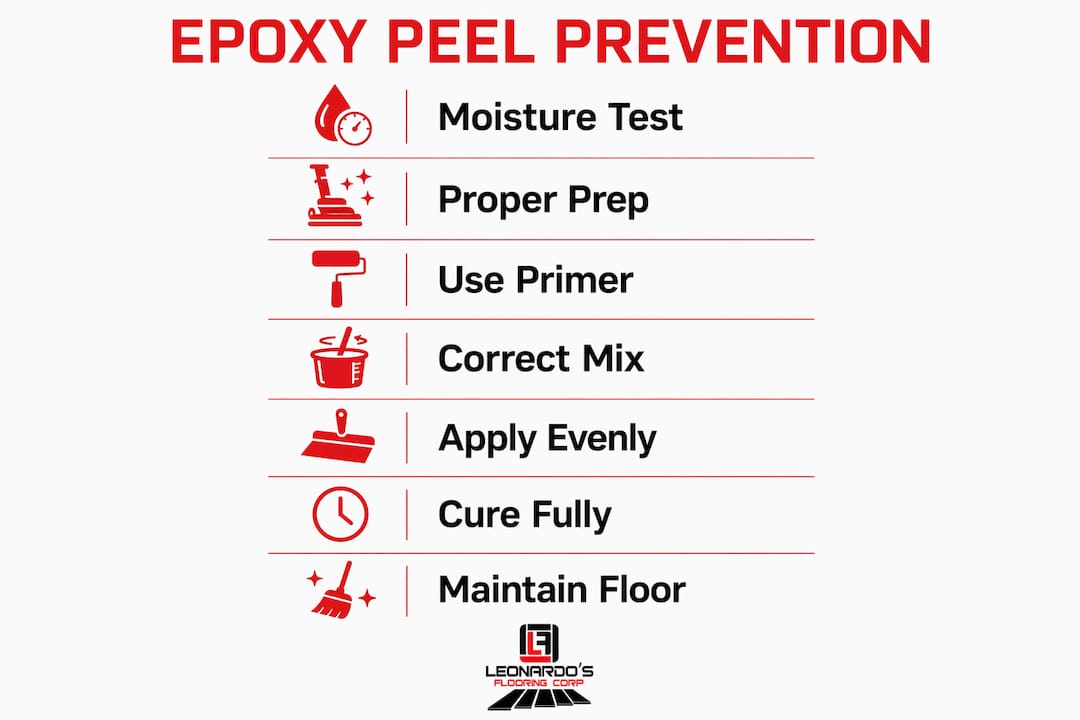
Test the slab for moisture using ASTM F2170, grind the surface to the correct profile, apply a penetrating primer, and follow the manufacturer’s mix ratio and temperature requirements exactly. Skipping any one of these steps significantly increases the risk of failure.
Is epoxy flooring durable enough for commercial use?
Epoxy flooring is highly durable in commercial settings when installed correctly. It handles vehicle traffic, chemical exposure, and heavy loads for many years, making it a standard choice for warehouses, retail floors, and industrial facilities.