
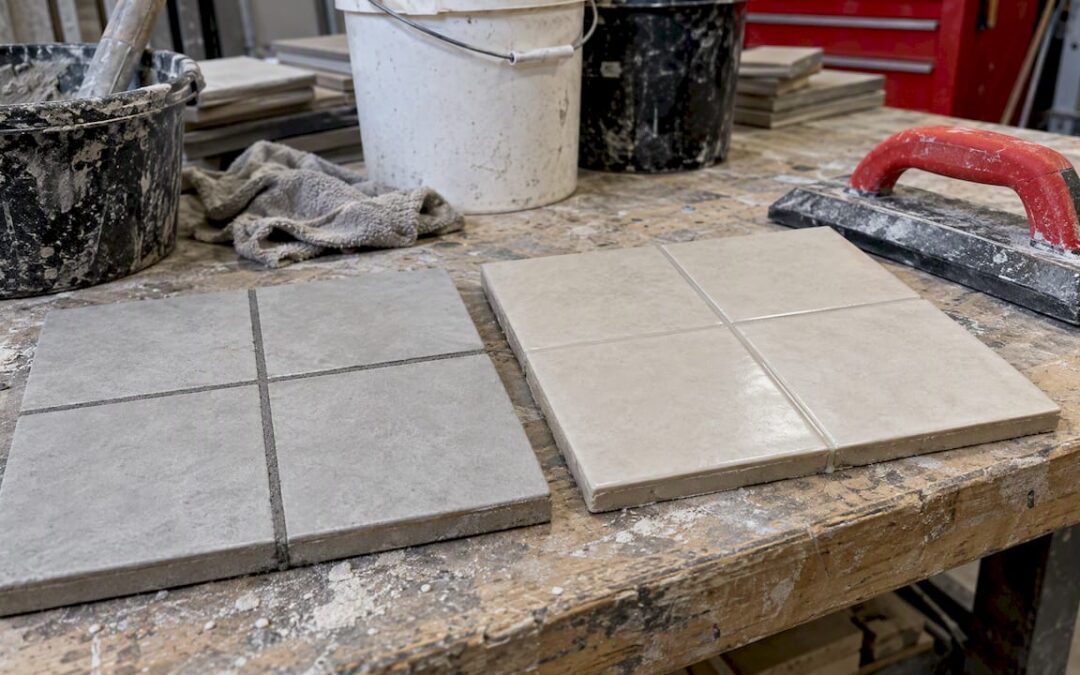
Epoxy grout is the better performer: it resists stains, moisture and chemicals, and it never needs sealing. Cement grout costs far less, is easier to install, and is the right call for many dry, low-traffic rooms. The choice comes down to where the tile is, how wide the joints are, how much the surface gets abused, and what you want to spend on the job and on upkeep afterward. Sanded grout isn’t a third rival. It is a type of cement grout, and we cover where it fits below.
What are the key differences between epoxy and cement grout?
- Epoxy grout is resin-based, far less porous and much more stain-resistant. It costs more and is harder to install, so the labor line on your quote matters as much as the material.
- Cement grout (sanded or unsanded) is porous. It needs sealing after it cures and again over the years, but it is forgiving to install and fits most residential interiors.
- Joint width decides sanded vs unsanded: unsanded is for joints 1/8 inch or narrower, sanded for 1/8 inch or wider.
- Choose epoxy for showers, kitchens, entryways, commercial floors and anywhere spills or chemicals are routine. Choose cement for dry rooms, tight budgets and large decorative joints.
- Installer skill matters more with epoxy. Its working time is short and cleanup mistakes are hard to undo.
Table of Contents
- What actually separates epoxy and cement grout
- Epoxy vs cement grout side by side
- Stains, moisture and color change
- The downsides of epoxy grout
- The downsides of cement grout
- How long each one lasts
- Cost over the life of the floor
- Which grout for which space
- What to check before you decide
- Our perspective
- Talk to us about your tile floor
- FAQ
- Sources
What actually separates epoxy and cement grout
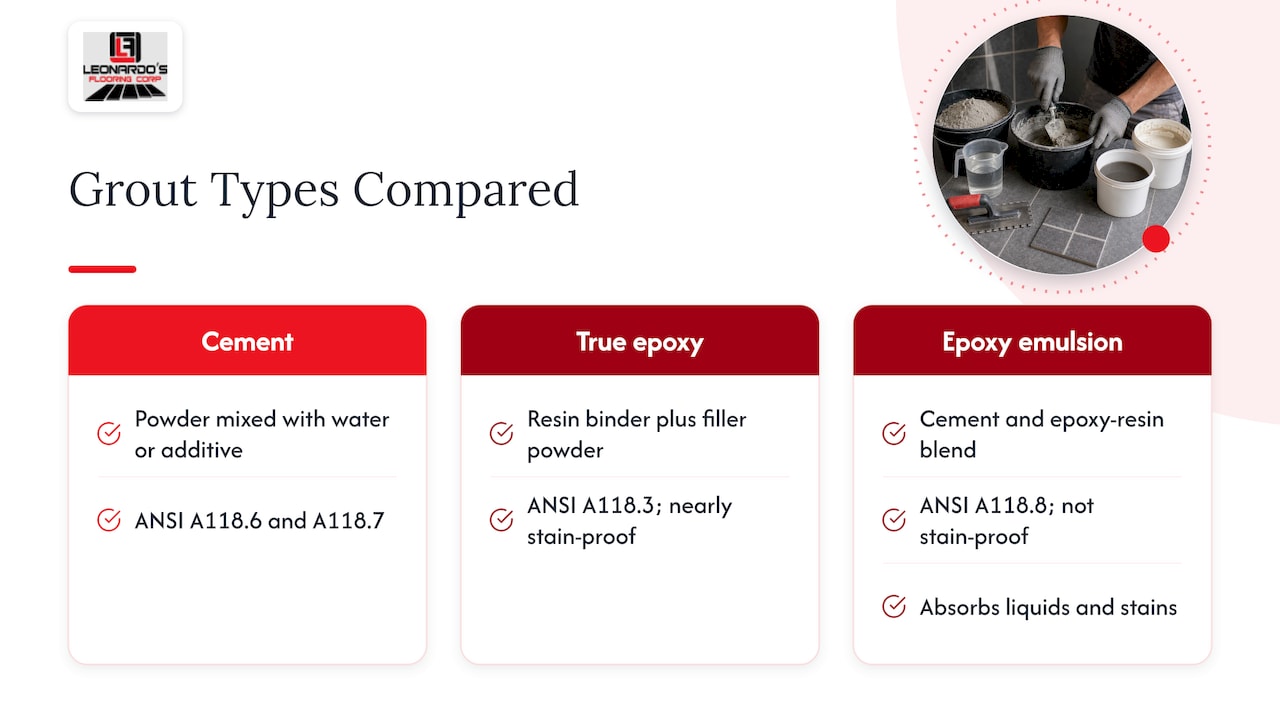
Cement grout is a cement-based powder you mix with water (or a liquid additive). North American cement grout for tile is defined by the ANSI A118.6 and A118.7 standards, according to the Tile Council of North America. It is what most people picture when they think of grout.
Epoxy grout swaps the cement binder for resin. The Flooring Institute describes it as epoxy resins plus filler powder, and says it is dramatically less porous and considerably more stain-resistant than cement-based grout. Industry guidance from TCNA calls ANSI A118.3 epoxy grout extremely hard, durable and nearly stain-proof.
One trap: not everything sold as “epoxy” is the same. TCNA notes that epoxy emulsion grout, a blend of cement and epoxy resins covered by ANSI A118.8, is not stain-proof and generally absorbs liquids and stains. If a quote says “epoxy grout,” ask which product, and confirm it is a true two- or three-part epoxy if stain resistance is the reason you’re paying extra.
Where sanded and unsanded grout fit
People searching “epoxy vs sanded grout” are comparing a binder type with a joint-size type. Both sanded and unsanded grout are cement grouts. Per TCNA’s cement grout guidance, unsanded grout uses fine aggregates and is meant for joints 1/8 inch or less (and sometimes glass tile), while sanded products use graded sand and are meant for joints 1/8 inch or greater.
The sand has a job. In wide joints, fine sand particles help prevent shrinkage, which is why you don’t use unsanded grout in a wide joint and expect it to hold up. Epoxy grout also contains an aggregate such as sand or ground stone, and it is formulated for a range of joint widths. Check the manufacturer’s data sheet for the width you plan.
Epoxy vs cement grout side by side
| Factor | Cement grout (sanded or unsanded) | Epoxy grout |
|---|---|---|
| Binder | Portland cement, often with polymer additives | Epoxy resin plus filler |
| Porosity | Porous and absorbent; needs sealing | Very low water absorption |
| Stain resistance | Poor unless sealed | Excellent |
| Chemical resistance | Can degrade or effloresce with some chemicals | High |
| Color consistency | Can vary with curing and drying | Excellent |
| Installation | Forgiving, long working time | Short working window, strict cleanup |
| Upfront cost | Lower | Higher (materials and labor) |
| Ongoing care | Periodic resealing | Routine cleaning only |
The performance ratings in the middle rows are summarized from a grout property comparison, and they line up with the manufacturer and trade guidance cited throughout this article.
Stains, moisture and color change
Stains and moisture. Traditional cement grout is porous, so it needs sealing to help prevent staining. Modern cement grouts may include polymer additives for better flexibility and color consistency, which narrows the gap but doesn’t remove it. Epoxy doesn’t rely on a sealer, because the joint itself barely absorbs anything.
Color. Standard cement grout can show minor color variation from the way Portland cement hydrates and cures. According to Custom Building Products, if the grout loses water too quickly it can dry splotchy and dark. That is one reason a cement-grouted floor sometimes looks patchy a week after install even when the work was careful. Daltile says cleaned epoxy grout returns to its original color rather than keeping a grayish, dirty look.
Chemicals. Daltile also notes that cement grout may effloresce or degrade when exposed to chemical substances, and that sealing improves its protection from water and chemicals. For a kitchen, a garage entry or a commercial space where harsh cleaners are routine, that matters.
Cracking. Excess water at mixing or cleaning is a leading cause of cement grout trouble: the Flooring Institute says it can weaken the grout and cause pinholes, discoloration and shrinkage cracks. Cracks can also come from a floor that moves, and no grout fixes a bad substrate. Solid subfloor preparation comes first, whichever grout you pick.
The downsides of epoxy grout
Epoxy is not simply “better.” The honest list of drawbacks:
- Cost. TCNA says epoxy grout can cost three to eight times as much as cementitious grout. That’s a material comparison. Grout is a small part of a tile budget, so the effect on a whole project is much smaller than the multiple suggests.
- Harder to work with. The same TCNA page says most installers find epoxy harder to use, shape and slope, and that it must be kept rigorously clean.
- Short working window. The Flooring Institute points to a limited working time, and residue left on the tile can be difficult to remove without dulling or damaging the finish.
- Slumping. TCNA warns epoxy may slump in a joint hours after the floor is finished, as it becomes less viscous while heating and curing.
Every one of these is a workmanship issue. A crew that stages materials, grouts in small sections and cleans on schedule avoids them. A crew doing epoxy for the first time on your floor does not. Ask how many epoxy grout jobs your installer has done and which products they use.
The downsides of cement grout
Cement grout’s weak points are the flip side. It stains in kitchens and baths if the sealer fails. It can darken, haze or efflorescence-streak. Sealer needs reapplying; the Custom Building Products guidance says sealers may need reapplication depending on their quality, cleaning frequency and the cleaners used. And unsanded grout in a wide joint can shrink and crack.
Timing matters for the first seal. Apply sealer only after full cure and follow the manufacturer’s directions, as This Old House advises, then clean with a pH-neutral cleaner. We wrote up our own approach in wait 48 to 72 hours before sealing grout, including a quick paper towel test to see whether the joint is ready.
Maintenance is real for cement. A guide to cleaning bathroom floor grout shows what routine upkeep looks like when the joints are porous.
How long each one lasts
Both last a long time when installed well. LATICRETE says properly applied and maintained epoxy grout can last for the life of the installation, though demanding commercial or industrial settings may need repair or replacement depending on cleaning methods, environment and traffic. For cement, the environmental product declaration cited by the Flooring Institute assumes it lasts as long as the building, a 75-year reference service life.
Those are best-case reference figures, not warranties. In practice, grout “fails” in appearance long before it fails structurally: cement turns dingy and stained, and poorly cleaned epoxy can hold residue. What you are really choosing is how much upkeep you accept to keep the joints looking right.
Cost over the life of the floor
Epoxy costs more upfront and adds labor because installation is more demanding. Cement costs less but, as the Flooring Institute summarizes, typically needs periodic sealing, which adds maintenance. Sealing also costs materials and labor, and the Custom Building Products guidance says that cost recurs.
We don’t publish fixed prices for grout work, because the number depends on square footage, joint width, tile size, layout and access. Treat any online per-square-foot figure as a rough guide and ask for a quote that lists grout type, product and labor separately, so you can compare epoxy and cement on the same job.
Which grout for which space
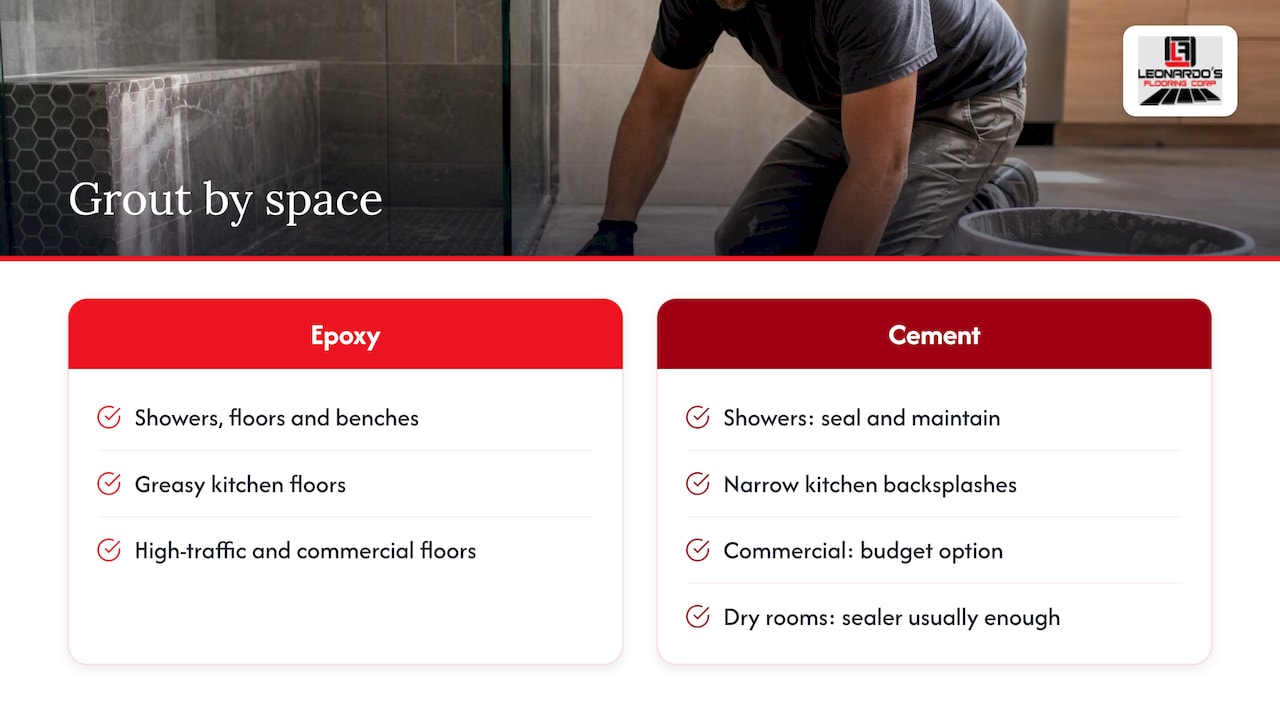
Showers and tub surrounds. Constant water and soap favor epoxy, especially on floors and benches. If you use cement, seal it and keep up with it. Also remember that grout isn’t waterproofing: the setting materials and shower assembly underneath matter more. Our piece on mastic vs thinset explains why same-day grouting is no shower pass.
Kitchen floors and backsplashes. Grease, juice and wine make epoxy attractive for floors. Backsplash joints are narrow and see less abuse, so cement can be fine there.
Entryways, mudrooms and high-traffic floors. Dirt, de-icer and constant cleaning favor epoxy. Our article on why tile suits high-traffic areas covers the tile side of that equation.
Commercial spaces. Restaurants, clinics and retail floors face frequent cleaning chemicals and heavy use, which is where epoxy earns its premium. That said, cement grout products are commonly used in commercial, light commercial, institutional and residential projects, interior and exterior, so they remain a legitimate option on a budget.
Bedrooms, living rooms and dry bathrooms. Cement grout with a good sealer is usually enough, and the savings are real.
Exterior tile. Cement grout is used outdoors as well, so it is an established choice. For patios with freeze and thaw cycles, as we get in Colorado, ask the installer for products rated for exterior use and follow the manufacturer’s instructions for the specific tile and setting material.
Quick decision guide
- Is the area wet, greasy or cleaned with strong chemicals? Lean epoxy.
- Is the joint wider than 1/8 inch and the area dry? Sanded cement is a solid, economical choice.
- Is the joint 1/8 inch or less (or glass tile)? Unsanded cement, or epoxy if the area is demanding.
- Do you want zero sealing in future? Epoxy.
- Is the budget tight and the room low-traffic? Cement, sealed properly.
- Is your installer experienced with epoxy? If not, don’t make your floor their first try.
What to check before you decide
The This Old House guide to choosing grout boils the decision down to tile material and location, joint width and moisture exposure. Add these:
- Tile type. Natural stone and some textured tiles need specific grout guidance and a test area. Check the tile maker’s recommendation.
- Joint width. Measure it. It decides sanded vs unsanded and affects how epoxy behaves.
- Color. Pick a grout color from a cured sample, not a wet one. For cement, remember color can vary as it dries.
- Substrate. Cracked or flexing subfloors crack any grout. Fix the base first.
- Schedule. Epoxy needs staged work and careful cleanup. Cement tolerates a more relaxed pace.
- Cleaning plan. Plan on a pH-neutral cleaner for cement, and follow the manufacturer’s directions for epoxy.
If you’re planning a larger project, our tile floor design ideas can help you settle layout and joint width before you choose grout. For a view of how grout differs from mortar and what each does in the assembly, this grout versus mortar overview is a handy companion.
Our perspective
Most homeowners who call us about grout have already read that epoxy is “best” and wonder whether they have to pay for it everywhere. They don’t. We would put epoxy in the places that punish cement, such as showers, kitchen floors, entries and busy commercial floors, and we’d happily grout a guest bath or a bedroom in sanded cement with a proper seal.
What we care about is that the choice fits your project: your tile, your budget, your timeline and how you actually live in the room. That is how we run every job, and it’s why we ask questions before we quote. We also think the installer matters more than the label on the bucket. A well-run cement job beats a rushed epoxy job every time, and the reverse is true when the room really calls for epoxy and the crew knows the product.
— Jim
Talk to us about your tile floor
Leonardo’s Flooring Corp has served the greater Denver area for over 10 years, handling residential and commercial tile work along with subfloor preparation, and we back it with 125+ five-star reviews. If you’re planning a new tile floor or replacing worn grout, see our tile floor installation in Denver page and tell us about the space. We’ll help you choose the grout that suits it and give you an honest quote with no surprises.
FAQ
Is epoxy grout better than cement grout?
For stain, moisture and chemical resistance, yes. Epoxy has very low absorption and doesn’t need sealing. It is also costlier and harder to install, so cement grout can be the smarter pick for dry, low-traffic rooms.
What is the downside of epoxy grout?
Cost and installation difficulty. TCNA says it can cost three to eight times as much as cement grout, and it has a short working window and demanding cleanup. Residue left on tile can be hard to remove, so an experienced installer matters.
How many years does epoxy grout last?
LATICRETE says properly applied and maintained epoxy grout can last for the life of the installation. Harsh commercial or industrial conditions, cleaning methods and heavy traffic can shorten that, so no one can promise a specific number of years.
Is epoxy grout worth the extra money?
It usually is in showers, kitchens, entries and commercial floors, where staining and cleaning are constant. In a dry bedroom or guest bath, sealed cement grout often does the job for less. Compare quotes that itemize grout and labor.
Sources
- Epoxy Mortar, Tile Council of North America
- Cement Grout for Tile Installation, TCNA
- Grout and Sealing Basics, Flooring Institute
- Grout Type Property Matrix
- A Comprehensive Guide to Grout, This Old House
- How To Choose the Right Grout for Tile Installation, This Old House
- Grout Choices for Designers, Custom Building Products
- Which Grout Is Best for My Tile?, Daltile
- Epoxy Grouts FAQ, LATICRETE