
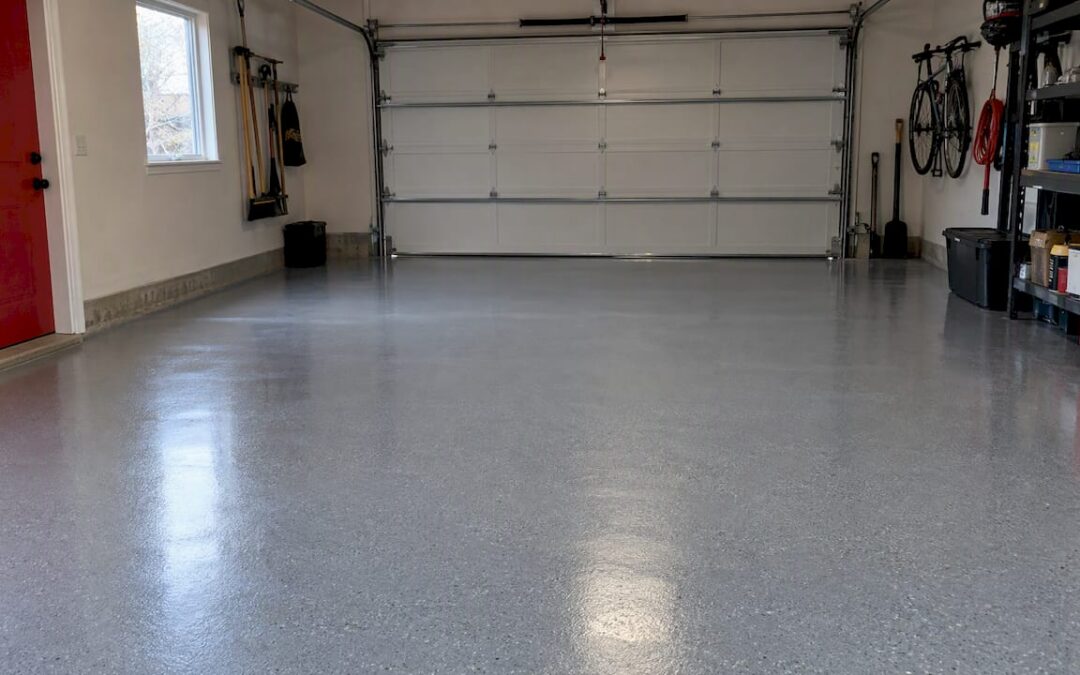
Most epoxy floor coatings are ready for light foot traffic in 12 to 16 hours, for normal use in one to three days, and for a full chemical cure in roughly 3 to 10 days. Which end of that range you get depends on the product, the temperature of the slab and the thickness of the coat. This guide covers the stages of curing, real manufacturer numbers, what slows a cure down, and how to plan a garage, basement or commercial floor around it.
TL;DR
- Epoxy cures in stages: dry to the touch, light foot traffic, heavy or vehicle traffic, then full chemical cure. Each stage has its own clock.
- At about 70°F, one widely used garage coating is ready for light foot traffic in 12 to 16 hours, and a different industrial system needs 7 to 10 days for a full chemical cure at 68°F.
- Cold slows the reaction, and below a product’s minimum temperature it can stall completely. Never fix a slow cure by changing the mix ratio.
- “5-minute” epoxy describes working time, not cure time.
- Your product’s technical data sheet beats any general rule, including the ones in this article.
Table of Contents
- Set time, dry time and cure time are not the same thing
- Typical epoxy floor cure times by stage
- What changes epoxy cure time
- Can you speed up an epoxy cure with heat?
- Ventilation: a dry floor can still be curing
- A realistic timeline for a garage floor
- Planning around cure time for commercial floors
- Our perspective: cure time is a planning problem
- Epoxy floors from Leonardo’s Flooring Corp
- What to do while the floor cures
- FAQ
- Sources
Set time, dry time and cure time are not the same thing
People use “dry,” “set” and “cured” as if they meant one thing. On a floor job they mean three, and mixing them up is how coatings get scratched, dented or peeled in their first week.
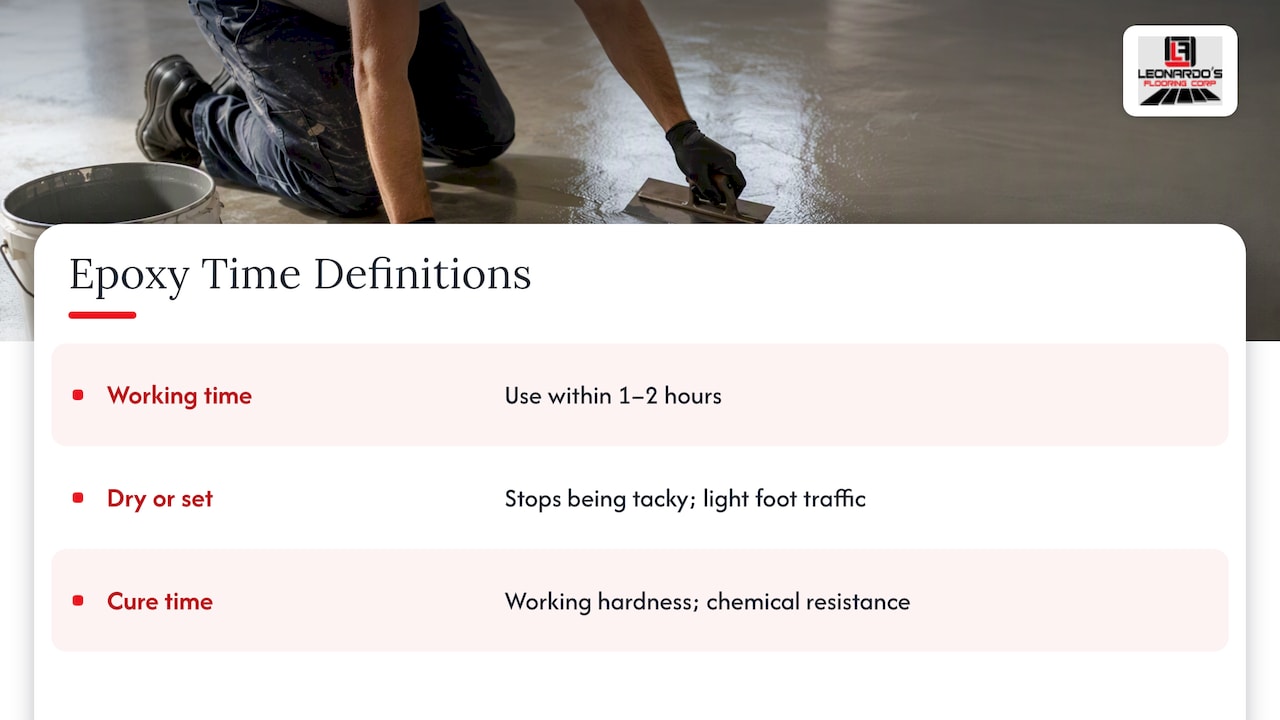
Working time (pot life) is how long you have to mix, pour and roll the material before it thickens. With water-based garage floor kits this is short: the manufacturer’s data sheet says the product must be used within 1 to 2 hours of mixing. That is a deadline for the installer, not a drying time.
Dry or set time is when the surface stops being tacky and can take light foot traffic. The coating is firm, but the chemistry is far from finished.
Cure time is how long the material needs to reach its working hardness and chemical resistance. Technical guides from epoxy makers such as West System describe the same path: mixed epoxy moves from liquid, through a gel state, to a solid. Stress or movement during that journey can compromise the bond.
The same trap shows up on small repairs. A “5-minute” epoxy sets enough to hold parts in place in minutes, but the 3M data sheet for a fast epoxy adhesive lists separate set and full-cure values, and the cure takes much longer. Read the full-cure line, not the headline number on the package.
Typical epoxy floor cure times by stage
No single number fits every product. Solvent-based, water-based and 100% solids systems behave differently, and so do thin garage coatings and thick commercial systems. The table below uses two published examples so you can see how much the ranges move.
| Stage | Water-based garage coating, about 70°F | Industrial system, about 68°F (20°C) |
|---|---|---|
| Light foot traffic | 12 to 16 hours | 12 to 16 hours |
| Normal or full traffic | 24 to 48 hours | 48 to 72 hours |
| Vehicle traffic and full cure | 3 days | 7 to 10 days for full chemical cure |
The left column comes from Rust-Oleum’s published dry-time guidance for its garage coating. The right column comes from the Sherwin-Williams ControlTech system guide, which publishes its figures in Celsius. Those are different products for different jobs, so treat the table as a spread, not a prediction for your floor.
What each stage means in practice
Light foot traffic. Socks or clean soft-soled shoes, no dragging, no spills. You can inspect the floor, but you should not move furniture or tools onto it.
Normal traffic. Regular walking, light carts, putting shelving back. Keep sharp or heavy loads off until the data sheet says otherwise.
Vehicle or heavy traffic. For garage floors, this is the stage most homeowners are waiting on. Hot tires are harder on a young coating than cold ones, so give a new floor the full time listed rather than the minimum.
Full chemical cure. This is when the coating reaches its rated chemical and abrasion resistance. Until then, avoid wet cleaning with strong cleaners, standing water and chemical spills. If you plan to put a topcoat or decorative layer on, the data sheet also gives a recoat window, and that window matters as much as the cure time.
What changes epoxy cure time
Temperature
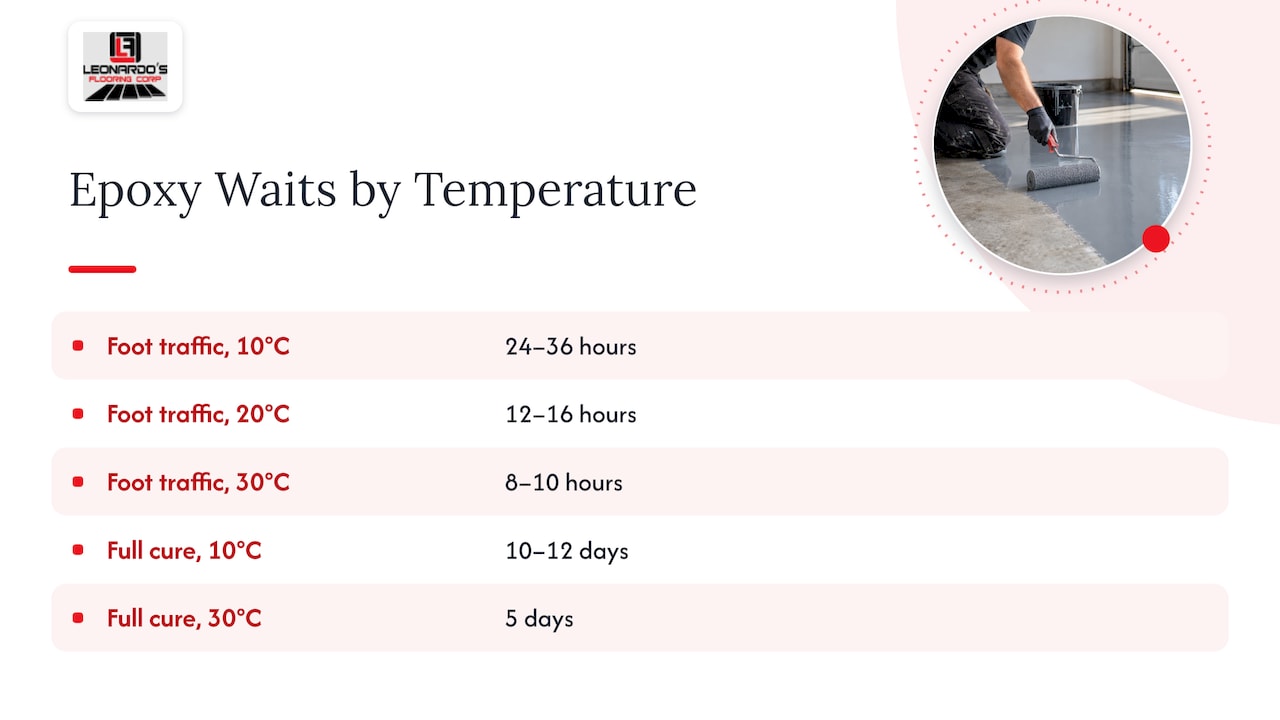
Temperature is the biggest lever. Epoxy’s own guidance is simple: cure time is shorter when the epoxy is warmer and longer when it is cooler. The Sherwin-Williams guide quantifies it for one system: foot traffic takes 24 to 36 hours at 10°C (50°F), 12 to 16 hours at 20°C (68°F) and 8 to 10 hours at 30°C (86°F). Full chemical cure falls from 10 to 12 days at 10°C to 5 days at 30°C.
That matters in Colorado, where an unheated garage or basement slab can be much colder than the air in your kitchen, especially in late fall and winter. Measure the surface temperature of the concrete, not just the room. Each product states a minimum application temperature, and a cold slab can make a one-day wait stretch into several.
Going below the minimum is not just slower
It is tempting to assume a cold floor will simply take longer and be fine in the end. Manufacturer guidance says otherwise: if conditions fall below the minimum on the data sheet, the reaction can stall, leaving a coating that stays tacky or never develops its full properties. That is a failure, not a delay, and the fix is usually grinding it off and starting over.
Humidity and dew point
Moisture is the other quiet problem. Sherwin-Williams’ data sheet for a water-based epoxy calls for the surface to sit a few degrees above the dew point so condensation does not form on the wet coating. Condensation can cause blushing, a cloudy or greasy film, and adhesion trouble. Rust-Oleum’s garage coating data sheet bases its times on 70°F and 50% relative humidity and says to allow more time when it is cooler.
Moisture also comes up through the slab. Basements are the usual suspects, which is why a moisture test belongs before any coating. Our guide to basement epoxy flooring explains what to check first.
Thickness and mass
A thick pour of mixed epoxy generates its own heat as it reacts. West System describes this exothermic effect: a large mass can run away, get very hot and shorten its working time. Installers spread the mix across the floor promptly instead of leaving it in the bucket, which is why pouring into a shallow container or onto the surface right away extends usable time. Thicker coats can also take longer to harden all the way through. If you are choosing between a thin coat and a heavier system, our page on epoxy floor thickness covers what to specify.
The mix itself
Do not tweak the ratio to speed things up. The epoxy maker is blunt about it: do not adjust cure time by altering the mix ratio, because an accurate ratio is essential to a proper cure and full physical properties. A hardener-heavy or resin-heavy batch can stay soft or turn brittle.
Can you speed up an epoxy cure with heat?
Sometimes, carefully. Heat accelerates the chemical reaction, and West System notes that on small repairs and thin applications warming can cut cure time dramatically. But it also describes the risks: thick masses can overheat, heated epoxy thins and can sag, and heating epoxy over a porous surface can push air out of the substrate and through the wet coating as bubbles. Their advice is to wait for the gel stage before adding gentle heat, per the epoxy chemistry guide.
On a floor, the safe version is boring: bring the whole space to the product’s recommended temperature before you start, and hold it there. Keep these in mind:
- Do not use unvented propane or kerosene heaters. Sherwin-Williams warns that their combustion byproducts can contaminate the surface and stop it from curing or bonding properly, per its water-based epoxy data sheet.
- Do not point a heat gun at a freshly rolled floor to “help it along.”
- Heat the space before you coat, not after problems appear.
Ventilation: a dry floor can still be curing
A floor that feels dry is not necessarily finished reacting. Many floor coating systems release vapors while they cure, and some products contain solvents. Keep the space ventilated through the whole cure period as the product label and safety data sheet direct, and keep children, pets and anyone with breathing sensitivities out of the area. If you are unsure about a product, read its safety data sheet and talk to your installer before work starts. For specific health concerns, ask your doctor.
A realistic timeline for a garage floor
Here is how a typical residential garage job tends to run when conditions are in range. Your product’s data sheet sets the real numbers.
- Day 0, prep and coat. Grinding, cleaning, crack repair, then coating. New concrete must be fully cured first: Rust-Oleum’s data sheet asks for a minimum of 28 days before coating new slabs.
- Next morning. The surface may be ready for careful light foot traffic. Resist the urge to move things back in.
- Days 2 to 3. Normal use, then vehicles, if the product and temperatures allow.
- Week 1 to 2. Avoid harsh chemicals, pressure washing and dragging heavy objects while the full cure completes.
Build a margin into your calendar. If the car has to be back in the garage on a certain date, schedule the coating several days earlier, not the day before.
Planning around cure time for commercial floors
For a business, cure time is downtime, so it belongs in the schedule from the first conversation. A shop, showroom or storage area can often be sectioned and coated in phases, with traffic rerouted. Kitchens and food areas need more care because of washdown, moisture and sanitation requirements; our guide for foodservice managers on moisture testing before epoxy floors shows why the substrate comes first. For a broader view, see commercial epoxy flooring explained for business owners and the examples of commercial epoxy floors.
Questions to settle with your contractor before the work starts:
- Which system is being used, and what are its light-traffic, full-traffic and full-cure times on the data sheet?
- What temperature will the space be held at, and who is responsible for it?
- Can the job be done in phases or over a weekend?
- When can forklifts, carts or vehicles return, and when can the floor be cleaned with normal products?
Our perspective: cure time is a planning problem
Most of the cure-time frustration we hear about comes from the same place: a floor is treated like paint, and the schedule is built around the shortest number on a label. The shortest number is usually the one for light foot traffic, and it assumes ideal temperature and humidity. The reality in the Denver area is that garages and basements swing in temperature, and slabs hold cold longer than you expect.
So we start with the property, not the product. We look at the slab, the space, the moisture and the date you need the room back, then pick a system and a schedule that fit. We would rather tell you that a floor needs a few extra days than hand it back early and watch a coating get marked up or fail. That approach comes from how we run every project: tailored to your needs, budget and timeline, with no surprises.
If a contractor promises a full cure much faster than the manufacturer’s data sheet says, ask which product they are using and to see the sheet.
— Jim
Epoxy floors from Leonardo’s Flooring Corp
We install epoxy floor coatings for homes and commercial properties across the Denver metro, and we prepare the subfloor or slab before we coat it, because prep and cure go hand in hand. If you want a floor with a schedule you can trust, look at our epoxy floor coating service in Denver, or browse all of our flooring services. For homeowners weighing a project, our Denver homeowner guide to epoxy coating is a good next step.
What to do while the floor cures
- Keep the area closed to foot traffic until the stated time, and block it off visibly.
- Keep pets, dust and debris away. Fur and grit embed in a soft surface.
- Do not wash the floor early. Water on a young coating can mark it.
- Wait for the recommended period before heavy furniture, shelving or rubber mats go back, since trapped moisture or soft coatings can leave marks.
- Check the surface in good light after a day and note anything unusual. Tacky spots after the stated time point to a mixing, temperature or moisture issue worth raising right away.
Once the floor is in service, maintenance extends its life. Our guide on epoxy floor maintenance covers cleaning habits, and if you ever see lifting or bubbling, why epoxy floors peel explains the usual causes. If you are choosing between finishes, the epoxy finishes overview compares types, and for a sun-exposed space see our note on stopping epoxy from yellowing under UV.
FAQ
How long before I can walk on an epoxy floor?
For many garage-grade coatings, light foot traffic is possible after 12 to 16 hours at about 70°F. Cooler slabs take longer: one industrial system lists 24 to 36 hours at 50°F. Check the data sheet for your product and wait longer if the floor still feels tacky.
How long does epoxy take to fully cure?
A full chemical cure typically takes about 3 to 10 days, depending on the system and temperature. A water-based garage coating lists 3 days for vehicle traffic, while one industrial system lists 7 to 10 days at 68°F. Thick or cold applications can take longer.
Does epoxy cure faster with heat?
Warmth speeds the reaction, but too much heat on a thick mass can cause a runaway reaction, and heating a fresh floor can create bubbles or sagging. The safe approach is to hold the whole space at the product’s recommended temperature. Avoid unvented fuel heaters entirely.
Is a 5-minute epoxy fully cured in 5 minutes?
No. The name refers to working time and initial set. Full strength typically takes 24 hours or longer, so follow the full-cure value on the technical data sheet.
Can I park on an epoxy floor the next day?
Usually not. Vehicle traffic is typically allowed after about 3 days for one common garage coating, and longer for other systems. Hot tires and turning wheels are tough on a young coating, so leave a margin.
Sources
- WEST SYSTEM: Epoxy chemistry basics
- WEST SYSTEM User Manual
- WEST SYSTEM: Dispensing and mixing
- Sherwin-Williams ControlTech E-M system guide
- Sherwin-Williams Resuflor WB product data sheet
- Rust-Oleum EpoxyShield water-based garage floor coating data sheet
- Rust-Oleum EpoxyShield garage floor coating dry time
- Rust-Oleum EpoxyShield solvent-based professional floor coating data sheet
- 3M Scotch-Weld epoxy adhesive technical data sheet