
Most people assume epoxy floor coating is just a tougher version of regular floor paint. It isn’t. Epoxy is a completely different category of material, and understanding that difference could save you thousands of dollars in repairs down the road. For homeowners and business owners in the Greater Denver Area, where freeze-thaw cycles, road salt, and intense UV exposure test every surface, choosing the right floor coating matters more than it does in most cities. This guide breaks down what epoxy floor coating actually is, how it’s installed, how it stacks up against other options, and what mistakes to avoid before you commit.
Table of Contents
- What is epoxy floor coating?
- How epoxy floor coatings are applied
- Epoxy vs. other flooring: What’s best for Denver?
- Common mistakes and how to avoid them
- Our approach to epoxy flooring: Lessons from Denver
- Epoxy flooring solutions for Denver homes and businesses
- Frequently asked questions
Key Takeaways
| Point | Details |
|---|---|
| Epoxy’s unique durability | Epoxy floor coating combines chemical and mechanical strength, making it ideal for high-traffic and harsh climates. |
| Proper installation is crucial | Surface preparation and moisture testing are essential to ensure longevity and prevent common failures. |
| Comparisons reveal strengths | Epoxy outperforms alternatives under Denver conditions—especially in garages and commercial spaces. |
| Local climate matters | Denver’s freeze-thaw cycles and road salt require specialized installation and maintenance for epoxy floors. |
| Professional help prevents mistakes | Expert installers help avoid errors and adapt solutions to local needs for best results. |
What is epoxy floor coating?
Epoxy floor coating isn’t paint. It isn’t a sealer. It’s a chemically engineered system. According to the National Concrete Coating Authority, an epoxy floor coating is a thermoset polymer system created by mixing epoxide resin with a polyamine or polyamide hardener. When those two components meet, they don’t just mix. They react. The chemical reaction forms a tightly cross-linked molecular network that bonds to your concrete at a structural level.
That’s the key distinction. Latex paint sits on top of concrete. Epoxy becomes part of it. The result is a surface that resists chemicals, heavy impact, abrasion, and moisture in ways that paint simply cannot match. This is exactly why hospitals, auto shops, warehouses, and now residential garages and basements across Denver have all made the switch.
Here’s a quick breakdown of epoxy’s core advantages:
- Superior adhesion to cured concrete when properly prepared
- Chemical resistance to oils, solvents, and road salt
- Mechanical strength that holds up under vehicle traffic and heavy equipment
- Easy cleaning since the non-porous surface doesn’t trap dirt or bacteria
- Aesthetic flexibility with options ranging from solid colors to metallic finishes and decorative flake systems
| Feature | Epoxy | Latex paint | Polyurethane |
|---|---|---|---|
| Adhesion to concrete | Excellent | Poor to moderate | Good |
| Chemical resistance | Excellent | Low | Moderate |
| Impact resistance | High | Low | Moderate |
| UV stability | Moderate (needs topcoat) | Low | High |
| Lifespan (with proper install) | 10 to 20 years | 1 to 3 years | 5 to 10 years |
| Cost range | Moderate to high | Low | Moderate |
Denver’s climate puts floors through more stress than most people realize. Epoxy’s molecular network is what keeps it bonded when road salt migrates through a garage slab or when a Colorado winter sends temperatures swinging 40 degrees in a single day. That cross-linked structure isn’t just chemistry. It’s protection.
If you’re exploring the epoxy floor coating process for your home or business, understanding this foundation helps you set realistic expectations and ask the right questions when getting quotes.
How epoxy floor coatings are applied
Understanding the structure leads to how these coatings are actually installed, which is where their durability is made or broken. A proper epoxy job is more than just rolling on a product. It’s a multi-step installation process that demands precision at every stage. Skipping even one step is the most common reason Denver floors fail within the first two years.
Here’s how a professional installation breaks down:
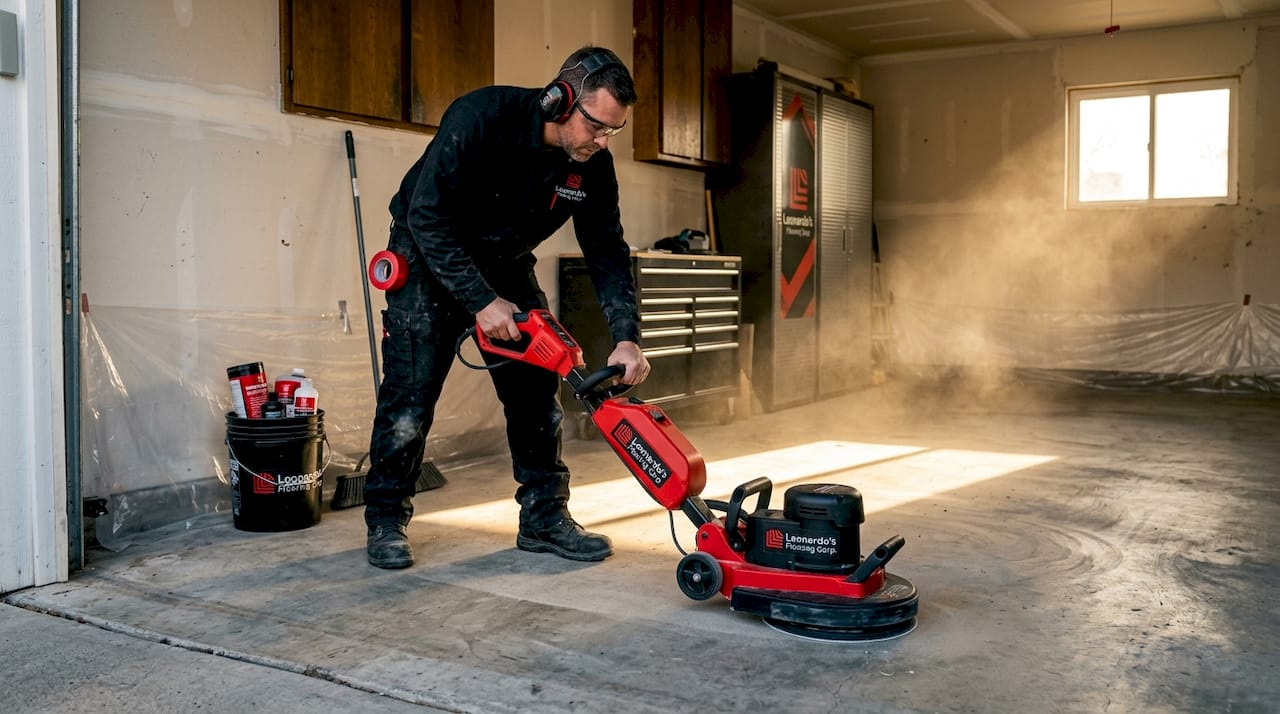
- Surface preparation. The concrete must be cleaned, degreased, and profiled. According to industry standards, surface prep to ICRI CSP 2-5 is required, which means shot blasting, diamond grinding, or acid etching. This creates the microscopic texture epoxy needs to grip.
- Moisture testing. Concrete breathes. If moisture vapor moves through the slab at a rate above the coating’s tolerance, the epoxy will delaminate. ASTM moisture testing sets thresholds: an MVER below 3 to 5 lbs per 1,000 sq ft per 24 hours, or relative humidity below 75 to 80 percent.
- Crack and joint repair. Any cracks, spalls, or joints are patched before coating begins. This prevents the coating from telegraphing damage or cracking along existing weak points.
- Primer coat. A penetrating primer is applied to seal the surface and further strengthen adhesion.
- Base coat. The main epoxy coat is applied at the correct mix ratio, typically 2:1 or 3:1 resin to hardener, with an induction time allowed before application.
- Decorative broadcast (optional). Colored flakes or quartz aggregate can be broadcast into the wet base coat for texture and appearance.
- Topcoat. A clear or tinted topcoat, often polyaspartic or polyurethane, seals the surface and adds UV protection and gloss.
Curing is not optional, and it’s not fast. According to research, foot traffic is safe after 24 hours, vehicle traffic after 72 hours, and full cure takes 7 days. Driving on an uncured floor can cause permanent damage to the surface.
Pro Tip: Never let vehicle tires sit on epoxy that’s less than 72 hours old, and even then, avoid parking hot tires on the surface for the first week. Hot rubber can literally lift the coating. This is especially relevant for Denver drivers who run their vehicles hard in cold morning starts.
Proper subfloor preparation in Denver is one of the biggest determinants of how long your floor lasts. A beautifully applied topcoat over a poorly prepped surface will fail in months, not years. When you understand the epoxy floor coating steps, you can hold any contractor accountable for doing the job right.
Epoxy vs. other flooring: What’s best for Denver?
Once you know how epoxy is applied, it’s helpful to compare it to other popular flooring choices in Denver homes and businesses. Epoxy isn’t always the best answer. It depends entirely on the space, the use, and the conditions.
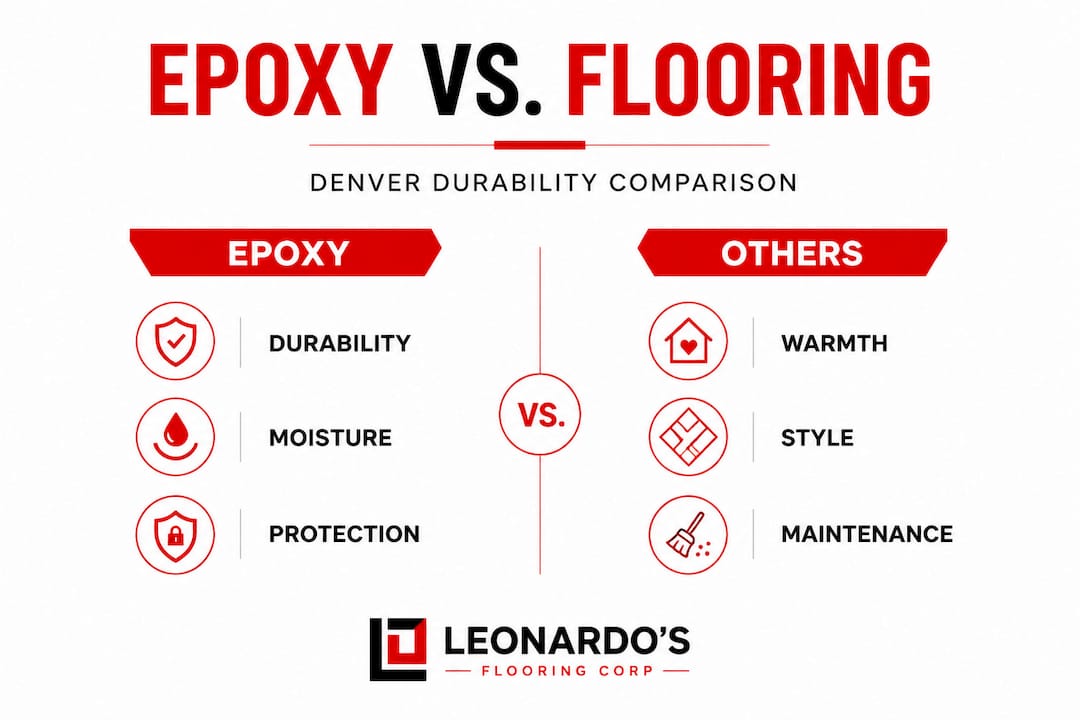
| Flooring type | Durability | Moisture resistance | Aesthetic range | Maintenance | Best use case |
|---|---|---|---|---|---|
| Epoxy | Excellent | Excellent | High (flake, metallic) | Low | Garages, warehouses, basements |
| Tile | Very good | Very good | Very high | Moderate | Kitchens, bathrooms, entryways |
| Hardwood | Moderate | Poor | Very high (natural) | Moderate to high | Living rooms, offices |
| Laminate | Good | Moderate | High | Low to moderate | Bedrooms, living areas |
| Vinyl | Good | Excellent | High | Low | Multi-purpose, wet areas |
Denver specifically adds a few wrinkles to this comparison. The city sits at 5,280 feet, gets over 300 days of sunshine per year, and experiences some of the most dramatic freeze-thaw cycles in the country. On top of that, the city spreads magnesium chloride (MgCl) road salt aggressively during winter months. That salt migrates into garages on tires and boots, and it’s corrosive.
Poorly installed epoxy in Denver shows its failure modes in specific ways. Research on Denver freeze-thaw and road salt failures points to these as the most common:
- Delamination from moisture trapped beneath the coating
- Osmotic blistering when moisture vapor pushes up through uncured concrete
- Hot tire pickup where soft or incompletely cured epoxy bonds to rubber
- UV yellowing and chalking on floors with no UV-stabilizing topcoat
- Edge peeling where the coating wasn’t properly feathered or terminated
This is where materials like laminate flooring or tile sometimes make more sense for living spaces. Hardwood adds warmth and resale value to areas where aesthetics matter more than chemical resistance. And vinyl flooring holds up well in high-moisture areas where epoxy’s prep requirements create scheduling complexity.
The point isn’t that epoxy always wins. It’s that epoxy wins in the right setting, when installed correctly. Explore all your Denver flooring options before you decide.
Common mistakes and how to avoid them
Comparing flooring types highlights epoxy’s advantages, but to maximize those benefits, avoiding common local mistakes is essential. We’ve seen floors that looked great on installation day and looked terrible 18 months later. In almost every case, the failure traced back to one of four avoidable mistakes.
- Skipping or rushing surface preparation. This is the number one cause of epoxy failure. Shot blasting and diamond grinding aren’t optional upgrades. They’re the foundation of everything that follows. Surface contamination, old paint, or a smooth concrete profile will prevent bonding no matter how good the product is.
- Ignoring the moisture test. Denver slabs, especially in older homes, often have moisture issues. Applying epoxy over a slab with excessive vapor transmission causes osmotic blistering and delamination. The ASTM test costs very little compared to a full recoat.
- Rushing the curing process. This happens constantly in commercial settings where business owners want their space back fast. Driving on or loading a floor before it reaches proper cure causes damage that can’t be spot-repaired cleanly.
- Skipping the UV-protective topcoat. Denver gets intense solar radiation at altitude. An epoxy base coat without a UV-stabilizing topcoat will yellow noticeably within one to two seasons. The color change is cosmetic, but it signals degradation in the coating’s performance too.
Pro Tip: Always insist on a ASTM moisture test before any epoxy installation quote is finalized. If a contractor skips this step and prices the job without it, that’s a red flag. The cost of a failed floor far exceeds the cost of doing the test.
If problems do occur after installation, the fix depends on timing and severity. Blistering caught early can sometimes be addressed with patch repairs, but widespread delamination almost always requires full removal and reinstallation. Getting proper subfloor preparation right the first time is far more cost-effective than fixing a failed coating.
For more guidance before your project starts, review flooring installation tips that apply across all flooring types in Denver’s climate.
Our approach to epoxy flooring: Lessons from Denver
Here’s an opinion that might surprise you: not every floor needs epoxy, and not every epoxy failure is a product failure.
After more than a decade of installing floors across the greater Denver metro area, we’ve come to a conclusion that most generic epoxy guides won’t say out loud. The product is rarely the problem. The process is. And local conditions demand a level of process rigor that DIY guides and out-of-state contractors consistently underestimate.
Generic advice says to prep the surface. Local experience says that Denver garages, especially those built in the 1970s through the 1990s, often have slabs that were poured with minimal vapor barriers. That means moisture readings come back high even in dry months. We’ve walked away from jobs and told homeowners to address the slab first, because putting epoxy over a bad foundation just creates an expensive problem to fix later.
Generic advice says to apply a topcoat. Local experience says Denver’s UV index regularly hits 10 or above in summer, which is extreme by any standard. A standard clear epoxy topcoat degrades faster here than it would in, say, Houston or Chicago. We specify UV-stabilized polyaspartic topcoats on every Denver project because we’ve seen what happens when you don’t.
And sometimes, after walking a space and talking through how a homeowner actually uses it, the honest answer is that epoxy isn’t the right material. A bedroom, a dining room, a home office: these spaces often call for hardwood, laminate, or luxury vinyl. Epoxy belongs where performance is the priority over warmth and natural aesthetics.
Our local epoxy expertise is built on having these honest conversations. Combined with specialized subfloor preparation work that accounts for Denver’s specific slab conditions, we make sure floors are built to actually last here, not just look good on installation day.
Epoxy flooring solutions for Denver homes and businesses
If this article has moved you from curious to ready, the next step is a real conversation about your space, your budget, and your timeline.

Leonardo’s Flooring Corp has been serving Denver homeowners and businesses for over 10 years, and our 125+ five-star reviews reflect how we work: honestly, carefully, and without cookie-cutter approaches. Whether you need Denver epoxy flooring for a garage, a commercial warehouse, or a basement renovation, we tailor every project to your actual conditions. Need hardwood in a living space while the garage gets epoxy? We handle that too, with hardwood flooring installation and laminate flooring installation across the full Denver metro. Contact us to get a quote and find out exactly what your floor needs to perform for years, not months.
Frequently asked questions
How long does epoxy floor coating last in Denver homes?
Epoxy floors can last 10 to 20 years with proper installation and maintenance, but Denver’s freeze-thaw cycles and road salts may shorten this without UV-protective topcoats. Choosing the right system from the start makes the biggest difference in longevity.
Can epoxy floors handle Denver’s freeze-thaw cycles?
Epoxy performs well through freeze-thaw cycles when installed with correct surface prep and moisture testing, but poor prep or moisture issues make these cycles highly destructive to the coating. Professional installation that accounts for Denver’s specific climate is the safest path.
What maintenance do epoxy floors require?
Epoxy floors need occasional cleaning with a pH-neutral cleaner and periodic recoating to maintain UV and salt protection, especially in high-traffic garage spaces. Most well-installed epoxy floors need a topcoat refresh every five to seven years under normal use.
Is epoxy floor coating safe for homes with kids or pets?
Once fully cured at the seven-day mark, epoxy is safe and non-toxic for children and pets. The cross-linked molecular structure is inert after curing, and any installation fumes dissipate completely well before full cure is reached.
Recommended
- Epoxy Floor Coating in Denver, CO | Leonardo’s Flooring Corp
- Colorado Hardwood Flooring: Complete Installation Guide
- Subfloor Preparation Services in Denver, CO | Leonardo’s Flooring Corp
- Vinyl Flooring Installation in Denver, CO | Leonardo’s Flooring Corp
- Epoxy Floor Coating & Court Surfaces | Pinnacle Pavement Solutions