
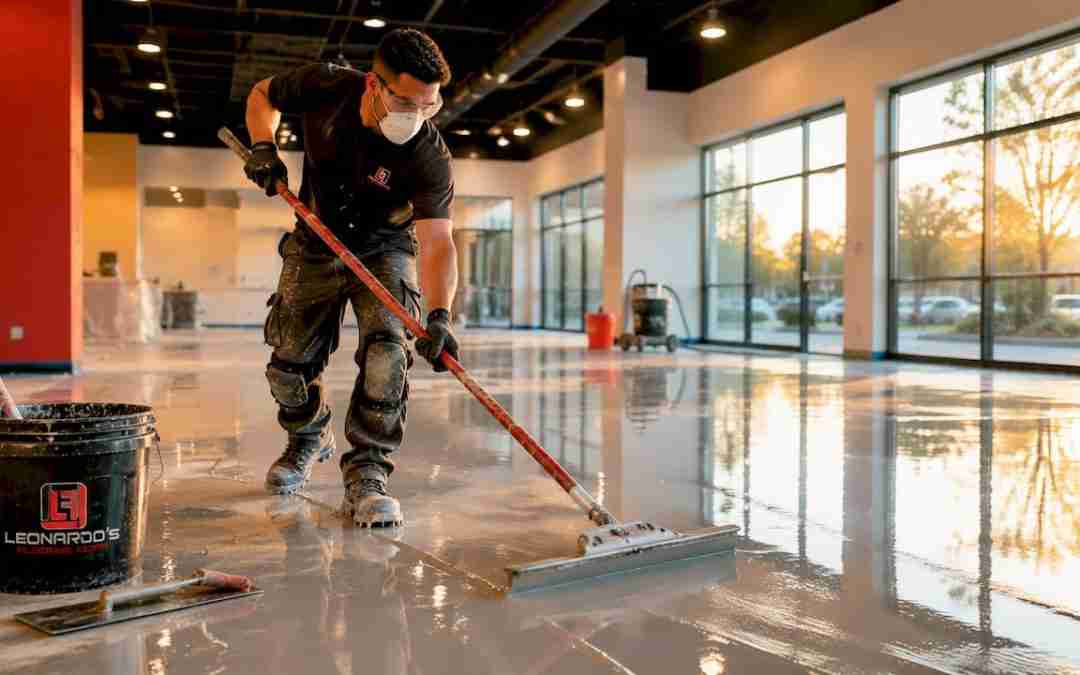
Commercial epoxy flooring is defined as a two-part coating system made from epoxy resin and a chemical hardener that bonds directly to concrete to form a seamless, durable surface. When the resin and hardener mix, they trigger a chemical reaction that creates a cross-linked polymer network far stronger than the concrete beneath it. The industry term for this product is “epoxy floor coating,” though property owners and business managers commonly search for what is commercial epoxy flooring explained. This guide covers composition, benefits, installation, comparisons with other commercial flooring options, and maintenance so you can make a confident decision for your facility.
What is commercial epoxy flooring and why does it matter?
Commercial epoxy flooring is a high-performance coating applied over concrete in facilities that face heavy use, chemical exposure, or strict hygiene requirements. It differs from residential epoxy kits in one critical way: thickness. Commercial systems range from 10 mils to over 250 mils, while residential kits typically top out at 12 mils. That extra thickness translates directly into longer service life and greater resistance to impact and abrasion.
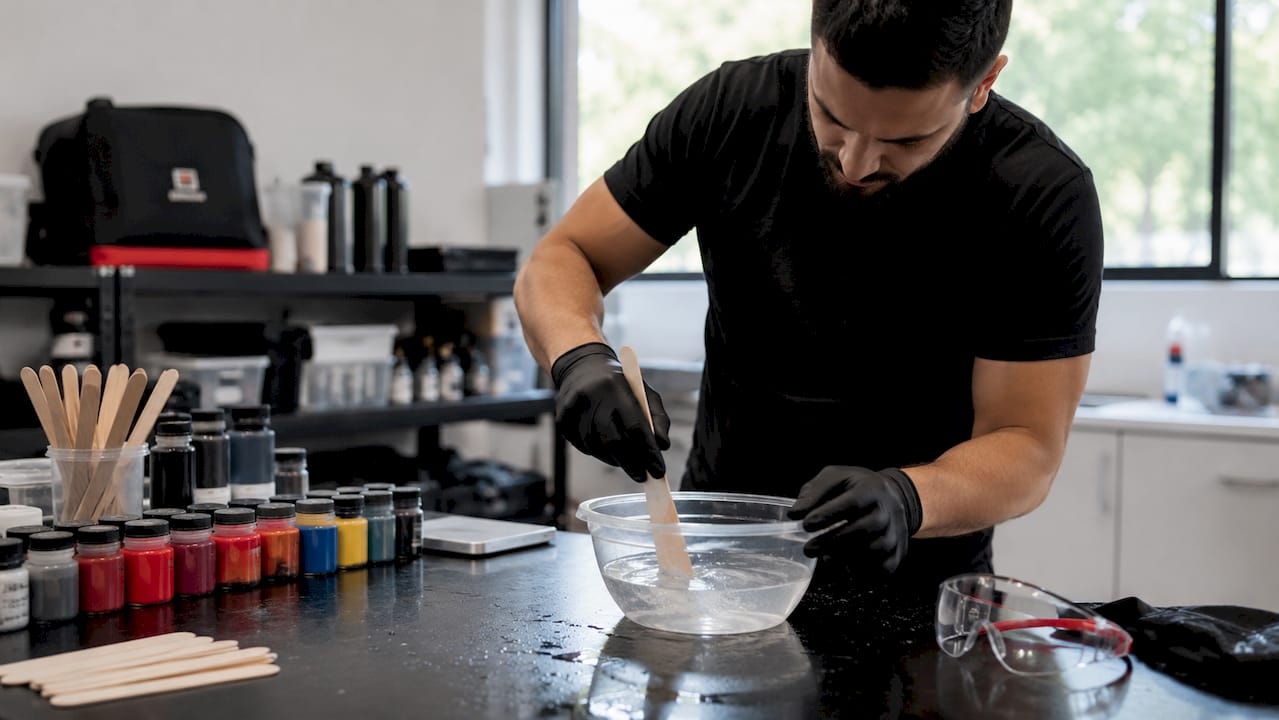
The chemistry behind the product is straightforward. Epoxy resin and a hardener are kept separate until application. Once mixed and spread over profiled concrete, they react and cure into a rigid, non-porous surface. That surface resists moisture, chemicals, and physical stress in ways that paint or standard concrete sealers cannot match.
For property owners evaluating commercial flooring options, epoxy coating stands out because it addresses durability, hygiene, and aesthetics in a single system. No other common commercial floor type does all three at the same price point.
What are the key benefits of commercial epoxy floors?
The advantages of epoxy floors fall into four clear categories: durability, chemical resistance, ease of maintenance, and design flexibility.
Durability that outlasts the competition
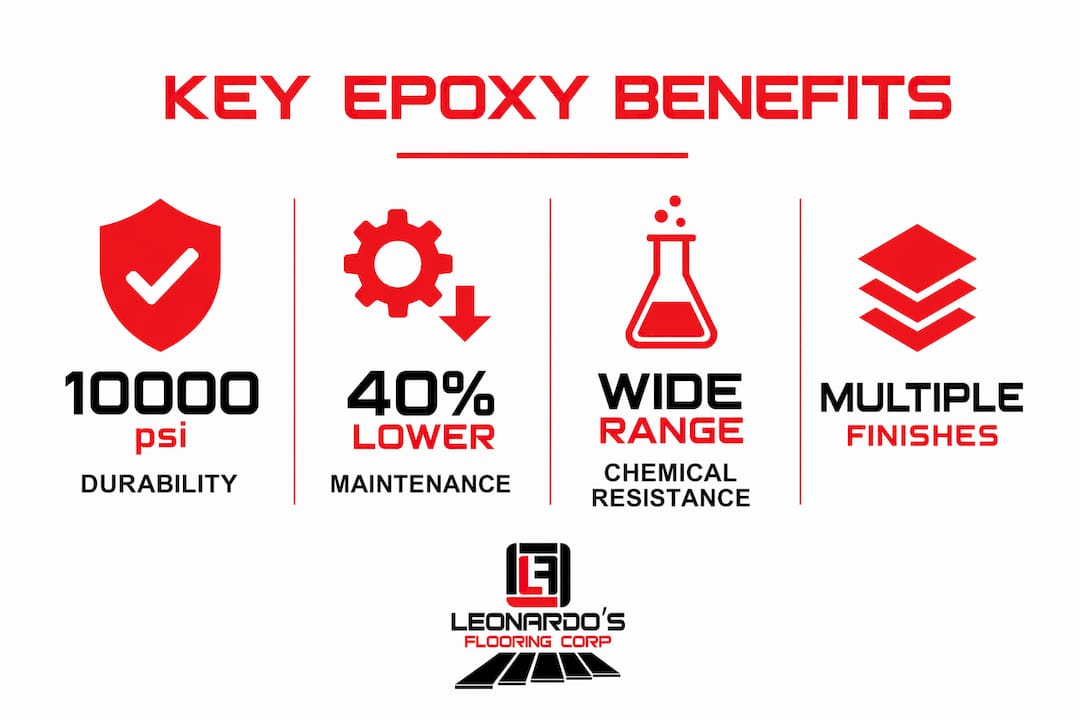
High-grade industrial epoxy reaches compressive strengths up to 10,000 psi. That means the concrete substrate will crack before the coating does. Forklifts, pallet jacks, and heavy foot traffic leave no lasting mark on a properly installed system.
Chemical resistance across a wide range
Epoxy is highly resistant to oils, acids, and industrial cleaning agents. Facilities that deal with chemical spills, automotive fluids, or aggressive sanitizers benefit most from this property. Tile grout and vinyl seams absorb these substances over time. Epoxy does not.
Low maintenance costs
Epoxy flooring can reduce lifecycle maintenance costs by up to 40% compared to vinyl or tile by eliminating strip-and-wax cycles. That saving compounds over a 10 to 20 year service life. For a facility manager running a large square footage, the budget difference is significant.
Aesthetic flexibility
Epoxy systems come in solid colors, metallic finishes, broadcast flake patterns, and custom graphics. Retail showrooms and corporate lobbies use decorative epoxy to create polished, branded environments without sacrificing floor performance. You can review epoxy finish types to match the right look to your space.
Pro Tip: Add a UV-stable topcoat if your space gets direct sunlight. Standard epoxy yellows under UV exposure, and a clear urethane or polyaspartic topcoat prevents that discoloration without adding significant cost.
How is commercial epoxy flooring installed?
Installation quality determines whether your floor lasts 5 years or 20. The process is not complicated, but each step is non-negotiable.
- Concrete surface profiling. Diamond grinding or shot blasting opens the concrete pores and creates a mechanical profile for the epoxy to grip. Skipping this step is the single most common cause of premature delamination.
- Moisture and contamination testing. Residual oils, curing compounds, or moisture vapor will prevent adhesion. A calcium chloride test or relative humidity probe identifies moisture levels before any product is applied.
- Primer coat application. A low-viscosity primer penetrates the profiled concrete and establishes the chemical bond. A standard commercial system uses at minimum a primer and a topcoat, though demanding environments add a base coat and decorative broadcast layer between them.
- Base coat and optional decorative layers. The base coat builds thickness and structural performance. Decorative aggregates like quartz or vinyl flake are broadcast into the wet base coat at this stage.
- Topcoat application. The topcoat seals the surface, adds gloss or matte finish, and determines chemical and abrasion resistance. Polyurethane and polyaspartic topcoats outperform standard epoxy topcoats in UV stability and scratch resistance.
- Curing time. Most commercial epoxy systems require 24–72 hours before light foot traffic and up to 7 days before heavy equipment returns to the floor.
Pro Tip: Schedule installation during mild weather. Epoxy does not cure correctly below 50°F or above 90°F. In Denver, spring and fall installations avoid the temperature extremes that cause bubbling or slow curing.
How does commercial epoxy compare to other flooring options?
| Flooring Type | Durability | Chemical Resistance | Maintenance Cost | Slip Resistance | Typical Lifespan |
|---|---|---|---|---|---|
| Commercial epoxy | Very high | Excellent | Low | Requires additives | 10–20+ years |
| Vinyl tile (VCT) | Moderate | Low to moderate | High (strip/wax) | Good | 5–10 years |
| Ceramic tile | High | Good | Moderate (grout) | Good | 10–20 years |
| Polished concrete | High | Low | Low | Low | 10–20 years |
| Carpet tile | Low | Poor | High | Good | 5–8 years |
Epoxy wins on chemical resistance and lifecycle maintenance cost against nearly every alternative. Ceramic tile matches epoxy on durability but requires grout maintenance that becomes a hygiene liability in food service or medical environments. Polished concrete costs less upfront but offers no chemical protection without a sealer.
The one area where epoxy requires attention is slip resistance. Smooth epoxy finishes are not inherently slip-resistant. Adding quartz aggregate or aluminum oxide to the topcoat solves this problem and brings the floor into OSHA compliance for wet environments. Temperature sensitivity is another real limitation. Temperatures outside the typical operating range cause epoxy to crack or delaminate, so cold storage facilities and commercial kitchens near open flames need specialized systems.
What industries and facilities use epoxy flooring most?
Epoxy floor coating appears across a wide range of commercial and industrial settings because the core properties, durability, chemical resistance, and hygiene, apply to many different problems.
- Warehouses and distribution centers. Forklift traffic, pallet drops, and heavy racking loads demand a floor that resists impact and abrasion. Epoxy handles all three while keeping the surface bright enough to improve lighting efficiency.
- Manufacturing facilities. Chemical spills, machine oil, and thermal cycling are daily realities. Epoxy systems rated for chemical exposure protect the concrete substrate and reduce slip hazards from fluid accumulation.
- Hospitals and medical laboratories. Seamless surfaces eliminate grout lines where bacteria collect. Epoxy floors in these environments are typically finished with antimicrobial topcoats and meet strict hygiene standards.
- Automotive service centers and garages. Oil, brake fluid, and transmission fluid break down most floor coatings quickly. Epoxy resists all three and cleans up with a mop and mild detergent.
- Retail showrooms and commercial lobbies. Decorative metallic or flake epoxy systems create high-end visual appeal at a fraction of the cost of polished stone. You can see real commercial epoxy examples across these settings to understand what is achievable.
- Food and beverage processing. FDA-compliant epoxy formulations resist food acids and sanitizing chemicals while providing the seamless, cleanable surface required by health codes.
What are maintenance practices and lifespan expectations?
Properly installed commercial epoxy floors last 10 to 20 years in demanding environments with routine maintenance. That lifespan assumes correct surface preparation at installation and consistent upkeep afterward.
- Daily cleaning. Sweep or auto-scrub to remove grit. Grit acts as an abrasive under foot traffic and accelerates surface wear faster than chemical exposure does.
- Wet mopping. Use a mild, pH-neutral detergent. Avoid bleach-based cleaners at full concentration and strong solvents, which degrade the topcoat over time.
- Spot repairs. Address chips or worn areas before moisture penetrates. A small patch repair costs far less than a full recoat.
- Periodic recoating. High-traffic zones may need a fresh topcoat every 5 to 7 years even when the base coat remains intact. Recoating is faster and cheaper than full removal and reinstallation.
- Avoid thermal shock. Pouring boiling water or steam-cleaning directly on cold epoxy causes micro-cracking. Allow the floor to reach ambient temperature before wet cleaning after a cold night.
The most common causes of early failure are inadequate surface preparation, moisture vapor transmission from below the slab, and thermal shock. All three are preventable with proper planning before installation begins.
Key Takeaways
Commercial epoxy flooring delivers the best combination of durability, chemical resistance, and low maintenance cost among common commercial flooring options when installed correctly over properly prepared concrete.
| Point | Details |
|---|---|
| Two-part resin system | Epoxy resin and hardener react to form a surface stronger than the concrete beneath it. |
| Thickness determines performance | Commercial systems run 10–250 mils, far exceeding residential kits and delivering greater durability. |
| Surface prep is non-negotiable | Diamond grinding or shot blasting is required for proper adhesion and long-term performance. |
| Maintenance costs drop significantly | Epoxy can cut lifecycle maintenance costs by up to 40% compared to vinyl or tile flooring. |
| Slip resistance requires additives | Quartz or aluminum oxide must be added to the topcoat for safe traction in wet conditions. |
What I’ve learned after years of commercial epoxy installations
The number one mistake I see property owners make is treating surface preparation as optional. They get a competitive bid, the installer skips the grinder, and the floor delaminates within 18 months. The chemistry is unforgiving. If the concrete pores are not open and clean, the epoxy has nothing to bond to. Every dollar saved on prep costs three dollars in repairs.
The second thing I tell every business manager: match the system to the environment, not to the budget. A light-duty two-coat primer and topcoat works fine in a retail showroom. Put that same system in a food processing plant and it fails within a year from chemical exposure and thermal cycling. Specify the right mil thickness and the right topcoat chemistry for your actual conditions.
Slip resistance is the detail most people ignore until someone falls. Smooth epoxy looks great in photos but becomes dangerous when wet. I always recommend broadcasting aluminum oxide or fine quartz into the topcoat on any floor that sees water, cleaning chemicals, or outdoor foot traffic. The texture is barely visible and the safety benefit is real.
The ROI case for epoxy is strong when you run the full numbers. Lower maintenance costs, a 10 to 20 year service life, and no strip-and-wax cycles add up. The upfront cost of $4 to $12 per square foot for professional installation looks very different when spread across two decades of use. For most commercial properties, epoxy is not the cheapest floor to install. It is the cheapest floor to own.
— Jim
Professional epoxy flooring services in Denver
Leonardosflooringcorp has installed commercial epoxy floors across the Denver metro for over 10 years, handling everything from warehouse floors to retail showrooms. Every project starts with a proper site assessment, concrete moisture testing, and a system recommendation matched to your specific traffic and chemical exposure.

Whether you need a basic two-coat system for a commercial office or a heavy-duty broadcast floor for a manufacturing facility, Leonardosflooringcorp builds the specification around your space, not a standard package. Our epoxy floor coating services cover the full process from surface prep through final topcoat, with no subcontractors and no surprises. Contact us for a free consultation and estimate on your commercial flooring project.
FAQ
What is commercial epoxy flooring made of?
Commercial epoxy flooring is made from two components: epoxy resin and a chemical hardener. When mixed and applied to profiled concrete, they react to form a rigid, non-porous surface.
How long does commercial epoxy flooring last?
Properly installed commercial epoxy floors last 10 to 20 years in demanding environments with routine maintenance. High-traffic zones may need a topcoat refresh every 5 to 7 years within that lifespan.
How much does commercial epoxy flooring cost per square foot?
Professional commercial epoxy flooring installation typically costs between $4 and $12 per square foot. The final price depends on system thickness, decorative layers, and topcoat type.
Is epoxy flooring slippery?
Smooth epoxy finishes are not inherently slip-resistant. Adding quartz aggregate or aluminum oxide to the topcoat provides safe traction and brings the floor into compliance for wet commercial environments.
What causes commercial epoxy flooring to fail early?
The most common cause of premature failure is inadequate surface preparation, including residual moisture, oils, or improper concrete profiling. Thermal shock and the wrong system specification for the environment are the next most frequent causes.