
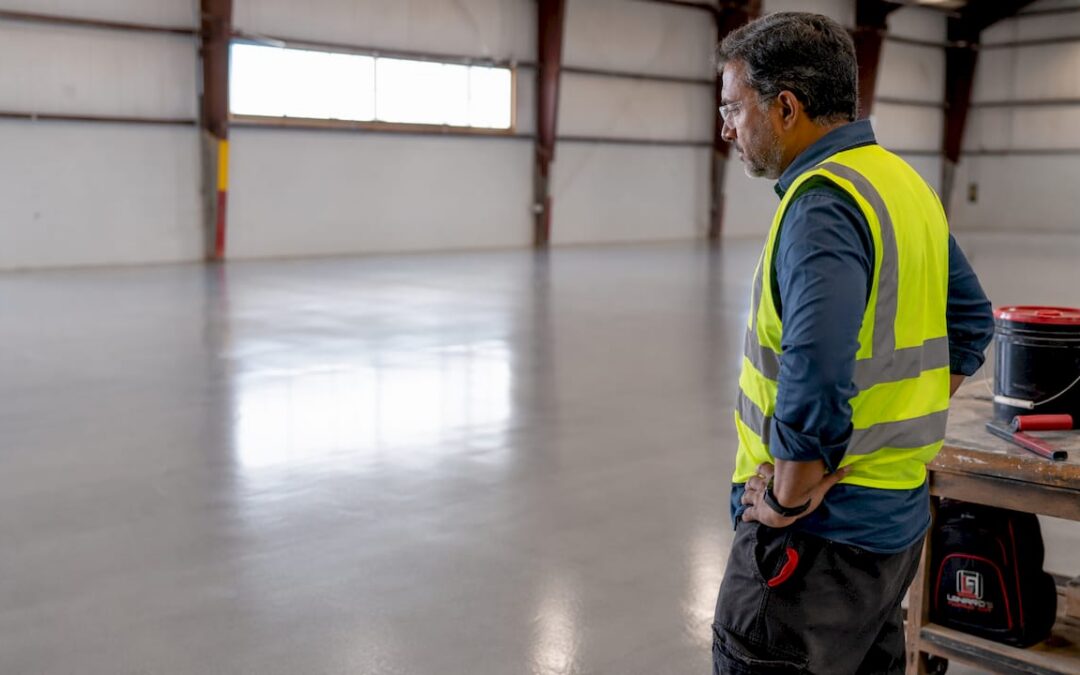
Commercial floors need protective coatings because uncoated concrete and flooring substrates deteriorate fast under real commercial conditions. Heavy foot traffic, forklift loads, chemical spills, and daily cleaning cycles strip away surface integrity in ways that cost far more to repair than to prevent. A properly specified coating system does several things at once:
- Shields the substrate from abrasion, impact, and chemical penetration
- Creates a sealed surface that resists staining and moisture intrusion
- Adds slip resistance through anti-slip aggregates like aluminum oxide or quartz
- Reduces maintenance frequency, labor hours, and chemical use
- Extends floor lifespan by years, sometimes decades, compared to bare concrete
- Improves light reflectivity, which can lower lighting costs in large facilities
- Supports regulatory compliance in food service, healthcare, and pharmaceutical environments
High-performance coatings demonstrate significantly lower total lifecycle costs over ten years compared to uncoated or frequently waxed floors. That single fact drives most of the decision-making for facility managers who think in budget cycles rather than square footage.
What commercial floor coatings actually are
Commercial floor coatings are protective performance layers applied directly over existing concrete or flooring substrates. They are not paint, and they are not the same as residential floor finishes sold in big-box stores. A true commercial coating is a multi-component system, typically a resin and hardener combination, that chemically bonds to the substrate and cures into a hard, durable surface.
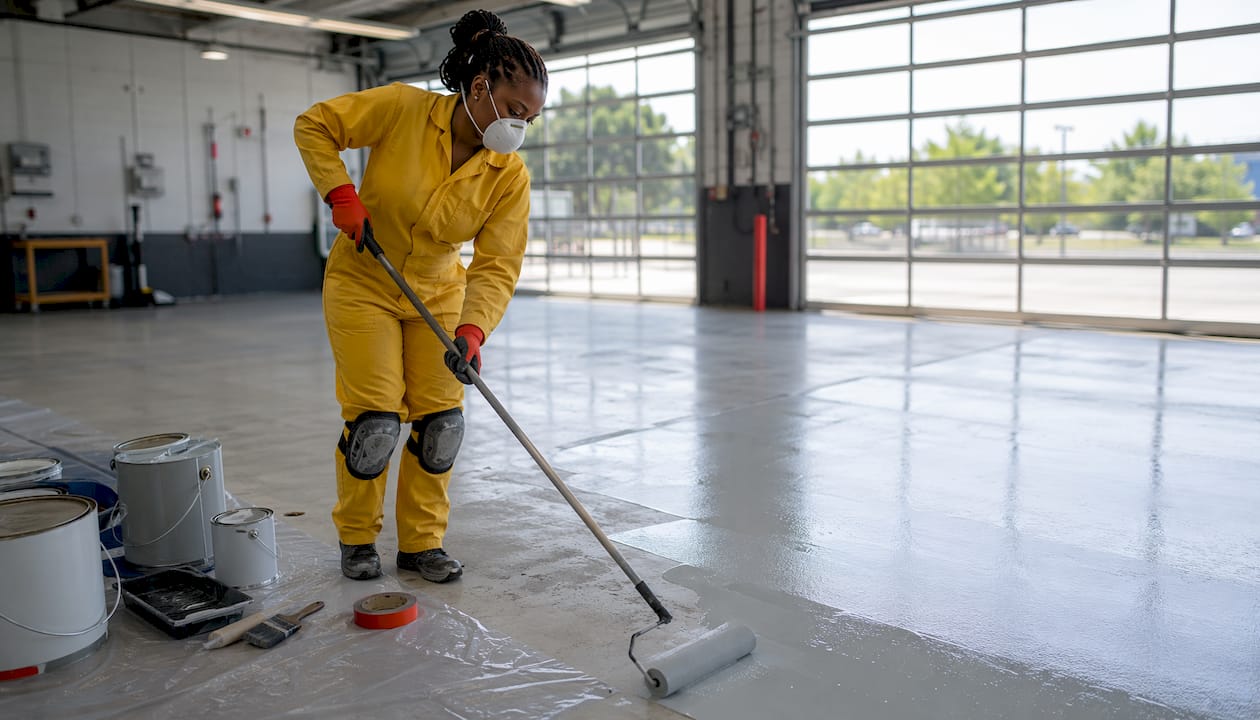
The most common base materials are epoxy, polyurethane, polyaspartic, and urethane cement, each with distinct chemistry and performance characteristics. These systems are applied at film thicknesses that residential products never reach. Commercial systems often exceed 40–80 mils, while a residential garage kit runs 10–20 mils. That thickness difference is what separates a floor that holds up under forklift traffic from one that peels within a year.
Surface preparation is required before any coating goes down. Without it, the coating has nothing to bond to. The substrate must be profiled, cleaned, and tested for moisture before application begins. Skip that step and the coating fails, regardless of product quality.
Key benefits of applying protective coatings to commercial floors
The core case for coating commercial floors comes down to durability, cost, and safety. Those three categories cover most of what facility managers actually care about.
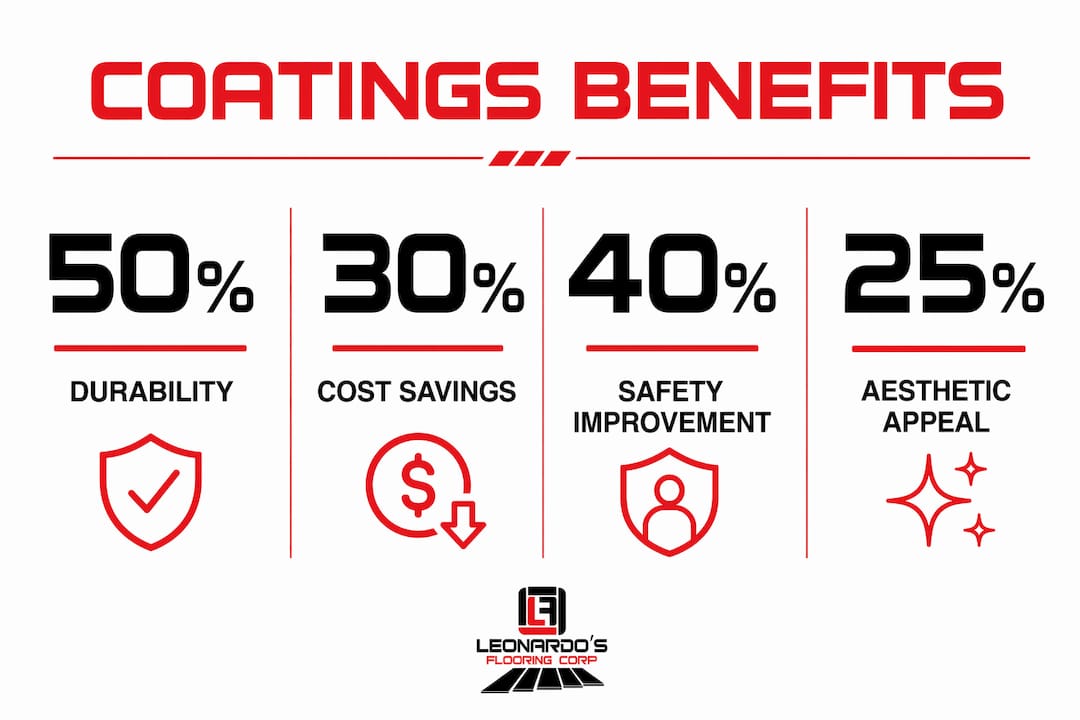
Durability and resistance. Coatings protect against abrasion from foot traffic and wheeled equipment, impact from dropped tools or pallets, and chemical attack from spills, cleaning agents, and process fluids. Bare concrete absorbs all of that damage directly. A coated floor takes the hit on the coating, which is far cheaper to reapply than to replace a damaged slab.
Cost reduction. High-performance coatings reduce floor maintenance frequency, labor, chemical use, and facility downtime while improving appearance and safety. Fewer stripping cycles, less waxing, and longer intervals between major maintenance events add up quickly across a large facility.
Safety. Anti-slip coatings reduce slip and fall accidents, which matters for both OSHA compliance and occupant wellbeing. Clear traffic zone markings, embedded in the coating system, reduce collision risk in warehouses and manufacturing floors.
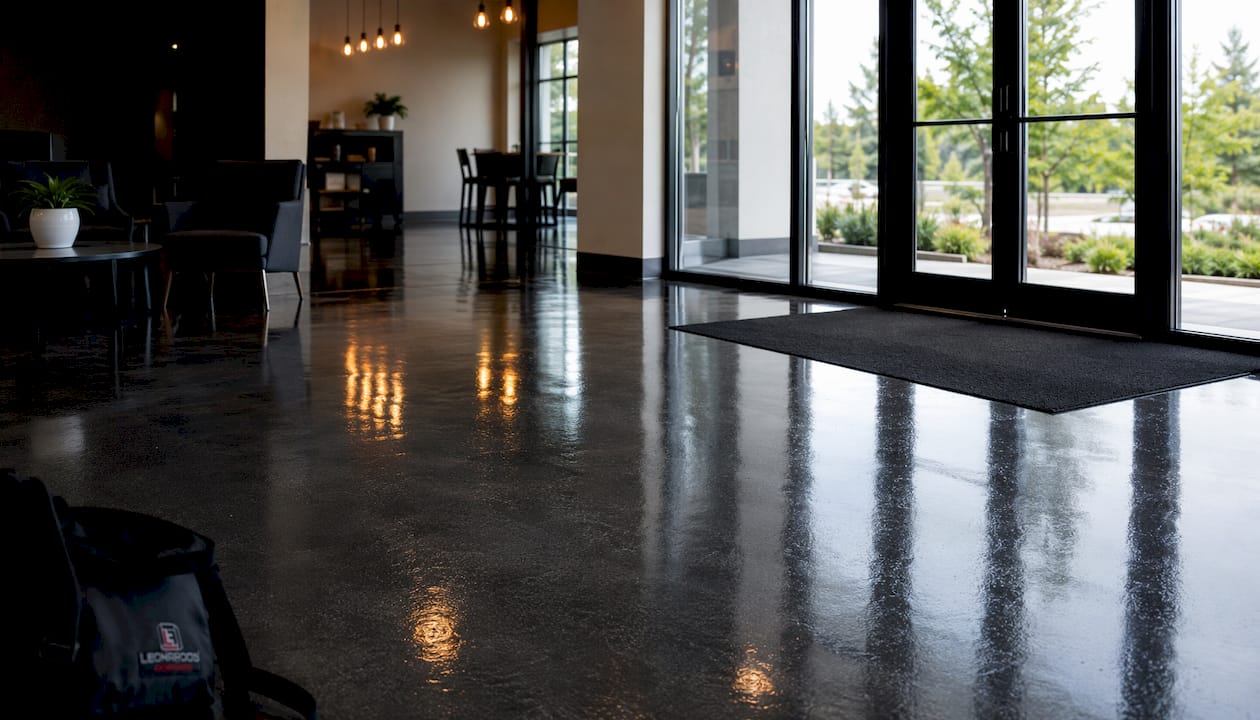
Aesthetics and professionalism. A sealed, uniform floor surface reads as clean and well-maintained to clients, inspectors, and employees. That perception has real operational value in retail, healthcare, and office environments.
Environmental responsibility. Low- and zero-VOC coatings improve indoor air quality and minimize environmental impact, aligning with LEED certification and green building goals.
Quick reference for facility managers:
- Reduced stripping and waxing cycles
- Lower long-term labor and chemical costs
- Slip resistance meeting OSHA walking surface requirements
- Improved appearance retention with routine cleaning
- Compliance support for food service, pharmaceutical, and healthcare environments
- Potential energy savings from light-reflective surfaces
What coating types are used in US commercial facilities?
The four primary coating families cover the vast majority of commercial applications. Choosing the wrong one for the environment is the most common and most expensive mistake in commercial floor specification.
| Coating Type | Typical Lifespan | Best Environment | Key Strength |
|---|---|---|---|
| Epoxy | 7–15 years | Warehouses, light manufacturing, retail | Chemical resistance, adhesion, compressive strength |
| Polyurethane | — | Exterior surfaces, UV-exposed areas | UV stability, color retention, flexibility |
| Polyaspartic | 10–15 years | Commercial, light industrial | Fast cure, UV resistance, abrasion performance |
| Urethane Cement | 20–30+ years | Food processing, commercial kitchens, breweries | Thermal shock resistance, moisture tolerance |
| MMA | — | Retail, healthcare, cold storage | 1–2 hour cure time, low-temperature application |
| Acrylic Sealer | — | Low-traffic areas, temporary protection | Low cost, easy application |
Epoxy is the workhorse of commercial flooring. It bonds well to properly prepared concrete, handles most chemical exposures, and provides strong compressive strength for forklift traffic. The limitation: epoxy requires UV-stable topcoats outdoors to prevent chalking and yellowing. For warehouse and distribution applications, a two-coat epoxy system with a polyurethane or polyaspartic topcoat is the standard specification.
Polyurethane coatings offer flexibility and UV resistance that epoxy lacks. They are most often used as topcoats over epoxy base systems, combining the adhesion strength of epoxy with the weathering performance of urethane. Aliphatic polyurethanes outperform aromatic formulations in UV-exposed settings.
Polyaspartic coatings cure in two to four hours, even at low temperatures. That fast return-to-service makes them practical for facilities that cannot tolerate extended downtime. UV stability and abrasion resistance are comparable to polyurethane. The trade-off is somewhat lower chemical resistance than epoxy or urethane cement, so they are not the right call for chemically aggressive environments.
Urethane cement is the premium choice for food processing plants, commercial kitchens, breweries, and pharmaceutical facilities. It handles thermal shock, steam cleaning, and aggressive sanitation chemicals that would cause standard epoxy to delaminate. The cementitious bonding mechanism resists moisture-vapor drive that defeats other systems. It costs more, but it is the correct specification for those environments.
MMA (methyl methacrylate) cures in one to two hours and can be applied at temperatures as low as -20°F, making it the go-to for cold storage facilities and overnight installations in retail or healthcare. Chemical resistance is moderate, and the strong odor during application requires effective ventilation.
For a deeper look at epoxy coating systems and how they match to specific commercial environments, Leonardosflooringcorp covers the full breakdown.
Signs that your commercial floor coating needs reapplication
Catching coating failure early saves money. Waiting until the substrate is damaged means the repair scope expands from a recoat to a full restoration.
- Visible cracking or peeling: The coating is losing adhesion. If left alone, moisture and contaminants reach the substrate.
- Surface dullness or discoloration: UV degradation or chemical attack has broken down the topcoat. The protective layer is thinning.
- Increased staining: A sealed coating repels spills. When stains start penetrating, the seal is compromised.
- Reduced slip resistance: Anti-slip aggregates wear down over time. A floor that once met OSHA friction requirements may no longer.
- Bubbling or blistering: Moisture vapor is transmitting through the slab. This usually indicates the coating was applied over an inadequately tested substrate, or the system has reached end of life.
- Visible concrete showing through: The coating has worn through entirely in high-traffic zones. Recoating at this stage requires more prep work than catching it earlier.
Routine inspections, quarterly in high-traffic facilities and annually in lower-demand environments, catch these signs before they become substrate problems. Facility consultants generally recommend documenting surface condition at each inspection to track degradation rate and plan recoating budgets accurately.
Expert perspective on maintenance and lifecycle costs
Protective coatings act as sacrificial wear layers, absorbing the daily abuse that would otherwise degrade the substrate. That framing changes how facility managers should think about maintenance budgets. The coating is not a permanent installation. It is a replaceable layer that protects a much more expensive asset underneath.
Matching the coating system to the facility’s exposure profile, including chemicals, thermal shock, and moisture conditions, is the single most important decision in the specification process. A system that performs well in a dry warehouse will fail in two to three years in a food processing plant with daily steam cleaning. The product is not defective. It was simply never designed for that environment.
Lifecycle cost models show that premium coating systems can deliver 15–30% lower total costs over a ten-year period compared to standard coating systems, when extended repaint cycles, reduced labor, and lower disruption costs are included. That math favors investing in the right system upfront rather than choosing the lowest bid.
Pro Tip: When facility downtime is the controlling constraint, specify polyaspartic or MMA systems. Fast-cure coatings reduce downtime significantly compared to traditional epoxy systems, which require 24–72 hours before light traffic and five to seven days before full forklift loads.
Warranty coverage in commercial coatings typically covers material defects only. Workmanship failures and substrate moisture issues fall outside most warranties. Professional installation with documented moisture testing is the only way to protect against those failure modes.
Where commercial floor coatings are most commonly applied
Commercial coatings work across a wide range of facility types, and the environment dictates the system. Warehouses and distribution centers need epoxy mortar systems that handle constant forklift traffic and point loads. Food processing plants and commercial kitchens require urethane cement for thermal shock resistance and sanitation compliance. Retail spaces and auto dealerships often use polyaspartic systems for their fast cure and clean appearance. Healthcare facilities and pharmaceutical manufacturing need seamless, nonporous surfaces that resist microbial growth and meet FDA or USDA requirements.
Stone and natural material floors in high-traffic commercial settings follow similar protective logic, where sealing and coating extend surface life and reduce maintenance costs. Office buildings and schools typically use lighter-duty systems focused on appearance retention and slip resistance rather than chemical or thermal resistance. The coating type follows the use case, not the other way around.
Surface preparation requirements before coating application
Inadequate surface preparation is the leading cause of coating failure, not product quality. The concrete must be mechanically profiled to at least ICRI CSP 3 to give the coating enough surface area to bond. Shot blasting is the standard method for most commercial work. Diamond grinding works for lighter-duty applications.
Before any coating goes down, the slab needs moisture vapor transmission testing. ASTM F1869 calcium chloride testing or ASTM F2170 relative humidity probe testing are the industry-standard methods. High moisture-vapor emission rates require either a moisture-mitigation primer system or a coating specifically designed to tolerate moisture drive. Skipping this step is the most predictable way to produce a bubbling, delaminating floor within months of installation.
Cracks and joints need repair before coating. Contamination from oils, silicones, or previous coatings must be removed completely. Any of these issues left unaddressed will compromise adhesion regardless of how good the coating product is. A qualified flooring contractor will assess all of these variables before specifying a system, not after.
Common application problems and how to avoid them
Most commercial coating failures trace back to three root causes: inadequate surface preparation, moisture vapor transmission, and system misspecification.
Adhesion failure (peeling and delamination) almost always points to prep. Contamination, insufficient mechanical profile, or unresolved moisture vapor transmission prevent the coating from bonding to the slab. The coating did not fail. The preparation did. Requiring shot blasting to ICRI CSP 3 or higher and documented moisture testing before any coating work begins eliminates most of this risk.
Bubbling and pinholes result from outgassing, where moisture vapor transmits through the slab and creates pressure under a freshly applied coat. A moisture-blocking primer in high-MVT environments prevents this. No primer means no protection against it.
Premature wear usually signals a mismatch between the specified system and actual use. A decorative broadcast floor is not rated for heavy forklift traffic. A thin epoxy in a food plant with daily steam cleaning will fail in two to three years. Specifying to actual load and traffic conditions, not aesthetics or budget alone, is the only way to avoid this outcome.
Temperature and humidity during application matter more than most facility managers realize. Applying coatings outside the manufacturer’s specified temperature and humidity range causes adhesion problems, extended cure times, and surface defects. Scheduling coating work during appropriate weather conditions or controlling the facility environment during application prevents these issues.
Key Takeaways
Protective coatings are the most cost-effective way to extend commercial floor lifespan, reduce maintenance costs, and maintain safety compliance across demanding facility environments.
| Point | Details |
|---|---|
| Coatings protect the substrate | They absorb abrasion, chemical attack, and impact that would otherwise damage the concrete slab directly. |
| Lifespan varies by coating type | Urethane cement lasts 20–30+ years in harsh environments; epoxy runs 7–15 years in standard commercial settings; polyaspartic systems last 10–15 years with UV resistance. |
| Surface prep determines success | Inadequate profiling to ICRI CSP 3+ is the leading cause of coating failure, not product quality. |
| Match system to environment | Thermal shock, chemical exposure, and moisture conditions must drive coating selection before cost does. |
| Premium systems cost less long-term | Lifecycle cost models show 15–30% lower total costs over ten years compared to standard coating systems. |