

A floor installation warranty is a written guarantee from your installing contractor that covers defects in the labor quality of your floor installation for a defined period. It is separate from the manufacturer’s product warranty, which covers material defects. Together, these two documents form the full protection picture for your flooring investment.
Here is what a floor installation warranty typically covers:
- Uneven surfaces or poorly prepared subfloors
- Gaps between planks or tiles caused by installer error
- Lifting, buckling, or shifting from improper adhesive application
- Misaligned transitions or improperly fitted stair nosing
- Seams separating due to faulty installation technique
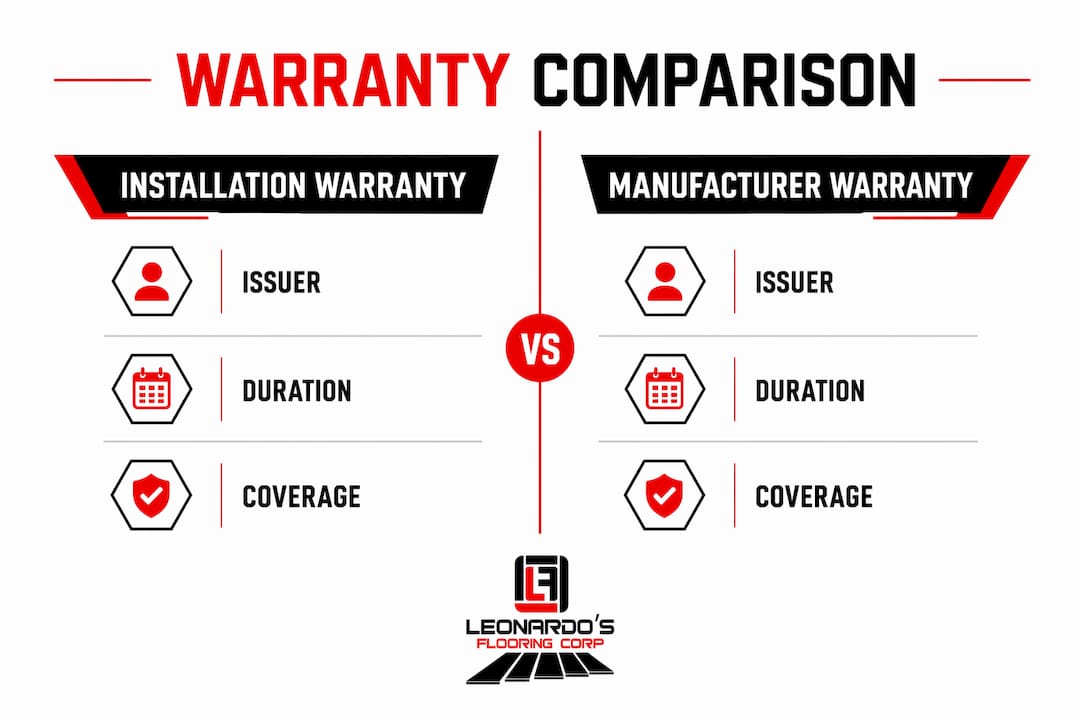
The contractor, not the manufacturer, issues this warranty. Installer workmanship warranties typically last 1–5 years, while manufacturer product warranties range from 5 years to a lifetime depending on the product.
What is the difference between an installation warranty and a manufacturer warranty?
These two warranties cover mutually exclusive failure modes, and confusing them is one of the most common reasons homeowners get a claim denied. Flooring warranties split into manufacturer product warranties covering material defects and installer workmanship warranties covering labor defects.
The manufacturer warranty covers:
- Delamination or finish failure from production errors
- Excessive surface wear under rated traffic conditions
- Dimensional instability caused by material flaws
The installer workmanship warranty covers:
- Improper adhesive application or subfloor prep failures
- Gapping or cupping caused by installation error
- Subfloor irregularities the installer failed to correct
Each warranty is governed by a different legal framework. Manufacturer warranties fall under the Magnuson-Moss Warranty Act (15 U.S.C. §§ 2301–2312), the federal baseline for written consumer product warranties. Installer warranties are governed by state contractor licensing law. When a floor fails, the first question is always: was this a product defect or an installation defect? The answer determines which party you call.
Pro Tip: Many manufacturers require professional installation to keep their product warranty valid. If you install flooring yourself, the burden of proof shifts to you to demonstrate that any defect is product-related, not installation-related. That is a difficult case to make without documented moisture tests and subfloor records.
What does a floor installation warranty cover, and what does it exclude?
Coverage and exclusions define the real value of any warranty document. Knowing both before installation saves you from surprises later.
Typical coverage under an installation warranty:
- Adhesive failures or loose pieces caused by installer error
- Uneven floors from inadequate subfloor preparation
- Gapping or seam separation due to improper technique
- Repair of transitional moldings installed incorrectly
Common exclusions:
- Damage from owner misuse, neglect, or improper cleaning agents
- Environmental damage from flooding, pipe leaks, or excessive humidity
- Heavy furniture damage, castor chairs without pads, or pet damage
- Casualty events typically covered by homeowners insurance
- Fading from sunlight exposure over time
Technical installation standards carry serious weight here. Subfloor flatness tolerances, defined by manufacturers, are a common warranty condition for hard surface products. Moisture testing per ASTM F2170 and ASTM F710 standards is another. Missing documented moisture tests before installation is one of the fastest ways to void coverage on both the product and workmanship side.
Duration at a glance: Workmanship warranties from installers run 1–5 years. Manufacturer product warranties range from 5 years to a lifetime. A vinyl flooring product with a 25-year residential warranty still depends on a properly documented installation to make that coverage stick.
How to protect your floor installation warranty
Documentation is the foundation of any successful warranty claim. Without it, you have no way to prove what was done, when, and by whom.
Keep these records from day one:
- Installation receipts and proof of purchase
- Batch and lot numbers from flooring packaging
- Written warranty documents from both installer and manufacturer
- Moisture test results and subfloor inspection records
- Photographs of the finished installation at completion
Retain installation receipts and lot numbers along with written warranties to prove defect cause and support any claim. If a dispute arises months later, these documents are the difference between an approved claim and a denial.
Choosing the right installer matters just as much as the paperwork. Installer workmanship warranties can become unenforceable if the contractor goes out of business, so assessing installer reputation and longevity before you sign a contract is critical. A company with 10-plus years of local history and verifiable reviews is a far safer bet than an unknown crew offering the lowest bid.

The typical claims process works like this: you document the defect with photos and a written description, notify the warrantor within the notice period stated in your agreement, and request an inspection. The National Wood Flooring Association (NWFA) maintains inspector certification programs used widely in residential dispute resolution. The inspector’s report determines whether the failure is a product defect, an installation defect, or owner-caused damage, and the remedy follows from that finding.
Pro Tip: Ask your contractor for their warranty terms in writing before work begins, not after. A contractor who hesitates to provide a written workmanship warranty is telling you something about how they stand behind their work. For proper floor installation in Colorado’s climate, written documentation is non-optional.
Quick reference: key warranty facts
- A floor installation warranty covers labor defects; the manufacturer warranty covers material defects. These are separate documents with separate claims processes.
- Common covered issues include adhesive failures, uneven subfloors, and gapping from installer error.
- Common exclusions include owner misuse, environmental damage, pet damage, and failure to follow maintenance instructions.
- Workmanship warranties typically run 1–5 years; manufacturer warranties range from 5 years to a lifetime.
- Professional installation is often required to keep the manufacturer warranty valid.
- Keeping thorough documentation, receipts, lot numbers, moisture test records, and written warranty papers, is the single most important step a homeowner can take.
- Contractor reputation directly affects whether a workmanship warranty is enforceable at all.
How to evaluate and compare your warranty coverage options
Not all warranty packages are equal, and the differences matter most when something goes wrong.
| Factor | Manufacturer Warranty | Installer Workmanship Warranty |
|---|---|---|
| Issuer | Product manufacturer | Installing contractor |
| Coverage trigger | Material or finish defect | Labor or installation defect |
| Typical duration | 5 years to lifetime | 1–5 years |
| Governed by | Magnuson-Moss Warranty Act | State contractor licensing law |
| Inspection authority | Manufacturer-designated | Contractor or neutral inspector |
| Transferable? | Usually no | Usually no |
When evaluating your coverage, focus on three things. First, read the installation requirements in the manufacturer warranty before the job starts. If the spec calls for a moisture barrier, a specific adhesive, or a minimum acclimation period, those are warranty conditions, not suggestions. Second, confirm your installer’s warranty is in writing and covers the specific failure modes you care about: subfloor prep, adhesive application, and seam quality. Third, consider the installer’s track record. A reputable flooring contractor with documented local history gives you a warranty that is actually enforceable.
For specialty applications like epoxy floor coatings or radiant heat flooring, warranty terms vary significantly by product type. Thermal expansion requirements and moisture thresholds differ from standard hard surface installations, so reviewing those terms before installation begins is worth the extra time.
One more consideration: commercial and residential warranties are not interchangeable. Installing a product outside its rated use classification, such as using a residential-grade laminate in a high-traffic commercial corridor, voids the manufacturer warranty regardless of how well the installation was done.
Leonardosflooringcorp has served the Denver metro for over 10 years, installing hardwood, laminate, vinyl, tile, and epoxy floors for homeowners and businesses across Colorado. Every installation comes with a written workmanship warranty, and the team follows manufacturer installation guidelines on every job to keep both warranties valid.

Ready to protect your flooring investment from day one? Explore professional hardwood installation from Leonardosflooringcorp, or browse the full range of flooring installation services for Denver homeowners and businesses.
Key Takeaways
A floor installation warranty and a manufacturer product warranty are legally separate documents that cover different failure modes and require different claims processes.
| Point | Details |
|---|---|
| Two separate warranties | Installation warranty covers labor defects; manufacturer warranty covers material defects. |
| Typical warranty durations | Workmanship warranties run 1–5 years; manufacturer warranties range from 5 years to a lifetime. |
| Documentation is critical | Keep receipts, lot numbers, moisture test records, and written warranty papers to support any claim. |
| Installer reputation matters | Workmanship warranties can become unenforceable if the contractor goes out of business. |
| Professional installation required | Many manufacturers require professional installation to keep their product warranty valid. |