
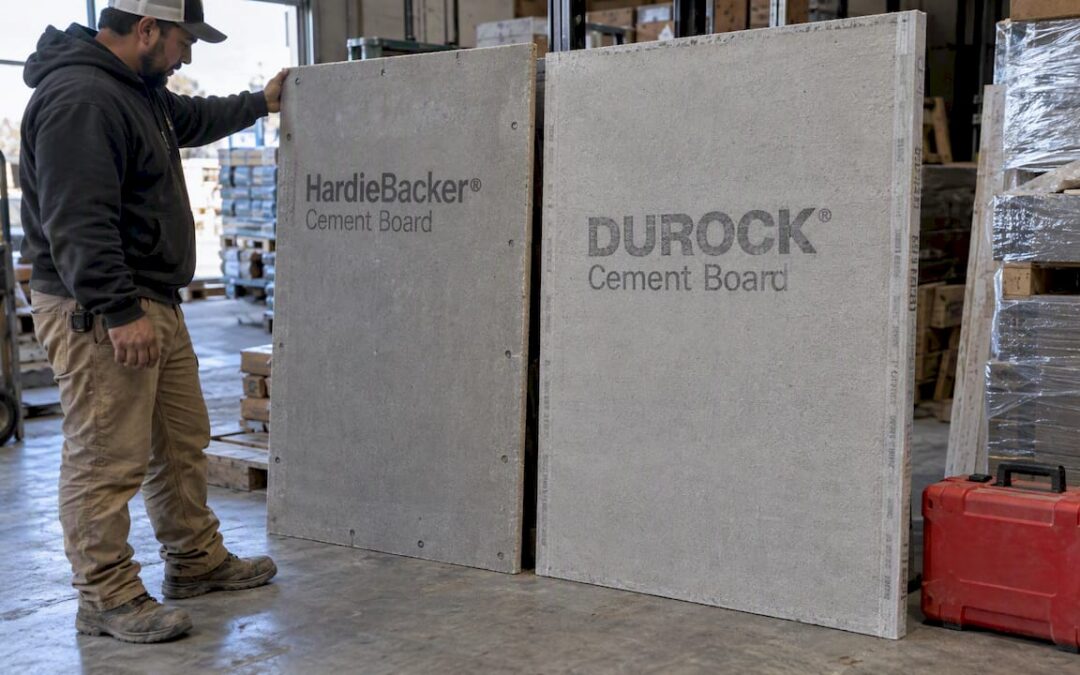
Both boards are cement-based tile backers, and both work under tile when they are installed correctly. HardieBacker is a fiber-cement board that is easier to cut and comes in thinner options for floors. Durock is a glass-mesh-reinforced cement board with tough edges, rated for interior wet areas and exterior use. Neither is waterproof on its own. The better choice depends on where the board goes, how much height your floor can spare, and who is cutting and fastening it.
Below we compare the two on the points that matter in a real tile job, then explain how we think about the decision on Denver-area projects.
TL;DR
- HardieBacker is made of cellulose fibers and cement. Contractors often pick it for its rigidity and clean score-and-snap cuts, and James Hardie recommends 1/4-inch board for most floors.
- Durock has a Portland cement core wrapped in polymer-coated glass-fiber mesh. Its EdgeGuard edges resist crumbling, and USG warrants it for interior and exterior use.
- Neither board is a waterproof layer. In a shower, USG says a separate barrier goes over or behind Durock, and the same logic applies to any cement board.
- Price is close. Home Depot lists 1/2-inch HardieBacker at $1.17 per square foot and 1/2-inch Durock at $1.06, so cost should not decide it.
- Installation matters more than the brand. Joints, fasteners, mortar bedding and a sound subfloor decide whether the tile lasts.
Table of Contents
- What each board is made of
- HardieBacker vs Durock at a glance
- Thickness and floor height
- Cutting, handling and fastening
- Drawbacks and installation challenges
- Which board for a tile floor
- Showers and wet areas
- Cost: what the price difference means
- Perspective: how we choose on a job
- Let us handle the tile base and the tile
- FAQ
- Sources
What each board is made of
The two products look alike on the rack, but they are built differently.
HardieBacker is made from cellulose fibers layered with cement slurry and cured through high-pressure autoclaving, with additives to inhibit mold growth, according to Fine Homebuilding’s backerboard comparison. James Hardie says the board is recognized as non-combustible when tested to ASTM E136.
Durock has an aggregated Portland cement core wrapped in polymer-coated, glass-fiber mesh, per the same Fine Homebuilding comparison. USG’s Durock with EdgeGuard is described as a Portland cement tile backerboard for floors, walls, countertops, tub and shower areas, with edges designed to prevent spinout and crumbling.
In practice, that means:
- HardieBacker has no glass mesh to cut through, so it behaves like a dense, stiff panel.
- Durock’s mesh skin gives it a texture and cutting feel closer to drywall, and the reinforced edges take fasteners well.
HardieBacker vs Durock at a glance
| Factor | HardieBacker | Durock |
|---|---|---|
| Maker | James Hardie | USG |
| Construction | Cellulose fibers and cement, autoclaved | Portland cement core with polymer-coated glass-fiber mesh |
| Floor guidance | 1/4-inch board recommended for floors unless 1/2-inch is needed for a transition | Cement board for floors, walls, countertops, showers and exterior systems |
| Edge feature | Moisture-resistant board, mold-inhibiting additives | EdgeGuard edges resist crumbling |
| Wet-area waterproofing | Separate membrane needed | Separate barrier needed |
| Contractor reputation | Valued for rigidity | Valued for cutting like drywall |
| 1/2-inch price at Home Depot | $1.17 per sq. ft. | $1.06 per sq. ft. |
Prices come from Home Depot’s cement board listings and change, so confirm current numbers before you budget.
Thickness and floor height
On a floor, thickness is often the deciding factor, because every layer you add changes where the finished surface lands against hallways, doorways and appliances.
James Hardie recommends 1/4-inch HardieBacker for floors unless you need 1/2-inch thickness to make a transition, and it describes the 0.42-inch board as resistant to moisture damage. A thinner board helps when you are matching an adjacent floor, clearing a door swing or keeping a dishwasher in its opening.
That height also touches trim. Thicker assemblies change how baseboards and quarter-round meet the tile, and we cover that in our guide to fitting baseboards with tile floors. If your project includes new trim, plan the build-up before you buy the board.
Cutting, handling and fastening
There is no consensus among tile contractors on the best backerboard, and Fine Homebuilding’s survey of options says materials vary in water resistance, weight and ease of cutting. Some contractors favor HardieBacker for its rigidity. Others prefer Durock because it cuts beautifully and is close to Sheetrock.
Here is what that means on the job.
Cutting
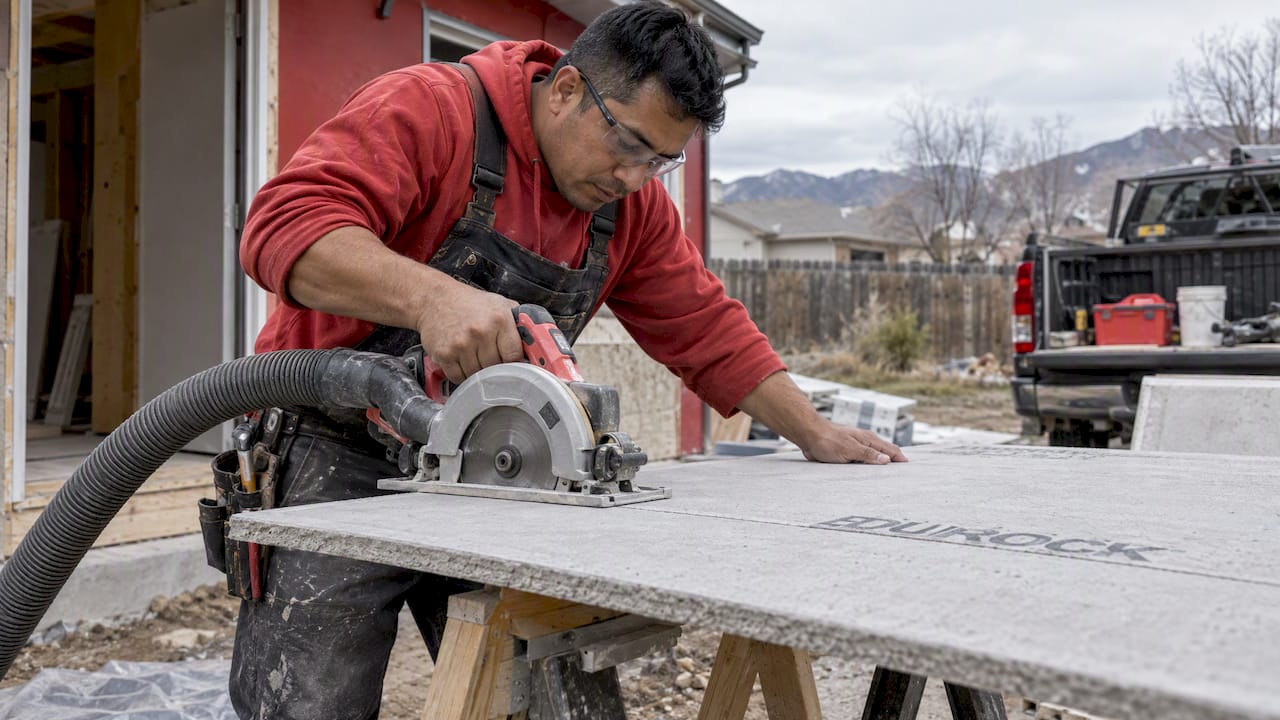
Both boards can be scored and snapped, or cut with a carbide-tipped or fiber-cement blade. A dust-control setup matters for any cement board. Cutting outdoors or with a vacuum-attached tool keeps silica dust out of the house.
Fastening
Fastener rules are specific, so follow the manufacturer:
- For HardieBacker on walls, James Hardie recommends corrosion-resistant roofing nails or 1.25-inch minimum Backer-On screws.
- For Durock, USG lists No. 8 Durock tile backer screws in 1.25- and 1.625-inch lengths for steel framing, and 1.25-, 1.625- and 2.25-inch lengths for wood framing, or 1.5-inch hot-dipped galvanized roofing nails.
The right screw depends on the framing and the board thickness. Countersunk screws that sit flush matter, because a proud head telegraphs through the tile as lippage. Our article on tile lippage standards explains how much variation is acceptable.
Joints
The joint treatment is nearly identical in spirit. James Hardie tells installers to fill all joints with mortar and embed 2-inch alkali-resistant glass-fiber tape. For floors, it also calls for a structurally sound subfloor. USG’s floor guidance says to bed Durock in adhesive or mortar, stagger the joints, and embed alkali-resistant fiberglass tape over the joints.
The common thread: neither board should be dry-laid and screwed down alone. The mortar bed under the board and the taped joints are what make the assembly work. If you are weighing adhesives, see our comparison of mastic vs thinset.
Drawbacks and installation challenges
Neither board is perfect, and the trade-offs are mostly about handling.
HardieBacker
- Its rigidity is an asset on a floor, but the stiff panel can be less forgiving when you fasten near the edges. Pre-drilling or keeping fasteners back from edges helps.
- Boards with 1/4-inch thickness are easy to carry but need full support and a proper mortar bed.
Durock
- Glass mesh makes cutting feel familiar, but it still produces cement dust, and the mesh can leave frayed edges at cuts that need cleaning up before tile goes down.
- The board is thicker in many floor builds, so it can cost you height at transitions.
These are general handling points rather than manufacturer claims. What both manufacturers do agree on is that a clean, flat, structurally sound substrate comes first. If your subfloor is out of flat, soft or damp, the better backer board will not rescue it. That is the work we do under subfloor preparation, and our guide to floor underlayments explains what sits between the joists and your finished surface.
Which board for a tile floor
For a kitchen, entry or bathroom floor over a wood subfloor, either board is a sound choice if the installation follows the manufacturer’s instructions. The decision usually comes down to:
- Height. If you need to keep the floor low, the 1/4-inch HardieBacker that James Hardie recommends for floors is a natural fit.
- Large-format tile. Big tiles demand a flat, stiff base. Many installers lean toward a rigid board and a careful flatness check. Our wood-look tile installation guide covers the long-plank case.
- Installer preference. An installer who cuts and fastens one board all day will often get a cleaner result with it.
- Movement. Tile over a backer board still needs perimeter and field movement joints. See our rules on tile expansion joints.
If you are choosing tile itself for a busy room, this overview of durable tile flooring options helps match the surface to the traffic, and our own page on tile for high-traffic areas does the same.
Showers and wet areas
This is where the “waterproof” misunderstanding does the most damage. Cement board does not rot like drywall, but water still passes through it.
USG says that if waterproof construction is specified or waterproofing is desired, a separate barrier must be applied over or behind Durock, and it recommends its Durock Liquid Waterproofing Membrane. USG’s Canadian construction handbook lists Durock as suitable for interior wet areas such as shower enclosures, bathroom floors and steam rooms. “Suitable for” a wet area means the board will not break down. It does not mean the wall cavity stays dry.
Some comparison guides note that HardieBacker’s HydroDefense treatment limits moisture absorption in the board itself, while Durock’s EdgeGuard does the same at the seams. Those are board-protection features, not a substitute for a membrane. Professional shower installations commonly use a dedicated waterproofing system over the board or in place of it. A hotel renovation reported by Tile Letter used the Schluter Shower System for its tiled showers.
For a shower or any wet room, plan the layers in this order:
- Sound framing and a correct slope.
- Backer board, with taped and mortared joints.
- A waterproofing membrane applied to the manufacturer’s specification.
- Thinset and tile.
- Grout, and sealing at the right time. Our post on sealing grout after installation gives the 48 to 72 hour guideline.
For the broader picture of moisture control in the home, read our waterproof flooring guide and our explainer on the flooring moisture barrier.
Cost: what the price difference means
At the Home Depot listings checked for this article, 1/2-inch HardieBacker is $1.17 per square foot and 1/2-inch Durock is $1.06. On a 100-square-foot bathroom floor, that is a difference of about $11 in material. The board is a small slice of a tile project’s cost. Labor, membrane, thinset, tile and subfloor repair all outweigh it.
So do not pick a board for a dime a foot. Pick it for the thickness you need, the application and the installer’s comfort with it. We do not publish flat project prices, because the scope of a floor, from subfloor condition to tile size, changes the figure. We quote each job after seeing the space.
Perspective: how we choose on a job
We get this question from homeowners who have watched a video declaring one board the winner. Our view is plainer: both are good products, and most failures we are asked to look at trace back to the substrate, the mortar or the movement joints, not the brand on the board.
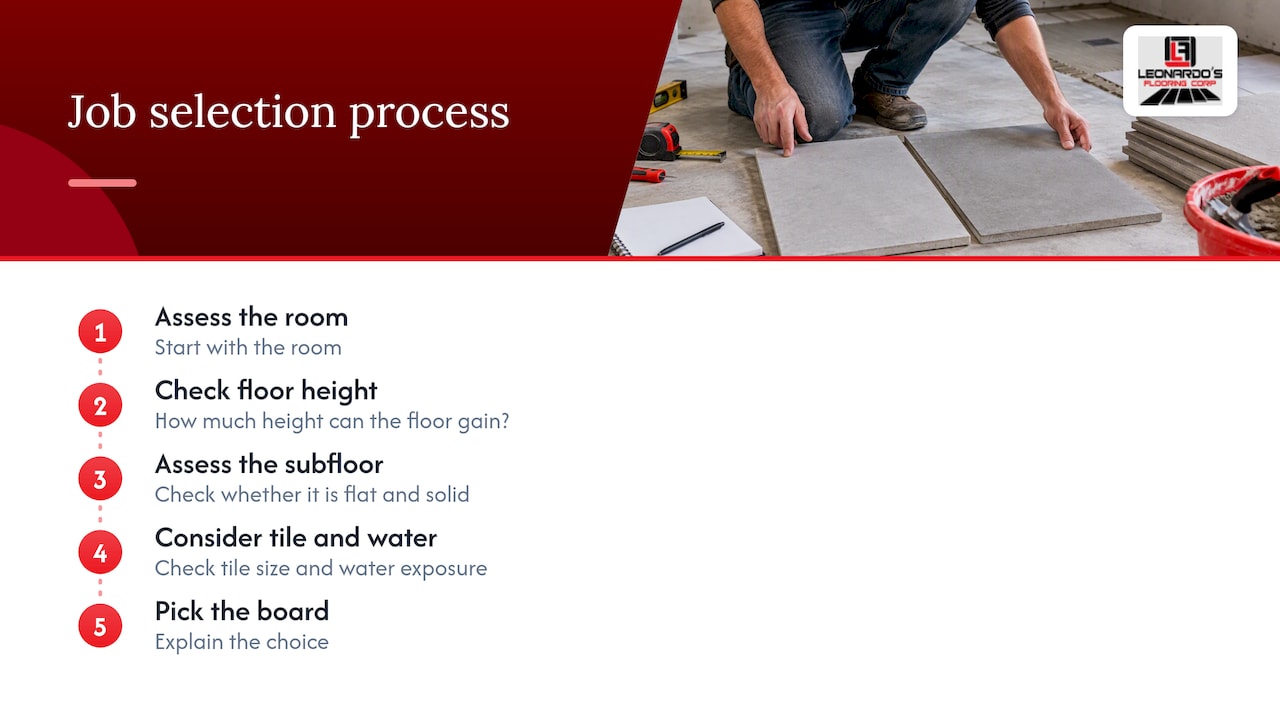
We start with the room. How much height can the floor gain? Is the subfloor flat and solid? Is the tile large? Is there water involved? Then we pick the board, and we tell you why. That fits how we work: every project is tailored to your needs, budget and timeline, with no surprises on the quote. With more than 10 years serving the Denver area and 125+ five-star reviews, we would rather explain a trade-off than hide it.
If you are comparing contractor quotes, ask each one which board they plan to use, how they will treat the joints, and what goes under the tile in wet areas. A clear answer tells you a lot.
— Jim
Let us handle the tile base and the tile
If you are planning a tile floor, bathroom or kitchen update in the Denver metro, our team handles subfloor preparation and tile floor installation for homes and commercial properties. You can see everything we install on our services page, and we will tell you which backer board suits your room before work starts.
FAQ
Is HardieBacker better than Durock?
Neither is better in every case. HardieBacker is favored by some contractors for rigidity and is offered in a 1/4-inch thickness that James Hardie recommends for floors. Durock is favored by others because it cuts like drywall and has strong edges. Both perform well when installed to the manufacturer’s instructions.
Can I use HardieBacker or Durock in a shower?
Yes, both are used in showers, but neither is a waterproofing layer by itself. USG says a separate barrier must go over or behind Durock when waterproofing is desired, and the same approach applies to HardieBacker. Ask your installer which membrane or shower system they will use.
Do you screw or nail HardieBacker?
Either can be used on walls. James Hardie recommends corrosion-resistant roofing nails or Backer-On screws of at least 1.25 inches. On floors, the board is bedded in mortar and fastened per the manufacturer’s pattern, with joints filled and taped.
Is Durock or HardieBacker cheaper?
The Home Depot listings we checked show 1/2-inch Durock at $1.06 per square foot and 1/2-inch HardieBacker at $1.17. The gap is small relative to total project cost, and prices vary by store and over time.
Sources
- Hardie Backer Board, James Hardie
- How to install HardieBacker cement board on walls, James Hardie
- How to install HardieBacker cement board on floors, James Hardie
- Durock Brand Cement Board with EdgeGuard, USG
- Durock Cement Board with EdgeGuard installation guide, USG
- Durock Cement Board Systems Catalog, USG
- Cement Board Construction, USG handbook
- What’s the Difference: Common Tile Backerboards, Fine Homebuilding
- Tile Backerboard Material Options, Fine Homebuilding
- Moisture Resistant Cement Boards, The Home Depot
- Schluter updates Hotel Drover, Tile Letter