
Most Arvada homeowners pay a modest to moderate amount installed per linear foot for quarter round, with material choice and floor condition doing most of the work to move that number up or down, with material choice and floor condition doing most of the work to move that number up or down. A typical bedroom or hallway job lands in the low hundreds of dollars, while whole-house trim work climbs from there. Because every room has its own quirks, the smartest first step is booking an in-person quote rather than guessing from a per-foot number alone.
TL;DR:
- Most contractors in Arvada charge between $2 and $8 per linear foot for quarter round installation, with labor costs ranging from $1 to $4 per foot.
- Material costs vary from about $0.50 for MDF to over $4 per linear foot for solid wood, affecting the total project price before labor.
- Large or complex rooms with irregular corners, uneven floors, or old trim can significantly increase labor time and costs beyond initial estimates.
- An on-site quote is essential for accuracy, as measurements, room features, and floor condition heavily influence final costs and may lead to adjustments.
- Small trim projects typically do not require permits in Arvada unless integrated into larger remodels affecting plumbing, electrical, or structure.
Table of Contents
- Installed cost breakdown: per linear foot, per room, and sample project math
- Material costs and how choice affects the installed price
- Labor pricing: how pros in the Denver area charge and what factors change labor rates
- Site-condition cost drivers: corners, transitions, uneven floors, removals, and finishing
- Permits, licensing, and local rules in Arvada that affect trim jobs and hires
- How to get an accurate quote: what installers will inspect and the questions you should ask
- Average installed cost per room and per-project examples
- Local perspective from Leonardo’s Flooring Corp
- Get a straight answer on your Arvada trim project
- Where to check permit rules and cost data yourself
- Sources
- FAQ
Installed cost breakdown: per linear foot, per room, and sample project math
Quarter round pricing works best as a range, not a single number, because labor and material both swing the total. On the low end, basic MDF quarter round installed by a budget crew can run close to $2 per linear foot. Mid-range jobs with pre-primed pine and a skilled installer often land between $3 and $5 per foot. Solid wood or detailed finish work, especially in older homes with uneven subfloors, can push past $8 per foot once scribing and extra corners are factored in.
A few worked examples make this concrete:
- A 10-by-12 bedroom needs roughly 44 linear feet of quarter round, so at $3 to $5 per foot installed, expect $130 to $220 for that room alone.
- A hallway with three doorways often runs 30 to 35 linear feet once you subtract door openings, putting the job around $90 to $175.
- A small whole-room refresh covering a 12-by-14 living area, closer to 52 linear feet, typically falls between $155 and $260.
That buffer rarely changes the quote by more than a few dollars per room, but it prevents a mid-job supply run.
Material costs and how choice affects the installed price
The material you pick sets the floor for your total cost before labor even enters the picture. MDF quarter round is the cheapest option and works fine in dry, climate-controlled rooms, but it swells if it gets wet. PVC costs a bit more and holds up better in bathrooms or basements where moisture is a concern. Pre-primed pine sits in the middle and is the most common choice for painted trim. Solid wood, usually oak or poplar, costs the most and is typically chosen to match stained baseboards or hardwood floors.
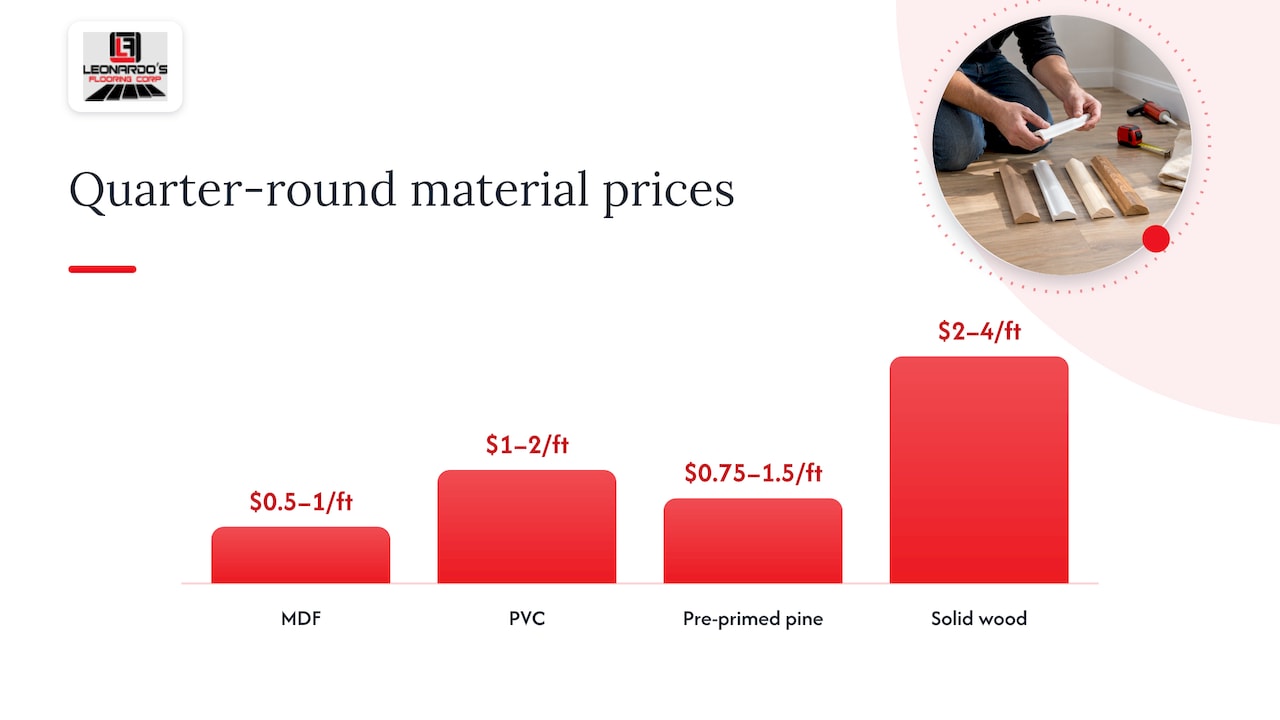
- MDF: roughly $0.50 to $1 per linear foot at retail, lowest cost but least moisture-resistant.
- PVC: around $1 to $2 per linear foot, a strong pick for kitchens, baths, and basements.
- Pre-primed pine: about $0.75 to $1.50 per linear foot, the standard for painted trim.
- Solid wood (oak, poplar): $2 to $4 or more per linear foot, best for stained finishes that need to match existing wood tones.
Pre-primed or pre-finished stock speeds up the job since installers skip a priming step, which can shave a small amount off labor time even though the material itself costs more upfront.
Pro Tip: If your baseboards are already painted, matching quarter round in pre-primed pine keeps finish work simple and consistent from room to room.
Labor pricing: how pros in the Denver area charge and what factors change labor rates
Installers typically price quarter round one of three ways: per linear foot, per room as a flat rate, or as part of a larger project quote that bundles trim with other work. Per-foot pricing is common for straightforward jobs with few corners, while flat per-room rates show up when a contractor wants to account for setup and cleanup time regardless of exact footage.
Labor alone, separate from materials, generally runs at a range of costs per linear foot depending on the installer’s experience and the finish quality expected. A crew doing rough paint-grade work charges less than one doing detailed, stain-matched miter work. Industry cost data from HomeGuide notes that labor and site conditions are the main drivers behind the spread in installed pricing, more so than the trim material itself.
- Per linear foot: common for simple rooms with minimal corners or obstacles.
- Per room flat rate: covers setup time and works well for smaller spaces.
- Project-based pricing: bundles trim with baseboard or flooring work for a single total.
Experienced installers often lean toward project pricing because it protects them from underbidding jobs with hidden variables like warped subfloors or extensive coping work.
Site-condition cost drivers: corners, transitions, uneven floors, removals, and finishing
The number on your initial estimate can move once an installer sees the actual room. A few conditions consistently add time and cost:
- Mitered or coped corners: rooms with bay windows, closets, or irregular layouts need more precise cuts at each corner, which takes longer than a simple rectangular room.
- Flooring transitions: doorways where flooring types change often require extra trim cuts and sometimes transition strips that weren’t in the original scope.
- Uneven floors: older Arvada homes, especially those with settled foundations, sometimes need scribing, where the installer shaves the trim to follow the floor’s contour.
- Old trim removal: pulling out and disposing of existing quarter round adds labor time and can chip paint or drywall that then needs a quick patch.
- Wall or baseboard patching: nail holes, gaps, or damaged baseboard sections found during removal sometimes need filler or touch-up paint before the new trim goes in.
Practitioners who bid these jobs regularly build in allowances for coping and multiple finish passes, according to HomeGuide’s trim installation data, which is part of why a per-foot number quoted over the phone rarely matches the final invoice exactly.
Permits, licensing, and local rules in Arvada that affect trim jobs and hires
Good news for most homeowners: small, non-structural trim work like quarter round generally does not require a building permit in Arvada. The City of Arvada’s residential interior guidance confirms that standalone interior finish work of this kind typically falls outside permit requirements.
That changes if your quarter round job is part of a bigger remodel or if work disturbs plumbing, electrical, or mechanical systems, since those projects often do require permits and licensed contractors; for such larger remodels, consider hiring a trusted general contractor to ensure smooth project management. When a permit is triggered, Arvada’s fee guidance notes that costs vary by project and can be estimated through the city’s fee schedule.
Before hiring anyone for combined trim and remodel work, ask for a license number, proof of insurance, and confirmation of whether they’ll pull any required permit themselves.
How to get an accurate quote: what installers will inspect and the questions you should ask
A reliable quote starts with an in-person walk-through, not a phone estimate. A good installer measures total linear footage, counts corners and transitions, and checks floor and wall condition for gaps that could affect scribing or fit.
Before agreeing to a quote, ask these questions:
- What pricing model are you using: per foot, per room, or a flat project rate?
- Is the finish (paint or stain) included in the price, or billed separately?
- What’s the expected timeline from start to finish?
- Do you offer a warranty on the installation work?
- Will you remove and dispose of the old trim, and is that included?
Pro Tip: Get two or three written, line-item bids rather than verbal ballpark numbers. It’s the easiest way to spot a contractor who’s guessing versus one who’s measured your space carefully.
Average installed cost per room and per-project examples
Room size and layout complexity matter more than square footage alone when it comes to quarter round. A small bathroom with a single doorway might only need 20 to 25 linear feet, keeping the installed cost between $60 and $125 depending on material. A standard bedroom, as covered earlier, usually runs $130 to $220. Larger open-concept living and dining areas can require 60 to 80 linear feet, pushing costs to $180 to $400 once material and labor are combined.
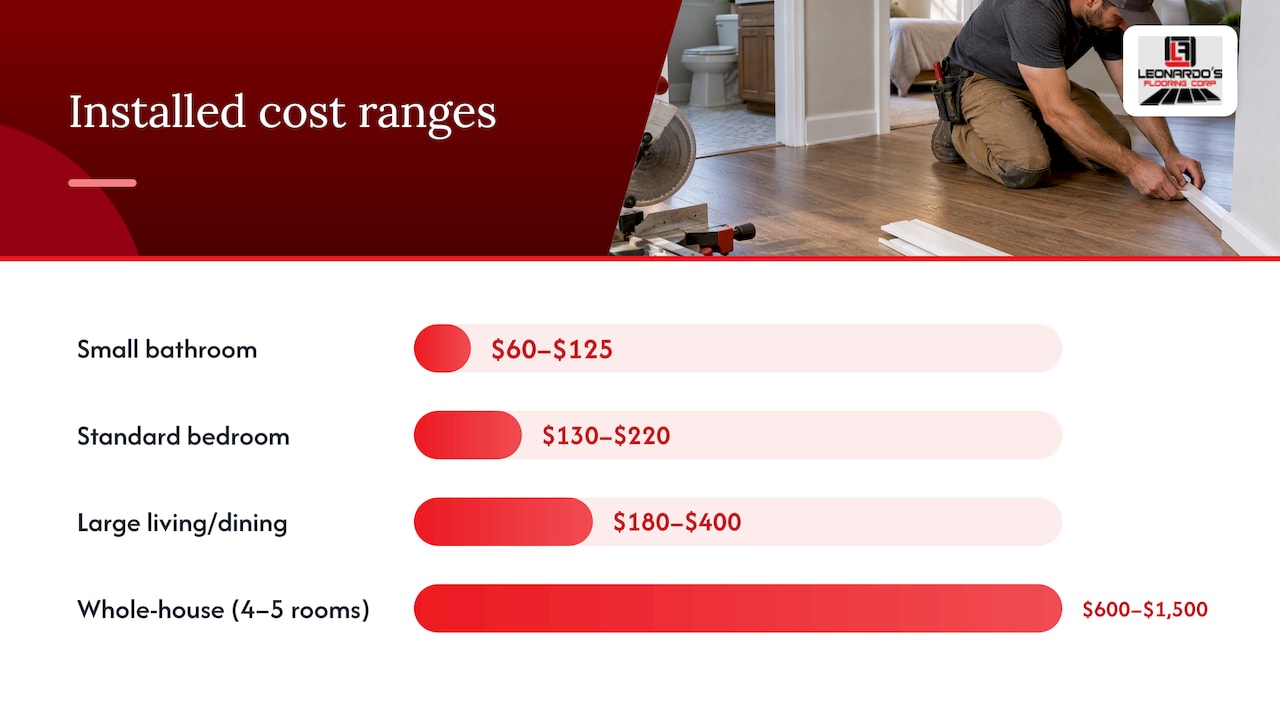
For a whole-house project covering four to five rooms plus hallways, homeowners in Arvada often see installed totals somewhere between $600 and $1,500, depending heavily on trim material and how many rooms have complicated corners or uneven flooring. A home replacing baseboards and quarter round together as part of one project will land toward the higher end of that range, since labor overlaps but material costs stack.
These figures assume quarter round installed on its own or alongside baseboard replacement. Projects that also involve new flooring, where quarter round is the finishing touch rather than a standalone job, are usually quoted as part of that larger flooring estimate rather than priced separately. If you’re planning new flooring at the same time, it’s worth asking your installer to bundle the trim into that quote so labor time isn’t billed twice for the same room.
Local perspective from Leonardo’s Flooring Corp
Arvada homes built in different decades bring different surprises: some have subfloors that shifted slightly over the years, others have baseboards that were never quite square to begin with. That variation is exactly why on-site measurement matters more than a phone quote, and why a transparent, line-item estimate protects both the homeowner and the installer from mismatched expectations.
— Jim
Get a straight answer on your Arvada trim project
A phone estimate can only guess at your room’s corners, floor condition, or trim material, but an on-site visit by a professional installer turns that guess into a fixed, written number. Experienced installers in the greater Denver area bring years of expertise to floors and trim projects, with many customer reviews reflecting a consistent approach: measure carefully, quote honestly, and leave the jobsite clean.
When we walk your home, you’ll get an itemized estimate covering material costs, labor, and a realistic timeline, so there are no surprises once work starts. Whether you need quarter round to match new hardwood floors or a standalone trim refresh, the process starts the same way: a visit, a measurement, and a quote you can actually rely on. Reach out through our flooring services page to schedule your on-site estimate.
Where to check permit rules and cost data yourself
For permit questions, Arvada’s residential interior page and sample permit records show real fee structures. For broader cost context, HomeGuide’s trim cost data offers an industry benchmark.
Sources
- Residential Interior | Arvada, CO
- Trim installation cost guide | HomeGuide
- Sample permit record | Arvada eTRAKiT
FAQ
How much should a contractor charge to install quarter round?
Most contractors in the Arvada area charge between $2 and $8 installed per linear foot, with labor alone typically running $1 to $4 per foot depending on skill level and finish quality. The final number depends heavily on room corners, floor condition, and whether trim is bundled with a larger flooring or remodel project.
How much does quarter round cost at a home improvement store?
Retail quarter round material alone typically costs between $0.50 and $4 per linear foot depending on the type, with MDF at the low end and solid wood at the high end. This is the material price only and does not include installation labor.
How much baseboard do I need for a 2,000-square-foot house?
The linear footage needed depends on room layout and door and window openings, not just total square footage, so there’s no fixed per-square-foot conversion. An in-person measurement of each room’s perimeter, minus openings, gives the most accurate footage count for both baseboard and quarter round.
How hard is it to install quarter round yourself?
Basic quarter round installation along straight walls is manageable for a confident DIYer with a miter saw and finish nailer. Rooms with tight corners, uneven flooring, or multiple transitions get significantly harder, since scribing and coped joints take practice to get looking clean.
Does quarter round installation in Arvada require a permit?
Small, non-structural trim work like quarter round generally does not require a permit in Arvada, according to the city’s residential interior guidance. A permit may be required if the trim work is part of a larger remodel that affects plumbing, electrical, or structural elements.