
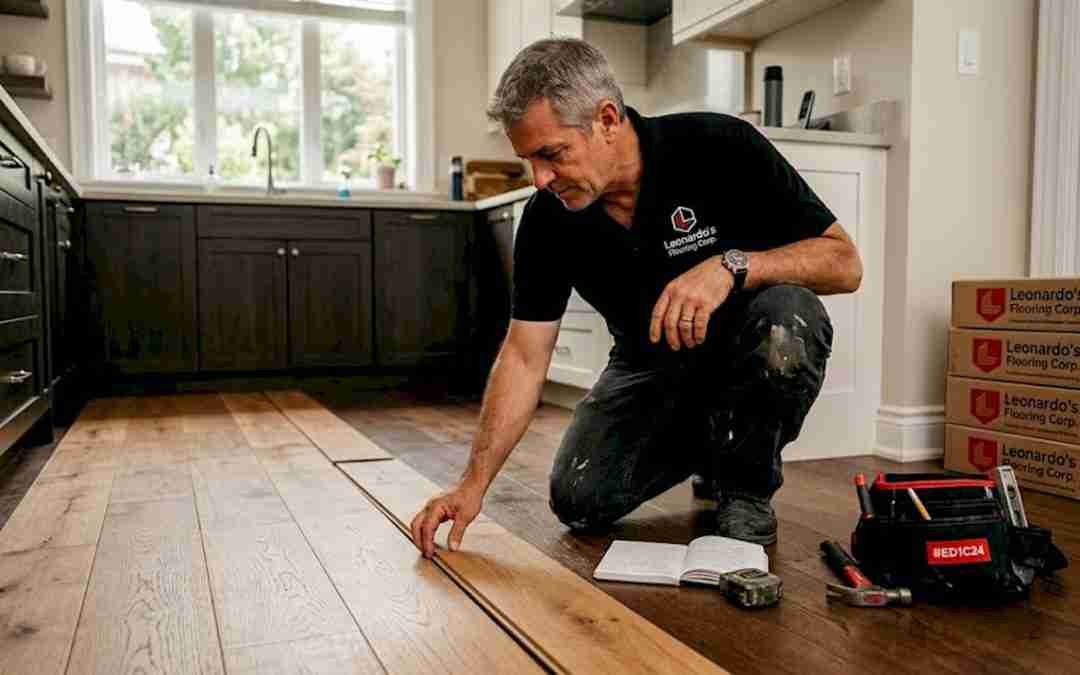
Flooring looks simple until something goes wrong. Most homeowners and property managers assume installing new floors is straightforward, so they underestimate how much skill, testing, and precision the job actually demands. Understanding the role of flooring contractors goes far beyond knowing they lay planks or tiles. They assess substrates, manage moisture conditions, coordinate with other trades, and protect you from failures that cost thousands to fix. This article breaks down what professional flooring contractors actually do, why their expertise matters, and how to make smarter decisions for your next flooring project.
Table of Contents
- Key Takeaways
- The real role of flooring contractors
- Technical standards contractors manage
- Common challenges and why hiring professionals matters
- How contractors fit into larger projects
- My honest take on what homeowners get wrong
- Ready to work with real flooring professionals?
- FAQ
Key Takeaways
| Point | Details |
|---|---|
| Contractors do more than install | Flooring contractors handle moisture testing, substrate prep, and finish work before a single plank goes down. |
| Technical standards protect your investment | Professionals follow strict moisture, flatness, and acclimation standards that prevent premature floor failure. |
| Hiring pros prevents costly mistakes | DIY or unqualified labor frequently causes gaps, hollow sounds, and adhesive failure that require full reinstallation. |
| Contractors manage project coordination | Flooring subcontractors work within construction timelines, coordinating with other trades and inspection authorities. |
| Local expertise adds real value | Hiring local flooring experts means faster communication, accountability, and knowledge of regional conditions. |
The real role of flooring contractors
Most people picture a flooring contractor showing up with boxes of material and a nail gun. The actual scope of the work is significantly broader. A qualified flooring contractor functions as both a technical specialist and a project manager for every aspect of the floor system, from the concrete slab or wood subfloor beneath your feet all the way to the finished surface you walk on every day.
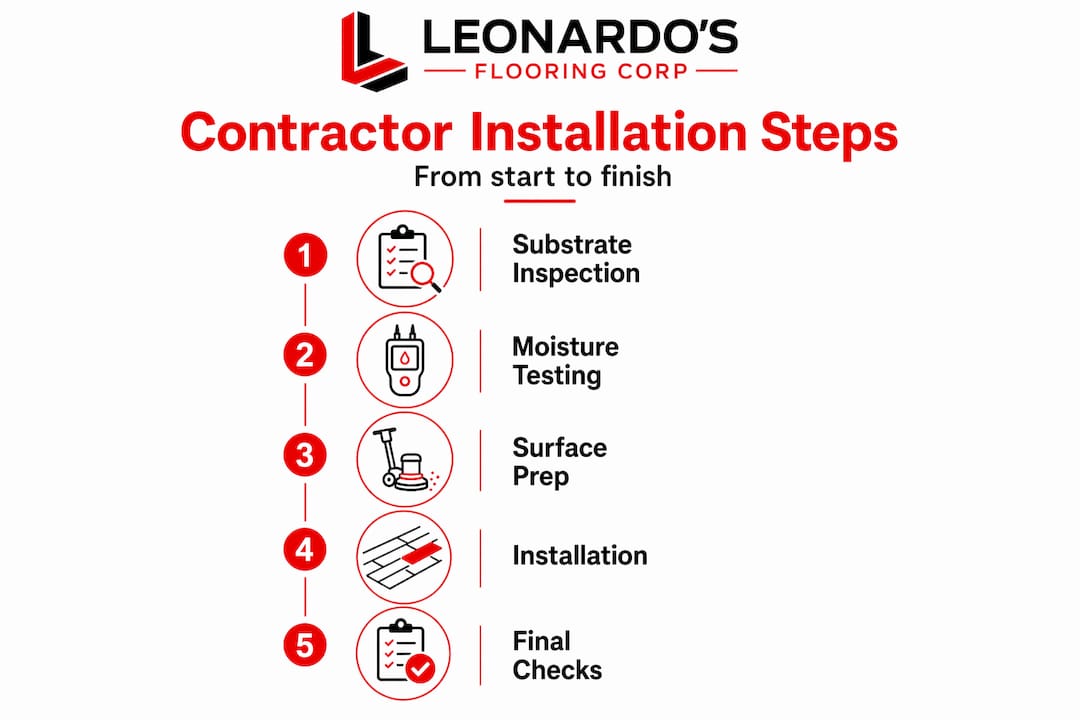
The core responsibilities of any professional flooring contractor include:
- Substrate inspection and preparation: Checking the subfloor for structural integrity, levelness, and contamination before any installation begins
- Moisture and environmental testing: Using calibrated instruments to verify that conditions meet manufacturer specifications
- Material selection guidance: Helping you choose the right flooring type for your specific traffic patterns, subfloor type, and budget
- Precision installation: Following manufacturer installation methods and industry standards for each flooring category
- Finishing and transition work: Installing moldings, transitions, and edge treatments that protect the floor and give it a professional look
- Post-installation inspection: Confirming the finished floor meets flatness, alignment, and visual quality standards
The flooring installation process covers a wide range of materials. Professional contractors work across hardwood, laminate, luxury vinyl plank, ceramic and porcelain tile, carpet, and epoxy coatings. Each material has its own installation method, subfloor requirements, and environmental conditions. A contractor who specializes in hardwood brings different technical knowledge than one who primarily installs tile, which is exactly why you want to ask about a contractor’s experience with your specific flooring type before signing any agreement.
Pro Tip: Ask your contractor to walk you through the substrate inspection before installation begins. If they skip this step or wave it off, that is a warning sign worth taking seriously.
Durability is not just about the material you choose. Professional flooring installation that follows the correct process produces floors that last decades. Poor installation of the same material can fail within months. The contractor’s workmanship is genuinely the deciding factor.
Technical standards contractors manage
This is the part of the role of contractors in flooring that surprises most homeowners. Before any flooring material gets installed, a qualified contractor runs through a checklist of technical tests that the average DIYer has never heard of.
Wood acclimation requirements
Wood is hygroscopic, meaning it absorbs and releases moisture depending on the environment around it. Before hardwood floors go down, the material needs time to stabilize in the space where it will live. Moisture acclimation standards require that wood flooring reach within 2 to 4 percent moisture content of the subfloor and within 2 percent of the building’s equilibrium moisture content. Skip this step and the floor will expand or contract after installation, leading to cupping, crowning, or gapping. A professional contractor manages acclimation as a non-negotiable part of the schedule.
Concrete slab moisture and pH testing
Concrete slabs present their own set of chemical and moisture challenges. Most resilient flooring manufacturers require the concrete slab’s relative humidity to stay below 75 to 80 percent before adhesive application. Exceeding this threshold leads to adhesive failure over time, causing tiles to lift, vinyl to bubble, and floors to separate from the substrate.
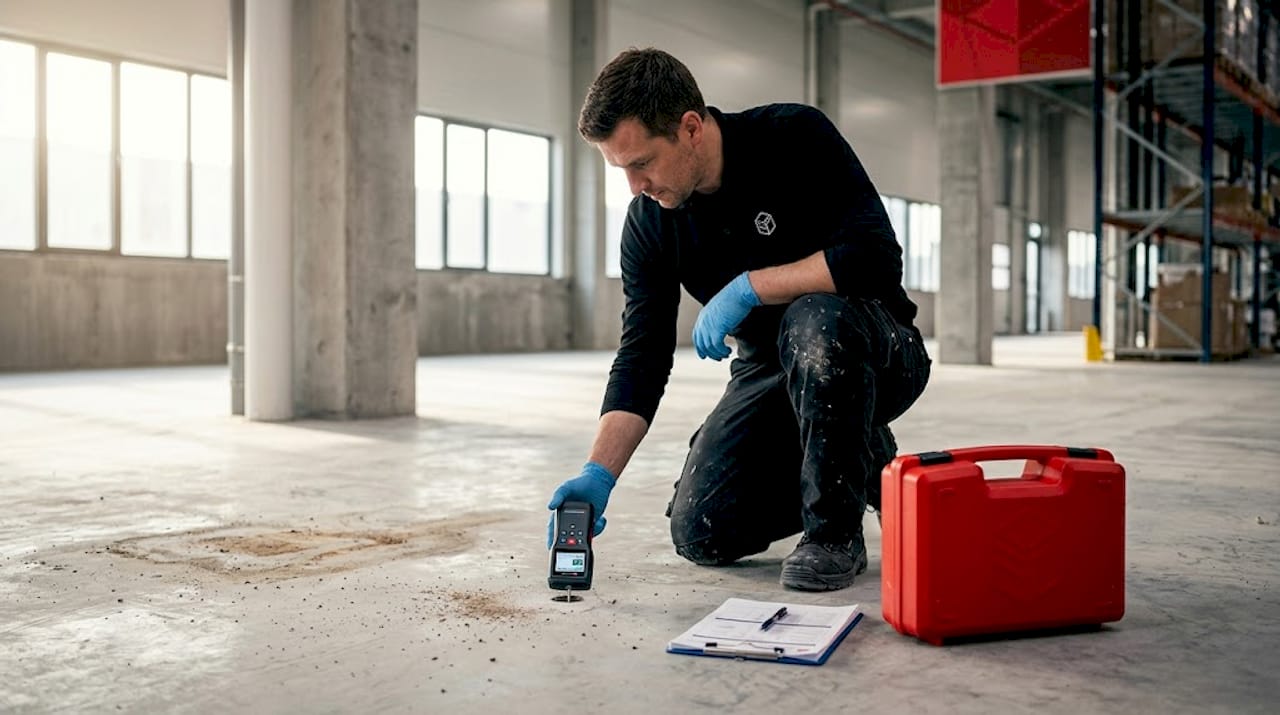
There is another risk that is less visible. High concrete pH above 10 creates alkalinity that attacks adhesive bonds silently, often taking months before the failure becomes obvious. You will not see the problem until tiles start popping or adhesive residue migrates to the surface. A knowledgeable contractor runs pH testing as a standard pre-installation step, not an optional add-on.
Surface moisture readings alone are not enough. Deep-slab ASTM F2170 testing is the industry gold standard because surface tests frequently miss high moisture content migrating upward from deep within the concrete. Professional contractors use the right testing method for the situation.
| Test type | What it measures | Why it matters |
|---|---|---|
| ASTM F2170 in-slab RH | Relative humidity deep in concrete slab | Prevents adhesive failure from moisture migration |
| Moisture content (wood) | Wood MC vs. subfloor MC differential | Prevents cupping, gapping, and crowning |
| pH alkalinity test | Concrete surface pH level | Prevents silent adhesive breakdown over months |
| Flatness verification | Floor deviation from level plane | Avoids hollow spots, rocking tiles, and click failures |
Flatness and levelness verification
Bridging ASTM E1155 flatness standards with flooring manufacturer specifications is one of the most common sources of project delays and rework. Concrete finishers work to one set of tolerances while flooring manufacturers specify another, often tighter, requirement. A professional contractor knows both sets of standards and identifies gaps before installation begins, not after.
Pro Tip: Request a written flatness report from your contractor before flooring installation starts. If the slab does not meet spec, you want that documented, not discovered after the material is installed.
Common challenges and why hiring professionals matters
Flooring work looks manageable on a home improvement video until you are looking at a warped floor six months after installation. DIY installation and unqualified labor frequently produce problems including gaps between planks, hollow sounds underfoot, peaking at seams, and premature wear along high-traffic paths. The root cause in nearly every case is improper subfloor preparation or moisture mismanagement, both of which are well within a qualified contractor’s scope to prevent.
Here is a short list of the specific pitfalls professional flooring contractors protect you from:
- Installing flooring over a subfloor that has not been checked for moisture, leading to adhesive failure or wood movement
- Using the wrong installation method for the flooring type, such as floating a product that requires glue-down over radiant heat
- Skipping acclimation for wood or engineered products in climates with significant seasonal humidity changes
- Failing to repair subfloor damage, such as soft spots or protruding fasteners, before laying the new surface
- Mishandling transitions between flooring types, leaving edges vulnerable to lifting, chipping, or trip hazards
Certified installers also protect your warranty. Most flooring manufacturers void warranties on products installed by unqualified labor or outside of their specified methods. That means a $5,000 hardwood floor installed incorrectly by a friend carries zero manufacturer backing if it fails. Hiring a professional keeps that protection intact.
The cost difference between professional and amateur installation is rarely what homeowners expect. The upfront savings from cutting corners disappear quickly when remediation, subfloor repair, and material replacement enter the picture. Getting it right the first time is almost always the cheaper path.
How contractors fit into larger projects
When flooring is part of a larger renovation or new construction project, the flooring contractor’s role becomes even more specific. They operate within a defined phase sequence and have formal responsibilities that connect directly to the work done by other trades.
Flooring subcontractors typically work after HVAC, plumbing rough-in, and drywall are complete, but before final painting and trim installation. This sequencing matters because HVAC system operation affects indoor humidity, which affects both concrete moisture readings and wood acclimation. A contractor who shows up before the building has been conditioned to occupied temperatures and humidity levels cannot get reliable moisture readings.
Documented substrate acceptance criteria in the project contract prevent disputes between general contractors and flooring subcontractors over who is responsible when conditions are not met. A flooring contractor who discovers the slab is out of spec has the professional authority to formally reject the substrate. That rejection pauses the project until conditions meet manufacturer thresholds. This protects everyone, including you as the property owner, because it prevents a qualified contractor from being held responsible for a failure that originated in someone else’s work.
Good subfloor preparation documentation also creates a clear record if issues arise later. If a floor develops problems two years after installation, those records tell you exactly what conditions were present when the work was done. Without them, disputes are much harder to resolve.
My honest take on what homeowners get wrong
I have watched a lot of flooring projects go sideways, and the pattern is almost always the same. The homeowner picked the material carefully, maybe even spent extra on a quality product, but then treated the installation as the easy part. That assumption is where the money gets lost.
What surprises most people is how much of a flooring contractor’s value is invisible. You do not see the moisture test results. You do not see the flatness readings or the pH logs. You just see someone laying planks. But those invisible steps are exactly what determines whether that floor looks good for two years or twenty years.
I am also honest about the why hire local flooring experts question. Local contractors who operate in your specific region understand your climate, your soil conditions, and your building stock in ways that a national chain simply cannot replicate. A contractor who has installed hundreds of floors in your area has seen the exact problems your home is likely to present. That regional knowledge is not something you can read about.
My advice is always the same: bring a flooring contractor into your project earlier than you think you need to. Not after you have picked the material and signed on a general contractor, but at the planning stage. A qualified professional can save you from choosing a product that will not work in your conditions, or a timeline that does not account for proper acclimation. That early conversation is almost always free and almost always worth it.
— Jim
Ready to work with real flooring professionals?
Leonardosflooringcorp has spent over a decade getting floors right for homeowners and property managers across the Denver metro. The team handles everything from subfloor assessment and moisture testing to the finished installation, across hardwood floor installation, laminate flooring, vinyl flooring, tile installation, and epoxy coatings. With 125+ five-star reviews and a no-surprises approach to every project, they bring the kind of expertise described in this article to every job they take on.

If you are planning a flooring project, whether it is a single room or a full renovation, reach out to Leonardosflooringcorp for a consultation. The conversation starts with listening to what you actually need.
FAQ
What does a flooring contractor actually do?
A flooring contractor manages the full process from substrate inspection and moisture testing through material installation and finishing work. They follow manufacturer specifications and industry standards to produce a floor that lasts.
Why hire flooring contractors instead of doing it yourself?
Professional contractors prevent the most common and costly installation failures, including moisture damage, adhesive failure, and flatness problems, while keeping your manufacturer warranty valid.
What is substrate acceptance and why does it matter?
Substrate acceptance is the formal process by which a flooring contractor verifies that the subfloor meets moisture, flatness, and environmental requirements before installation begins. If conditions fail, contractors can formally reject the substrate to protect against future failures.
How do flooring contractors test for moisture?
The industry gold standard is ASTM F2170 in-slab testing, which measures relative humidity deep within the concrete rather than only at the surface, giving a reliable picture of actual moisture conditions.
What flooring types do professional contractors install?
Professional flooring contractors work with hardwood, laminate, luxury vinyl plank, ceramic and porcelain tile, carpet, and epoxy coatings. Each material requires specific installation methods and subfloor conditions that a qualified contractor knows how to verify and address.