
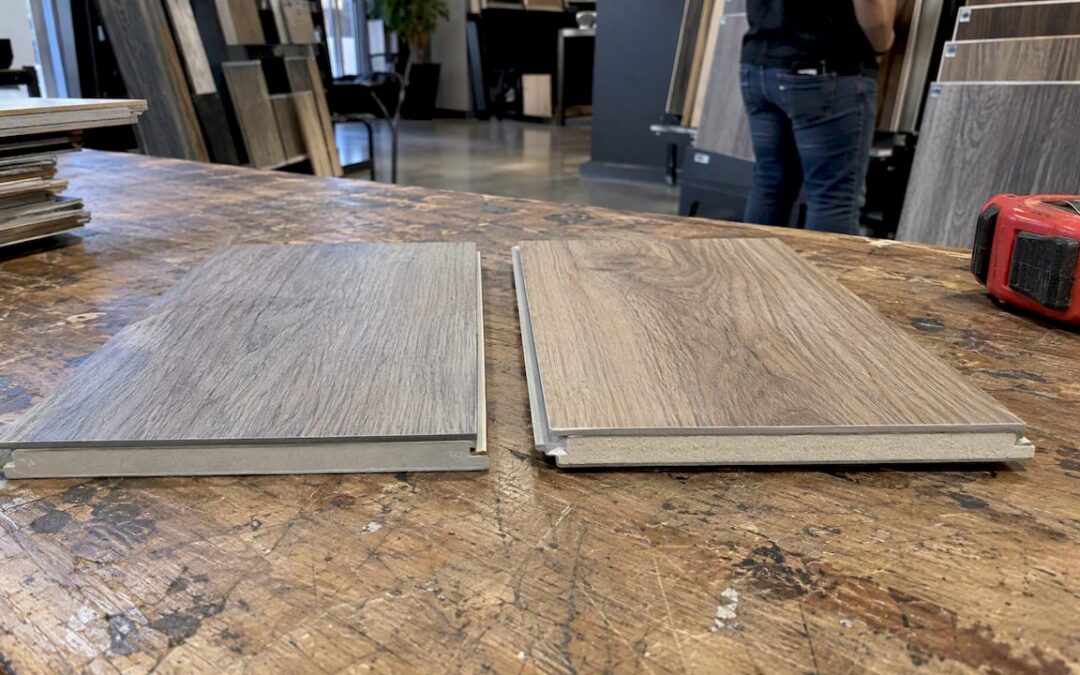
For most Denver homes, SPC (stone polymer composite) is the safer pick. It is denser, resists dents and handles temperature swings better. WPC (wood polymer composite) is thicker and feels softer and warmer underfoot, which makes it a good fit for bedrooms and living areas where comfort matters more than heavy-duty toughness. Both are waterproof luxury vinyl plank (LVP) with a rigid core, and both look nearly identical once they are installed.
This guide explains what actually differs, which rooms suit each core, what the installation side demands, and how to read a quote. We install both, so we will also tell you where the choice matters less than people think.
TL;DR
- SPC has a dense, limestone-based core. It resists dents and drops and stays more stable when temperatures swing. It is the usual choice for kitchens, entryways, basements and commercial spaces.
- WPC has a thicker, foamed core. It feels softer and warmer and absorbs more sound, but it dents more easily under heavy furniture and appliances.
- The core is only one layer. Wear layer, subfloor condition and installation quality decide how the floor looks in year five.
- Neither core is a moisture barrier. Basements and slab-on-grade floors may need a vapor barrier, and perimeters need to be sealed.
- Get subfloor preparation line-itemed in writing before you compare quotes.
Table of Contents
- What SPC and WPC actually are
- SPC vs WPC side by side
- Where SPC wins
- Where WPC still makes sense
- What the wear layer tells you that the core does not
- Waterproof does not mean moisture-proof
- The subfloor decides more than the core
- Indoor air quality: what to look for
- Installation details that protect your floor
- How to choose, room by room
- Our perspective
- Work with a Denver installer who talks through the options
- FAQ
- Sources
What SPC and WPC actually are
Both belong to the rigid core family of luxury vinyl. Floor Covering Weekly explains that rigid core sits under the luxury vinyl tile umbrella and was once called multilayer flooring, because WPC is built from several layers.
The difference is in the core:
- WPC was the first rigid core to reach the market. Its core combines wood or wood-like material, a foaming agent and PVC fillers. The foaming agent makes it thicker and softer.
- SPC is generally seen as the upgrade. Its core is made of limestone and PVC fillers, which makes it denser and tougher.
The same source notes that the choice only changes the core layer. The printed design film, the clear wear layer and the click-lock edges work the same way in both. That is why a sample of each can look identical on a showroom table and behave differently in your hallway.
If you also searched “SPC vs LVP”: SPC is a kind of LVP, not an alternative to it. LVP describes the plank format, and the core (SPC, WPC, or older flexible vinyl) describes how it is built. Our luxury vinyl plank buyer’s guide and core materials explainer go deeper on that split.
SPC vs WPC side by side
| Factor | SPC | WPC |
|---|---|---|
| Core | Limestone plus PVC, dense and rigid | Wood-like material plus foaming agent, lighter |
| Thickness | Usually thinner | Usually thicker |
| Dent resistance | Stronger | Weaker under point loads |
| Feel underfoot | Firmer, a bit colder | Softer, warmer |
| Sound | Can feel hollow without an underlayment | Absorbs more sound |
| Temperature stability | Better | Good, but less stable than SPC |
| Best rooms | Kitchens, entries, basements, commercial | Bedrooms, living rooms, low-traffic areas |
The thickness, dent and comfort rows come straight from the Bona comparison. The temperature point matches what Floor Covering Weekly reports on SPC’s dense core: it resists expansion and contraction better than WPC.
A caution on thickness: a thicker plank is not automatically a better one. A 7 mm WPC plank and a 5 mm SPC plank are not ranked by those numbers. Thickness tells you about the core and any attached pad, not about toughness.
Where SPC wins
Dents, drops and heavy furniture
WPC’s lighter core is more prone to indentation under refrigerators, range legs, bookcases and other loads that sit on small contact points. Industry experts note that SPC is more resistant to dents and drops. If a room has a dishwasher you will pull out every few years, a rolling office chair, or a rolling cart, SPC is the lower-risk choice.
Temperature swings
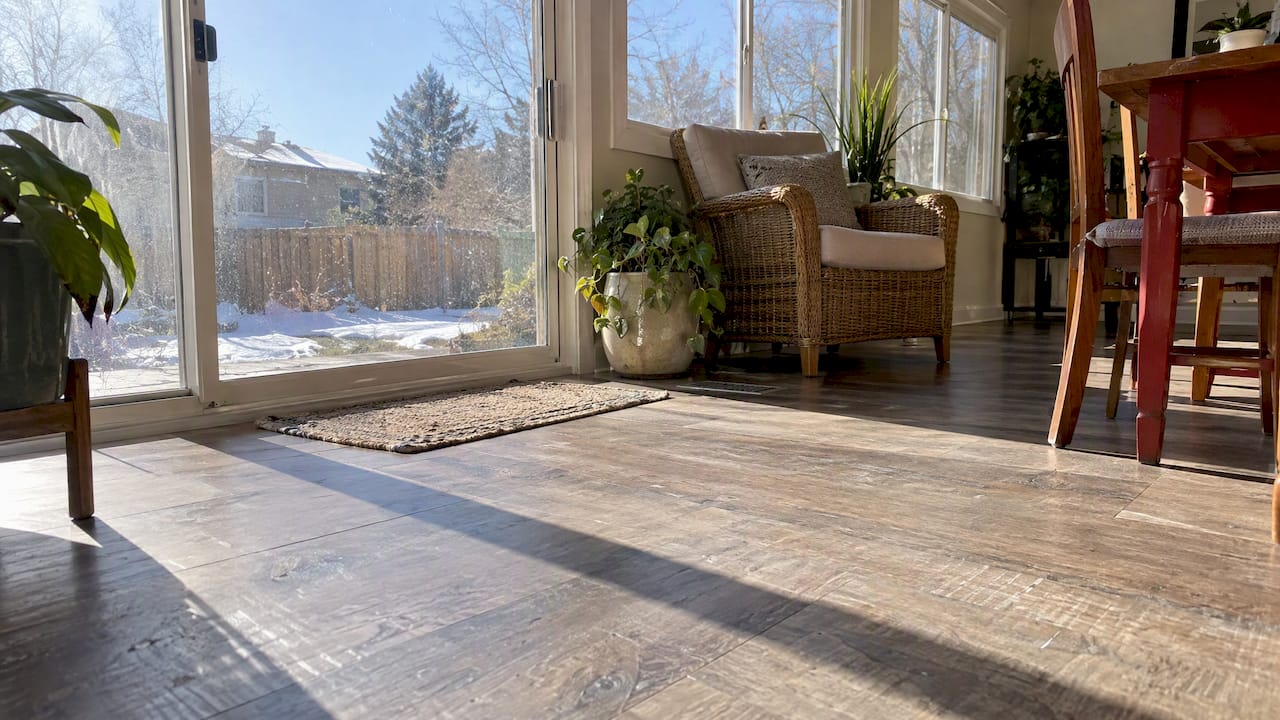
Denver gets sun-heated floors by a south-facing window in July and cold slabs in January. Floors that expand and contract can open gaps at the joints or stress the locking system. Because SPC’s dense core resists expansion and contraction more effectively, it is the more forgiving option for sunrooms, large open floor plans with big glass doors, and basements that run cool.
Commercial and heavy-use zones
For offices, retail and rental-ready spaces, we default to SPC with a thick wear layer. The core takes the abuse of rolling loads and dropped objects better, and it holds its joints under daily traffic.
Where WPC still makes sense
WPC is not outdated. It has one real advantage: comfort. The foamed core gives a little under your foot, feels warmer, and quiets footsteps. For a bedroom, a nursery, a family room where kids sit on the floor, or a home office where you stand for hours, that can matter more than extra dent resistance.
WPC works well when:
- The room has light furniture and no heavy appliances.
- You want less echo, especially on a second floor above living space.
- The subfloor is sound and flat (more on that below).
One more thing: many SPC planks now come with an attached foam or cork underlayment, which softens the feel and cuts sound. If you like SPC’s toughness but not its hollow sound, ask about attached pad options rather than switching cores. Check the plank’s spec sheet, since products vary.
What the wear layer tells you that the core does not
The wear layer is the clear top coating over the printed film, measured in mils (thousandths of an inch). It handles scratches and scuffs. A household with dogs, kids or a lot of foot traffic should look for a thicker one. Residential products commonly advertise wear layers of about 22 mil or more for active households, and rigid core lines in the big-box market advertise as high as 30 mil.
So a 12 mil SPC plank can scratch sooner than a 22 mil WPC plank. Compare wear layers first, then pick the core for the room.
Waterproof does not mean moisture-proof
Both cores resist water damage in the plank itself. The risks sit around and under the plank.
- Perimeters and wet rooms. Planks may be waterproof, but moisture can migrate beneath the floor in bathrooms and laundry rooms if perimeter joints are not sealed properly. That can lead to subfloor rot or mold. We cover the details in our guide to LVP in bathrooms.
- Basements and slabs. Waterproof planks are not a vapor barrier. Trade reporting says a 6-mil polyethylene vapor barrier is often required on basement or slab-on-grade installs, both to meet warranty terms and to avoid trapping moisture emissions. Always check the manufacturer’s installation instructions for your product. Our article on vinyl plank for basements lays out when it works and when it does not.
- Water-prone rooms generally. See our waterproof flooring guide for where each product belongs.
The subfloor decides more than the core
Rigid core planks float on click-lock joints. Any dip, ridge or bounce in the subfloor transfers to the joints, and joints that flex repeatedly can fail. Professionals flag that skipping subfloor repair before installing rigid core flooring often leads to buckling or joint failure, and that a bid with no line item for subfloor work is a red flag. Those costs are rarely inside the base per-square-foot installation rate.
What to ask every installer, including us:
- Will you check the subfloor for flatness and moisture before quoting, or at least before installing?
- What does subfloor preparation cost, written as its own line?
- What happens if you find a problem after demolition?
Our subfloor preparation service and the article on how to prep a subfloor for lasting results explain what that work involves.
Indoor air quality: what to look for
There are no government-mandated standards for rigid core flooring. Instead, voluntary programs exist: the Resilient Floor Covering Institute and SCS Global Services run the Assure Certified program covering indoor air quality, phthalates and heavy metals, and experts point to that or FloorScore as a benchmark. Ask for the certification on the product’s spec sheet instead of trusting “eco-friendly” on a label. Our guide to low-VOC flooring in Denver shows how to verify it. If you are refreshing walls at the same time, low-VOC paint works in the same spirit.
Installation details that protect your floor
A few jobsite habits show up in good installs:
- Mix cartons. Pull planks from several cartons as you lay them, which gives a natural look and minimizes visible shade differences.
- No tape on the floor. Tape applied directly to finished vinyl can damage the wear layer. If other trades are still working, protect the floor with ram board and tape only to baseboards or wall trim.
- Leave expansion gaps. Floating floors need room at the walls, hidden by baseboards and quarter-round. We handle that trim work in the same visit.
How to choose, room by room
| Room | Our usual recommendation | Why |
|---|---|---|
| Kitchen | SPC | Appliances, dropped pans, spills |
| Entryway or mudroom | SPC | Grit, boots, temperature changes |
| Basement | SPC, with moisture testing and a vapor barrier where required | Cooler slab, moisture risk |
| Living room | Either; WPC if comfort is the priority | Mostly a feel decision |
| Bedroom | WPC or SPC with attached pad | Warmth and quiet |
| Home office or retail | SPC | Rolling loads |
| Bathroom | Either, with sealed perimeters | Sealing matters more than core |
If one floor runs through the whole main level, which is common in open layouts, SPC avoids having a weak spot at the kitchen and keeps one consistent product from room to room.
Our perspective
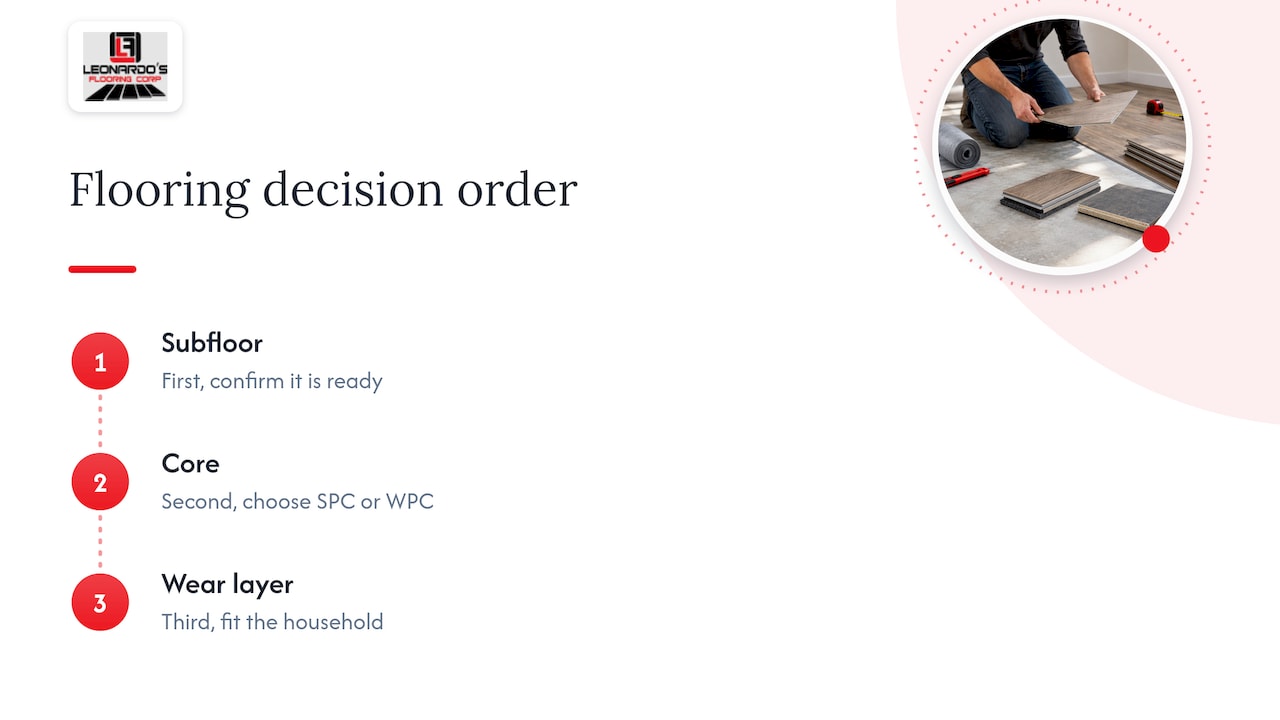
People come to us after reading a dozen articles that say one core is “best.” In our experience, the core is a good second decision. The first is whether the subfloor is ready, and the third is whether the plank’s wear layer fits the household. We have seen a premium plank fail over an uneven slab and a modest plank last because the prep was done right.
We lean toward SPC for kitchens, entries, basements and business spaces, and we are glad to put in WPC where a softer floor is what the family wants. What we will not do is hand you a number that hides the prep work. Every project is tailored to your needs, budget and timeline, and we treat the floor like it is going into our own home.
— Jim
Work with a Denver installer who talks through the options
We install rigid core vinyl plank, along with hardwood, laminate, tile, epoxy coatings, staircases and trim, for homes and businesses across the Denver metro. Read about our vinyl flooring installation, or see all our services and ask for an estimate with subfloor preparation written out as its own line.
FAQ
Which is better, SPC or WPC?
For most homes SPC is the better all-round pick because it is denser and resists dents and temperature movement. WPC wins on comfort and sound absorption. Choose by room, not by a single winner.
Is SPC the same as LVP?
Not quite. LVP is the plank format, and SPC is one core construction used in it. WPC is another. When someone sells you “LVP,” ask which core it has.
What are the disadvantages of WPC?
WPC’s lighter core is more prone to indentation under heavy furniture and appliances. It is also usually thicker, which can matter at door thresholds and transitions. It is a good floor for low-impact rooms.
Are SPC and WPC waterproof?
The planks themselves are, but neither is a moisture barrier. Sealed perimeters and, in many basement or slab installs, a vapor barrier are needed to protect the subfloor.
Is Lifeproof SPC or WPC?
Lifeproof is a brand sold through a big-box retailer, and its range has included both constructions, so you have to check the specific product’s spec sheet.
Sources
- SPC vs. WPC Vinyl Flooring, Bona
- Breaking Down the Core, Floor Covering Weekly
- Check out the latest rigid core flooring standards, Floor Covering Weekly
- Nordic Oak rigid core luxury vinyl plank, Floor & Decor