
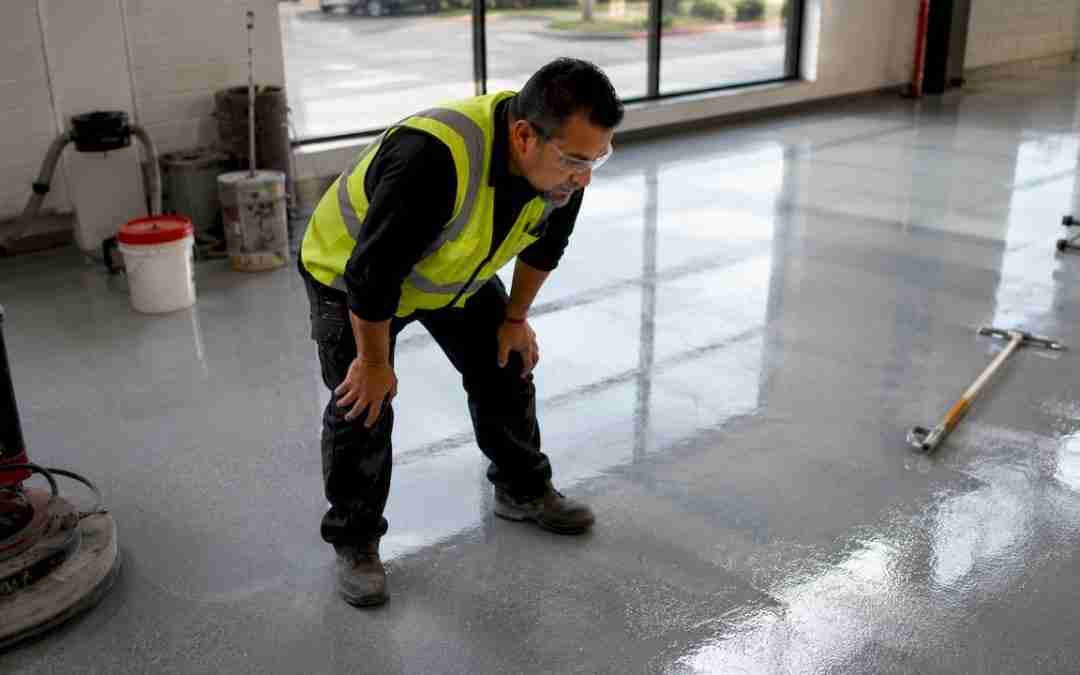
Epoxy flooring is defined as a resinous coating system bonded directly into a concrete substrate, creating a seamless, non-porous surface that outperforms bare concrete in every measurable category. Warehouse managers evaluating why epoxy flooring for warehouses makes sense will find the answer in three areas: structural durability, worker safety, and dramatically lower maintenance costs. Unlike paint or basic sealers, epoxy is a structural system. It chemically bonds to the slab, which means it does not peel, chip, or wear away under forklift traffic or heavy pallet loads. The industry term for this category is “resinous flooring systems,” and epoxy is the most widely installed type in commercial and industrial facilities across the United States.
What are the main benefits of epoxy flooring for warehouses?
Epoxy flooring delivers four core advantages for warehouse environments: extreme durability, chemical resistance, slip safety, and reduced maintenance burden.
Durability that outlasts the competition
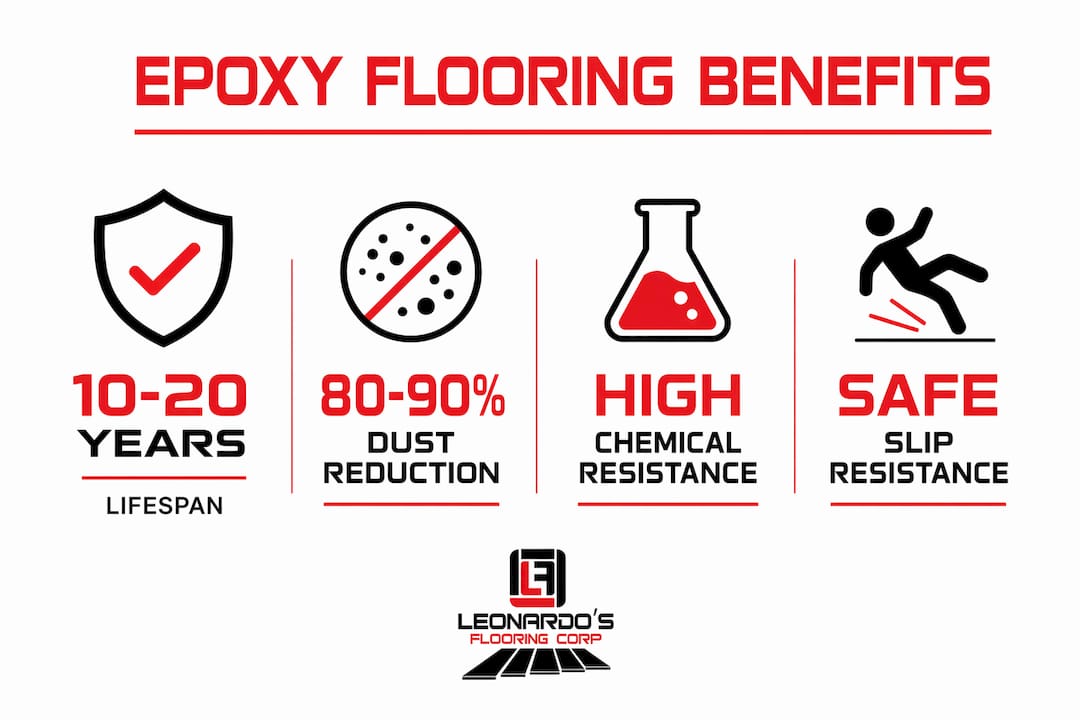
100% solids epoxy systems last 8 to 20 years with proper maintenance and substrate preparation. That lifespan far exceeds paint coatings, which typically fail within 2 to 3 years under industrial traffic. Epoxy also achieves a tension bond strength of 250–300 PSI, which means it grips the concrete slab tightly enough to resist delamination under heavy rolling loads. Compressive strengths of 8,000–10,000 PSI are common in fully cured epoxy systems, often making the coated surface harder than the concrete beneath it. That hardness translates directly to resistance against gouging, abrasion, and point-load damage from forklifts.
Chemical and spill resistance
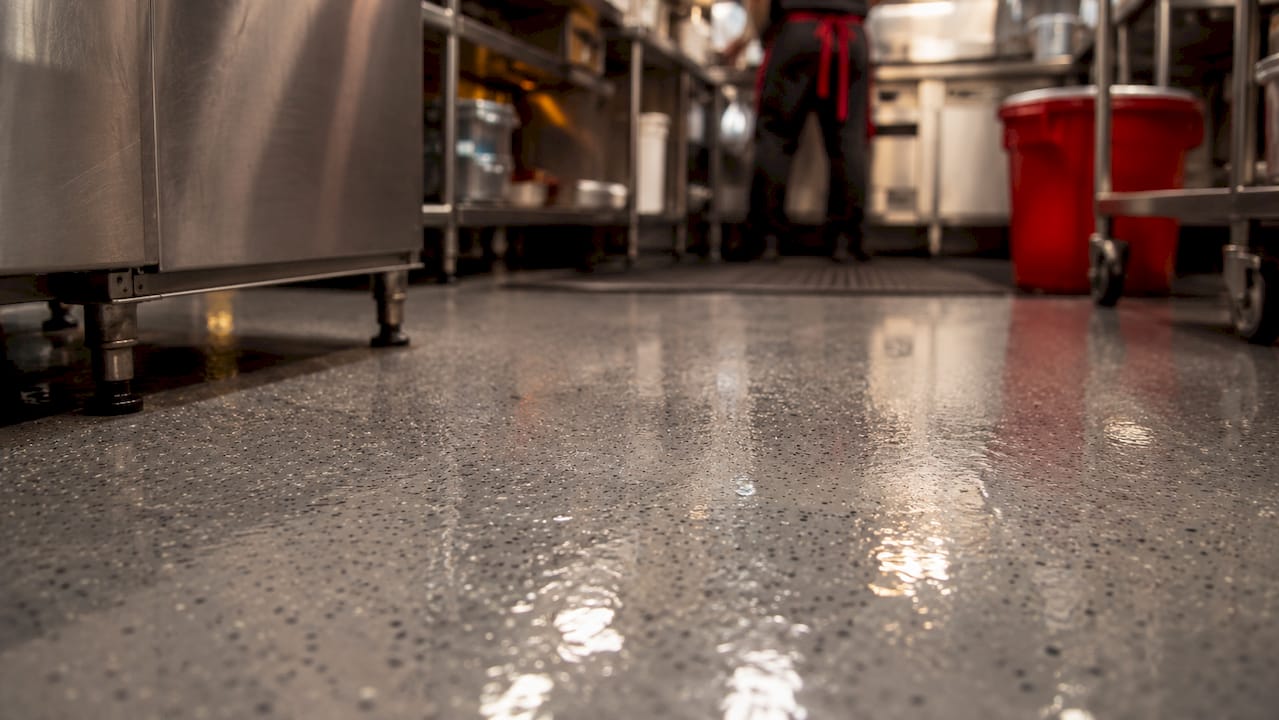
Bare concrete is porous. Oils, battery acid, cleaning solvents, and hydraulic fluid soak into uncoated slabs within minutes, staining the surface and degrading the concrete over time. Epoxy forms a non-porous barrier that prevents chemical absorption entirely. Spills sit on the surface and wipe away cleanly. This protection matters most in automotive distribution centers, food and beverage warehouses, and chemical storage facilities where floor contamination creates both safety and compliance risks.
Slip resistance and safety performance
Epoxy systems with anti-slip aggregates, such as aluminum oxide or quartz broadcast, exceed the DCOF (Dynamic Coefficient of Friction) threshold of greater than 0.36 required by ANSI A137.1 standards. That threshold is the minimum for surfaces considered slip-resistant in commercial settings. Facilities with professional high-traction epoxy flooring see a 40–60% reduction in slip incidents in the first year. Fewer slip incidents mean fewer OSHA recordables, lower workers’ compensation premiums, and less operational disruption.
Maintenance and dust control
Epoxy flooring reduces dust generation by 80–90% compared to bare concrete. Concrete dusting is not just a nuisance. It clogs HVAC filters, contaminates sensitive inventory, and creates a respiratory hazard for workers on long shifts. A sealed epoxy surface requires only a damp mop or auto-scrubber pass to stay clean. The total cost of ownership favors epoxy because the labor hours saved on cleaning accumulate into significant annual savings compared to maintaining untreated concrete.
How does epoxy flooring improve warehouse safety and efficiency?
Safety and operational efficiency are directly connected on a warehouse floor. Epoxy addresses both through four specific mechanisms.
- Anti-slip surface texture. Anti-slip aggregates broadcast into wet epoxy create a textured surface that maintains traction even in wet or oily conditions. Forklift operators and pedestrian workers both benefit, particularly in receiving docks and wash-down areas.
- Reflective finish and lighting efficiency. Epoxy’s glossy surface reflects light back into the warehouse. This reflective quality improves warehouse lighting by 20–30%, reducing the need for additional light fixtures. Better visibility means fewer picking errors, fewer near-miss incidents, and lower electricity costs.
- Color-coded traffic lanes and hazard zones. Permanent color-coded lines, painted directly into the epoxy system, define forklift lanes, pedestrian walkways, emergency exit paths, and hazardous storage zones. These markings do not fade or peel the way painted lines on bare concrete do. Workers respond to clear visual cues, which reduces confusion and improves throughput.
- Incident reduction. Facilities that install high-traction epoxy systems report a 40–60% drop in slip and fall incidents within the first year of installation. That figure has direct implications for OSHA compliance and insurance costs.
Pro Tip: When specifying epoxy for dock areas or wash-down zones, request aluminum oxide broadcast at a rate of 6–8 ounces per square foot. This creates a texture profile that maintains grip even when the floor is wet.
What are the critical installation and maintenance considerations?
Epoxy is only as good as the surface it bonds to. Skipping preparation steps is the single most common reason epoxy floors fail prematurely.
Surface preparation
Mechanical grinding is mandatory before any epoxy application in a warehouse setting. Grinding opens the pores of the concrete and creates a surface profile, measured in CSP (Concrete Surface Profile) units, that gives the epoxy mechanical grip. Shot blasting is an alternative for large open floor areas. Acid etching is not sufficient for industrial-grade systems because it does not create a deep enough profile for the bond strengths required under forklift traffic.
Moisture vapor transmission
Moisture vapor trapped beneath epoxy causes bubbling and delamination, often within weeks of installation. Moisture vapor transmission (MVT) testing using calcium chloride or relative humidity probes is a required step before any epoxy application. If MVT rates exceed the epoxy manufacturer’s threshold, a vapor barrier primer or moisture-tolerant epoxy system must be applied first. Skipping this test is the most expensive mistake a warehouse manager can make.
Pro Tip: Ask your contractor for the MVT test results in writing before installation begins. A reputable installer will always test and document moisture levels as part of the project scope.
Maintenance protocols and expected lifespan
| Maintenance Task | Frequency | Purpose |
|---|---|---|
| Damp mop or auto-scrubber | Daily or as needed | Remove surface debris and spills |
| Neutral pH cleaner wash | Weekly | Prevent residue buildup |
| Inspect for chips or cracks | Quarterly | Catch early damage before it spreads |
| Topcoat reapplication | Every 3–5 years | Restore gloss and surface protection |
| Full system recoat | Every 8–15 years | Extend system lifespan |
Routine maintenance keeps an epoxy system performing at full capacity. Topcoat reapplication every 3 to 5 years costs a fraction of a full reinstall and extends the system’s functional life significantly. Professional installation also preserves manufacturer warranties, which typically cover delamination and adhesion failures when prep protocols are followed correctly. You can review epoxy finish types and durability to match the right system to your specific traffic loads.
How does epoxy compare to other warehouse flooring options?
Warehouse managers often weigh epoxy against bare concrete, concrete sealers, and floor paint. The comparison is not close.
| Flooring Option | Avg. Lifespan | Chemical Resistance | Slip Safety | Maintenance Level | Approx. Install Cost |
|---|---|---|---|---|---|
| 100% Solids Epoxy | 8–20 years | Excellent | High (with aggregate) | Low | $3–$7 per sq ft |
| Bare Concrete | Indefinite | Poor | Low | High | $0 (existing) |
| Concrete Sealer | 1–3 years | Moderate | Low to moderate | Moderate | $0.50–$1.50 per sq ft |
| Floor Paint | 1–3 years | Poor | Low | High | $0.25–$1 per sq ft |
| Polyurethane Coating | 5–10 years | Good | Moderate | Low to moderate | $4–$8 per sq ft |
Bare concrete costs nothing upfront but generates ongoing expenses. Dusting requires frequent cleaning, chemical spills damage the slab, and slip incidents create liability. Floor paint and basic sealers fail quickly under forklift traffic because they sit on top of the concrete rather than bonding into it. Epoxy is a structural system, not a topical coating. That distinction explains why epoxy is not just a paint but a bonded system that becomes part of the slab itself.
The total cost argument for epoxy flooring for industrial use becomes clear over a 10-year horizon. Lower cleaning labor, fewer slip incident costs, and no slab degradation from chemical absorption all reduce operating expenses. You can see commercial epoxy examples from real warehouse and industrial installations to understand what the finished system looks like in practice.
Key Takeaways
Epoxy flooring is the most cost-effective warehouse floor system available because it combines structural durability, slip safety, chemical resistance, and low maintenance into a single bonded coating.
| Point | Details |
|---|---|
| Durability and lifespan | 100% solids epoxy lasts 8–20 years with proper prep and routine maintenance. |
| Safety improvement | High-traction epoxy systems reduce slip incidents by 40–60% in the first year. |
| Dust and chemical control | Epoxy cuts dust generation by 80–90% and blocks chemical absorption into the slab. |
| Installation prep is non-negotiable | Mechanical grinding and moisture vapor testing are required for lasting adhesion. |
| Total cost of ownership | Maintenance savings and incident reduction make epoxy cheaper than bare concrete over time. |
What I’ve learned from warehouse epoxy projects over the years
The clients who get the most out of epoxy flooring are the ones who treat it as a structural investment, not a cosmetic upgrade. The ones who struggle are almost always dealing with the same two problems: inadequate surface prep and ignored moisture.
I have seen warehouse floors delaminate within six months because a contractor skipped MVT testing to save time. The repair cost exceeded the original installation price. Moisture is invisible until it is not, and by then the damage is done. Every reputable installer will test and document moisture levels before touching the floor.
The other thing I push hard on is traction specification. Warehouse managers often default to a standard smooth finish because it looks cleaner. But in dock areas, near wash stations, or anywhere forklifts operate in wet conditions, a smooth finish is a liability. Aluminum oxide or quartz broadcast aggregate adds minimal cost and prevents the kind of incidents that shut down operations for days.
Finally, verify the warranty before signing a contract. A legitimate commercial epoxy warranty covers adhesion failure and delamination for a defined period, typically 5 to 10 years, when the installer follows the manufacturer’s prep protocol. If a contractor cannot provide a written warranty, that tells you everything you need to know about their confidence in the work.
— Jim
Leonardosflooringcorp’s epoxy flooring services for warehouses
Leonardosflooringcorp has been installing commercial and industrial epoxy floor coatings across the Denver metro for over 10 years. Every warehouse project starts with a proper site assessment, including moisture vapor testing and concrete profile evaluation, before any material touches the floor.

The team at Leonardosflooringcorp handles the full installation process, from mechanical grinding through topcoat application, with documented prep protocols and written warranties. For warehouse offices or ancillary spaces that need a different solution, flooring installation services cover hardwood, laminate, vinyl, and tile as well. To get a quote for your facility, visit the Denver epoxy floor coating service page and request a consultation.
FAQ
How long does epoxy flooring last in a warehouse?
100% solids epoxy systems last 8 to 20 years with proper substrate preparation and routine maintenance. Topcoat reapplication every 3 to 5 years extends the system’s life toward the upper end of that range.
Is epoxy flooring slippery in a warehouse?
Standard epoxy can be slippery when wet, but anti-slip aggregates like aluminum oxide or quartz broadcast into the surface exceed the DCOF greater than 0.36 threshold required for commercial slip resistance. Facilities using high-traction epoxy see a 40–60% reduction in slip incidents in the first year.
What is the biggest risk during epoxy installation?
Moisture vapor transmission is the leading cause of epoxy failure. If moisture beneath the slab is not tested and mitigated with a vapor barrier primer, the coating will bubble or delaminate within weeks of installation.
How does epoxy flooring compare to concrete sealer for warehouses?
Epoxy bonds structurally into the concrete and lasts 8 to 20 years. Concrete sealers sit on the surface, last 1 to 3 years, and offer only moderate chemical resistance. For warehouse traffic loads, sealers are not a durable long-term solution.
Does epoxy flooring reduce warehouse cleaning costs?
Epoxy reduces dust generation by 80–90% compared to bare concrete and creates a non-porous surface that cleans with a damp mop or auto-scrubber. The labor savings on cleaning accumulate into significant annual cost reductions compared to maintaining an untreated concrete floor.