

Walk into any flooring showroom without knowing the basic vocabulary and you’ll walk out confused, overpaying, or worse — with the wrong floor. This flooring terminology guide cuts through the jargon so you can hold an informed conversation with any contractor, read product specs with confidence, and catch the kind of mistakes that lead to failed installations and voided warranties. Whether you’re renovating a bedroom in Denver or managing a commercial property, understanding the language of flooring is the single fastest way to protect your investment.
Table of Contents
- Key takeaways
- Your flooring terminology guide starts with materials
- Installation and performance terms you need to know
- Commercial flooring terms and standards
- Flooring defects and failure terms explained
- Flooring types compared by key terms
- My honest take on flooring jargon
- Ready to put this knowledge to work in Denver?
- FAQ
Key takeaways
| Point | Details |
|---|---|
| Learn material layers first | Knowing wear layer, core, and backing helps you compare products on real quality, not just price. |
| Acclimation prevents failures | Skipping the acclimation step causes buckling and voids warranties on hardwood and engineered floors. |
| Commercial floors have stricter standards | ASTM moisture testing and documented bond tests are required for commercial resilient installations, not optional. |
| Defect vocabulary protects you | Recognizing terms like cupping, delamination, and gapping lets you address problems before they become costly repairs. |
| AC ratings matter for laminate | Choose AC3 or AC4 for residential use. AC5 is the standard for heavy commercial traffic. |
Your flooring terminology guide starts with materials
Before you can discuss performance, installation, or cost, you need to understand what each flooring type actually is and how it’s built. Here’s a glossary of flooring materials and construction terms you’ll encounter constantly.
- Solid hardwood: Planks milled from a single piece of wood. Refinishable multiple times. Sensitive to moisture and humidity changes.
- Engineered hardwood: A real wood veneer bonded to a plywood or HDF core. More dimensionally stable than solid hardwood, making it better suited to basements and environments with humidity swings.
- Laminate: A photographic image layer protected by a clear wear layer, fused to a high-density fiberboard (HDF) core and a backing layer. No real wood involved, though it can look convincingly like it.
- Luxury Vinyl Plank (LVP) and Luxury Vinyl Tile (LVT): 100% synthetic products built from PVC layers. Waterproof, highly durable, and available in rigid core (SPC or WPC) formats. SPC stands for Stone Polymer Composite. WPC stands for Wood Plastic Composite.
- Tile: Ceramic, porcelain, or natural stone set in mortar or adhesive. Grout fills the joints between tiles. Porcelain is denser and more water-resistant than ceramic.
- Carpet: Fiber tufts (nylon, polyester, or wool) anchored to a backing. Measured by pile height, fiber weight, and density.
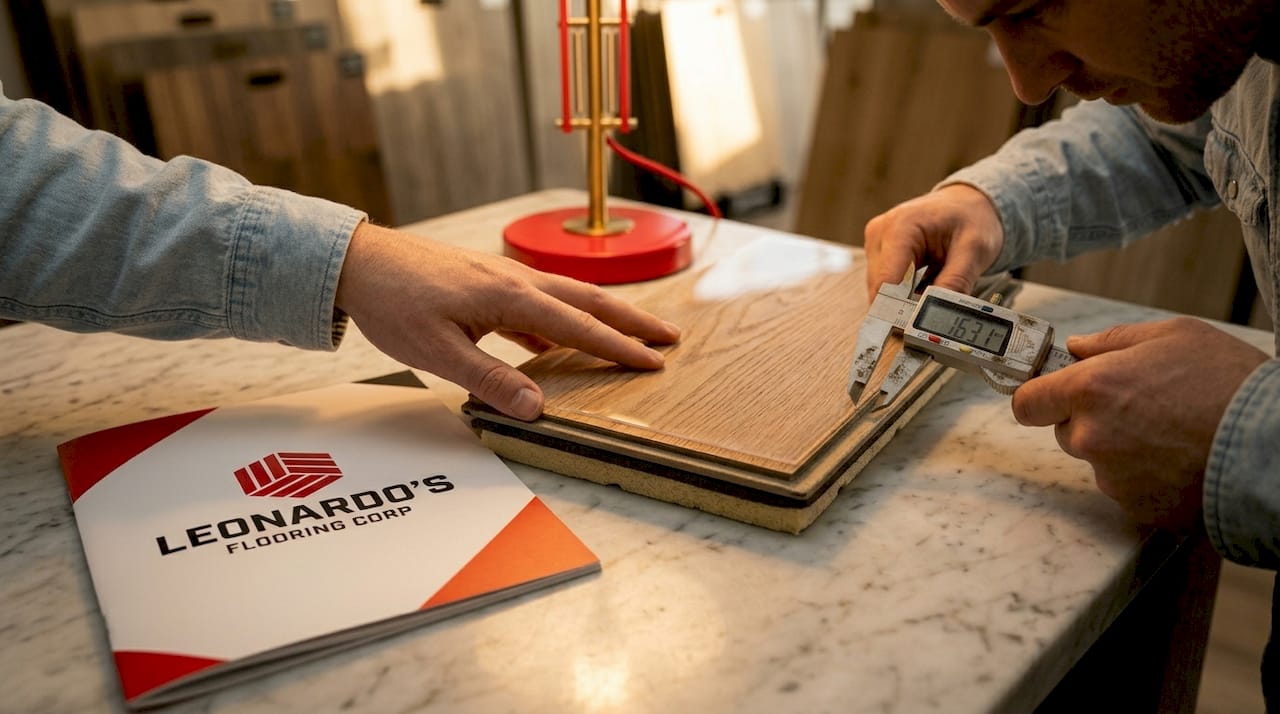
Beyond material type, every floor has a layer structure worth knowing. The wear layer sits on top and takes all the daily abuse. Wear layer thickness varies by product type, and thicker layers improve durability along with refinishing potential. The core provides structural stability. The backing anchors everything and often includes moisture-resistant properties. The underlayment is a separate component installed between the subfloor and the finished floor. It handles cushioning, sound absorption, and sometimes moisture protection, and we’ll cover it more in the next section.
Pro Tip: When comparing vinyl products, always ask for the wear layer thickness in mils. A 12-mil wear layer is adequate for most homes, while 20 mil or higher handles commercial-level traffic.
Installation and performance terms you need to know
Getting the materials right is only half the job. These installation terms directly affect how long your floor lasts and whether your warranty remains valid.
- Acclimation: The process of letting flooring adjust to the temperature and humidity of the room where it will be installed. For hardwood and engineered wood, leaving packs 48 to 72 hours in the installation space prevents expansion and contraction problems after installation. Skipping this step is one of the most common causes of buckling.
- Expansion gap: The deliberate space left between the floor and walls, door frames, and any fixed vertical surface. Most manufacturers recommend an 8 to 12 mm gap around the perimeter of the room. Baseboards or shoe molding typically conceal it. Without a proper gap, floors expand and have nowhere to go, which causes buckling and warping.
- Underlayment: A layer sitting between the subfloor and the finished floor. Its functions include cushioning underfoot, reducing sound transfer between floors, providing a thermal barrier, and in some products acting as a vapor barrier. Underlayment selection directly affects sound control and can influence warranty coverage, so choosing the right type for your flooring product matters.
- Subfloor: The structural base layer beneath all flooring materials, typically plywood or concrete. Its flatness and moisture content determine how well any finished floor performs.
- Abrasion Class (AC) rating: A standardized durability rating applied to laminate flooring. The scale runs from AC1 through AC5, with AC1 suited for light residential use and AC5 designed for heavy commercial applications. Most homes are well-served by AC3 or AC4.
- Floating floor: A floor not glued or nailed to the subfloor. Instead, planks click or lock together and rest on the underlayment. This method requires careful attention to expansion gaps because the entire floor moves as one unit.
One nuance that trips up a lot of DIYers: underlayment should never run up the wall. Improper underlayment placement restricts floor movement and defeats the purpose of leaving an expansion gap. Both systems need to work together, not against each other.
Pro Tip: For floating floors in large rooms, check your product specs for maximum run length. Rigid click-lock floors often require control joints or transition strips at approximately 30 linear feet to prevent stress buildup across long spans.
Commercial flooring terms and standards
Property managers need a slightly different vocabulary than homeowners. Commercial flooring specs involve testing protocols, documentation requirements, and grading systems that go well beyond what a residential installation typically demands.
- Moisture vapor emission rate (MVER): A measure of how much moisture moves through a concrete slab, expressed in pounds per 1,000 square feet per 24 hours. Tested per ASTM F1869.
- Relative humidity (RH) testing: An alternative moisture measurement taken inside the concrete slab using probes. Tested per ASTM F2170.
- Alkalinity (pH) testing: Concrete slabs can have high pH levels that degrade adhesives. Testing is done per ASTM F2659 and must be documented.
For commercial resilient flooring projects, ASTM moisture and pH testing is not a recommendation. It is a specification requirement. Test reports must include the date, the name of the person conducting the test, and the specific area tested. This documentation directly supports warranty compliance and audit readiness.
Beyond moisture testing, commercial managers should know these terms:
- Bond test: A field test confirming that adhesive properly bonds to both the substrate and the flooring material before full installation proceeds.
- Control joint: A deliberate cut or break in a concrete slab or floor system designed to control where cracking occurs. Floating floors installed over control joints require special transition details.
- Traffic classification: Commercial floors are rated by expected foot traffic intensity, often aligned with standards from organizations like ASTM or the manufacturer’s own grading system. Mismatching a floor’s traffic rating to actual conditions is a leading cause of premature wear.
Flooring defects and failure terms explained
Knowing what can go wrong is just as valuable as knowing how to install correctly. If you can name a problem accurately, you can diagnose its cause and communicate clearly with your contractor. Here are the most common defects and what they mean.
- Warping: A general term for any distortion that pulls a plank or tile away from its flat, level plane. Usually caused by moisture imbalance or improper installation.
- Buckling: When the floor lifts off the subfloor, often dramatically. The most common cause is an insufficient expansion gap or installation over a moisture problem that was never addressed.
- Cupping: Specific to wood floors. The edges of a plank rise higher than the center, creating a concave cross-section. This is almost always a moisture issue, where the bottom of the plank absorbs more moisture than the top.
- Crowning: The opposite of cupping. The center of a plank is higher than the edges. This can happen when a cupped floor is sanded before it has fully dried.
- Delamination: The separation of a floor’s layers from each other. Common in engineered wood, laminate, and LVP when adhesives fail or moisture penetrates the core. A hollow sound under tile can indicate delamination or voids beneath the surface.
- Gapping: Spaces that open between planks, typically during dry winter months when wood contracts. Some seasonal gapping is normal in solid hardwood. Excessive gapping points to skipped acclimation or a floor installed during high humidity that is now contracting.
Pro Tip: If you suspect hidden moisture under an existing floor, get a reading before and after removing the old material. Hidden moisture issues often appear only after overlay removal, which can change your underlayment and vapor barrier requirements entirely.
Flooring types compared by key terms
This table pulls together the core terminology from this guide and applies it to each major flooring type, so you can see at a glance how the vocabulary maps to real-world choices.

| Flooring Type | Wear Layer | Moisture Resistance | AC Rating | Best Use Case |
|---|---|---|---|---|
| Solid hardwood | Full plank depth | Low | N/A | Dry living areas, refinishable long term |
| Engineered hardwood | Wood veneer | Moderate | N/A | Basements, areas with humidity variation |
| Laminate | Melamine overlay | Low to moderate | AC1 to AC5 | Budget-friendly residential spaces |
| Luxury vinyl (LVP/LVT) | 12 to 28 mil PVC | High to 100% waterproof | N/A | Kitchens, bathrooms, commercial spaces |
| Porcelain tile | Glazed surface | Very high | N/A | Wet areas, high-traffic commercial zones |
| Carpet | Fiber pile | Low | N/A | Bedrooms, low-traffic residential areas |
For waterproofing terminology and how it applies specifically to LVP and tile, the differences between water-resistant and fully waterproof products are worth understanding before you commit to a material in a wet environment.
My honest take on flooring jargon
I’ve walked through hundreds of installations across the Denver area over more than a decade, and the single most costly mistakes I see come from people who didn’t know the right questions to ask before the work started.
Terms like “acclimation” and “expansion gap” sound technical, but once you understand them, they become a checklist you mentally run through before signing any contract. The number of times I’ve seen a brand-new floor buckle in the first winter because an installer skipped the expansion gap or rushed the acclimation period is genuinely frustrating to think about.
What I’ve learned is that the terminology most often overlooked is the installation-side vocabulary. Homeowners spend hours researching materials, but very few ask about the AC rating, the underlayment specification, or whether moisture testing was done on the subfloor. In commercial projects, skipping ASTM documentation doesn’t just risk the floor. It can void the warranty and create a compliance problem.
My advice: print out this glossary, bring it to your contractor conversation, and don’t be embarrassed to ask what any term means in the context of your specific project. A contractor who can answer those questions clearly is a contractor worth trusting. One who gets defensive or dismissive about the terminology is a red flag you’ll be glad you caught early.
— Jim
Ready to put this knowledge to work in Denver?
Knowing the vocabulary is the first step. Having a team that actually applies it correctly is what makes the difference between a floor you love and one you’re replacing in five years.
At Leonardosflooringcorp, we’ve been installing floors across the Denver metro for over 10 years. Our team handles hardwood floor installation, vinyl flooring installation, laminate, tile, epoxy coatings, and subfloor preparation for both residential and commercial properties. We speak this language every day and we’re happy to walk you through what every term means for your specific project. Whether you’re comparing wear layer specs or asking about ASTM moisture testing for a commercial renovation, we give you straight answers. Explore our full flooring installation services or reach out for a no-pressure consultation.
FAQ
What does acclimation mean in flooring?
Acclimation is the process of letting flooring materials adjust to a room’s temperature and humidity before installation. Hardwood and engineered wood should sit unopened for 48 to 72 hours in the installation space to prevent buckling or gapping after the floor is laid.
What is a wear layer in flooring?
The wear layer is the topmost protective surface of a flooring product that takes daily foot traffic, scratches, and stains. Thicker wear layers last longer and, in some hardwood products, allow for refinishing.
What AC rating do I need for my home?
For most residential applications, an AC3 or AC4 rating gives you the right balance of durability and value. AC5 is built for heavy commercial environments and is typically more expensive than a typical home requires.
What is the expansion gap and why does it matter?
The expansion gap is a small perimeter space left between the floor and all fixed vertical surfaces. Manufacturers generally recommend 8 to 12 mm to allow the floor to expand and contract with temperature changes. Without it, floors buckle.
What flooring terms are specific to commercial properties?
Commercial installations add vocabulary around moisture testing (ASTM F1869, F2170, F2659), bond testing, traffic classification, and control joints. These terms relate to compliance documentation and warranty requirements that most residential projects don’t require.