
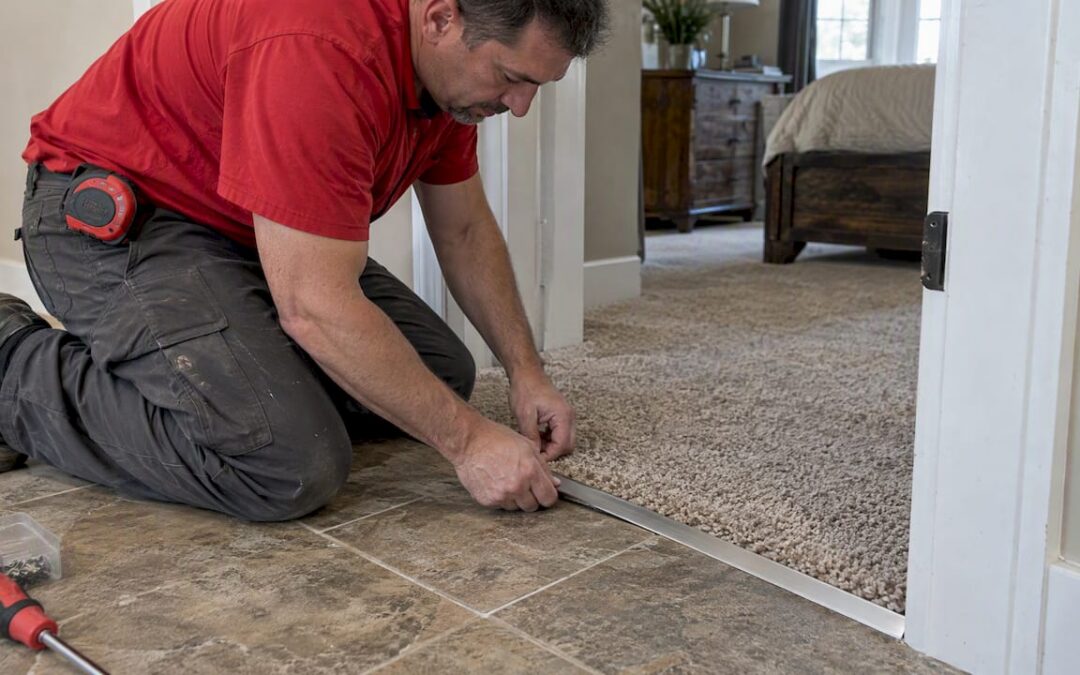
The best tile to carpet transition is the one that matches the height gap between the two floors, protects the carpet edge and leaves a flexible joint on the tile side. In most homes that means one of three things: a metal carpet-edge channel with the carpet tucked in, a low-profile reducer strip, or a tack strip with the carpet turned under and tucked tight against the tile. Which one is right depends on how far apart the two surfaces sit, and that is something you measure before you buy anything.
Below, we walk through each option, the height rules that matter, the step most guides skip (the movement joint), and how to tell when the problem is the subfloor rather than the strip.
TL;DR
- Measure the height difference first. The hard-surface edge should not stand more than 1/16 inch above the finished carpet thickness, according to the Carpet and Rug Institute installation standards.
- The three common finishes are a tucked carpet edge against the tile, a metal or wood carpet-edge strip, and a reducer for larger drops. Each suits a different height gap and traffic level.
- Tile needs a flexible movement joint where it meets a different material, per the TCNA Handbook as explained by TileLetter. A rigid fix can crack the tile later.
- A thicker new carpet may make doors drag. Plan for trimming door bottoms before the installer arrives.
- Uneven subfloors cause more bad transitions than bad strips do. Fix the level, then choose the trim.
Table of Contents
- What the transition is called, and why it matters
- Start with the height gap
- Four ways to finish a tile to carpet transition
- The movement joint most people skip
- Step by step: how a clean transition gets built
- Mistakes we see most
- Our perspective: fix the floor, then pick the trim
- Cost and budgeting for transitions
- Get the transition done right
- FAQ
- Sources
What the transition is called, and why it matters
Installers use “transition” for any trim that joins two different floor coverings. Depending on the profile, you will hear carpet-edge strip, carpet gripper bar, reducer, T-molding or threshold. They are not interchangeable.
- Carpet-edge (or carpet-to-hard-surface) strip: an L-shaped or channel piece that grips the carpet on one side and sits flush against the tile on the other.
- Reducer: a sloped piece that steps down from a taller floor to a shorter one. It suits cases where the tile sits noticeably higher than the carpet.
- T-molding: used when both floors are at nearly the same height. It rarely suits carpet because carpet is soft and compresses.
- Tuck-in (turn-and-tack) finish: no visible strip. The carpet is stretched over a tack strip and tucked against the tile edge.
The CRI residential and commercial standards say carpet edges must be protected or covered with appropriate transition moldings where carpet meets another floor covering. If no molding is used, the installer should apply a bead of seam sealer of at least 1/8 inch to the carpet edge so it does not fray.
Start with the height gap
Before choosing a strip, lay a straightedge across the tile and measure down to the subfloor where the carpet will go. Then add the carpet and pad thickness. You need three numbers: tile height, finished carpet height and the difference.
The CRI standard sets the target: the edge of the hard surface should not exceed the carpet’s total thickness by more than 1/16 inch. Anything bigger than that is a tripping edge, and the strip is being asked to hide a leveling problem.
A rough guide:
| Height difference | Typical solution | Notes |
|---|---|---|
| Under 1/16 inch | Tuck-in finish or flat carpet-edge strip | Cleanest look, works well with dense, low-pile carpet |
| 1/16 to 1/4 inch | Carpet-edge channel or low reducer | Common for tile over thin underlayment next to carpet and pad |
| 1/4 inch and above | Reducer, or fix the subfloor level | Large drops are a trip risk, and the strip becomes a ramp |
These are working ranges we use to talk through jobs, not code limits. For accessible routes, the ADA standards cap a change in level at 1/4 inch if it is vertical and require a bevel between 1/4 and 1/2 inch, as summarized by Door Security + Safety. Most single-family homes are not covered by those rules, but they are a sensible benchmark if anyone in your household uses a walker or wheelchair. Commercial spaces in the Denver area should confirm the requirements with the local building department.
A mismatch usually comes from one of three places: thick tile with thin-set over a subfloor that was never built up, a new plush carpet that compresses less than the old one, or an old pad left in place. The partner guide on managing floor-height clashes covers the same measuring logic for kitchens and baths, where tile, cabinets and neighboring floors all have to line up.
Four ways to finish a tile to carpet transition
1. Tuck-in (turn and tack)
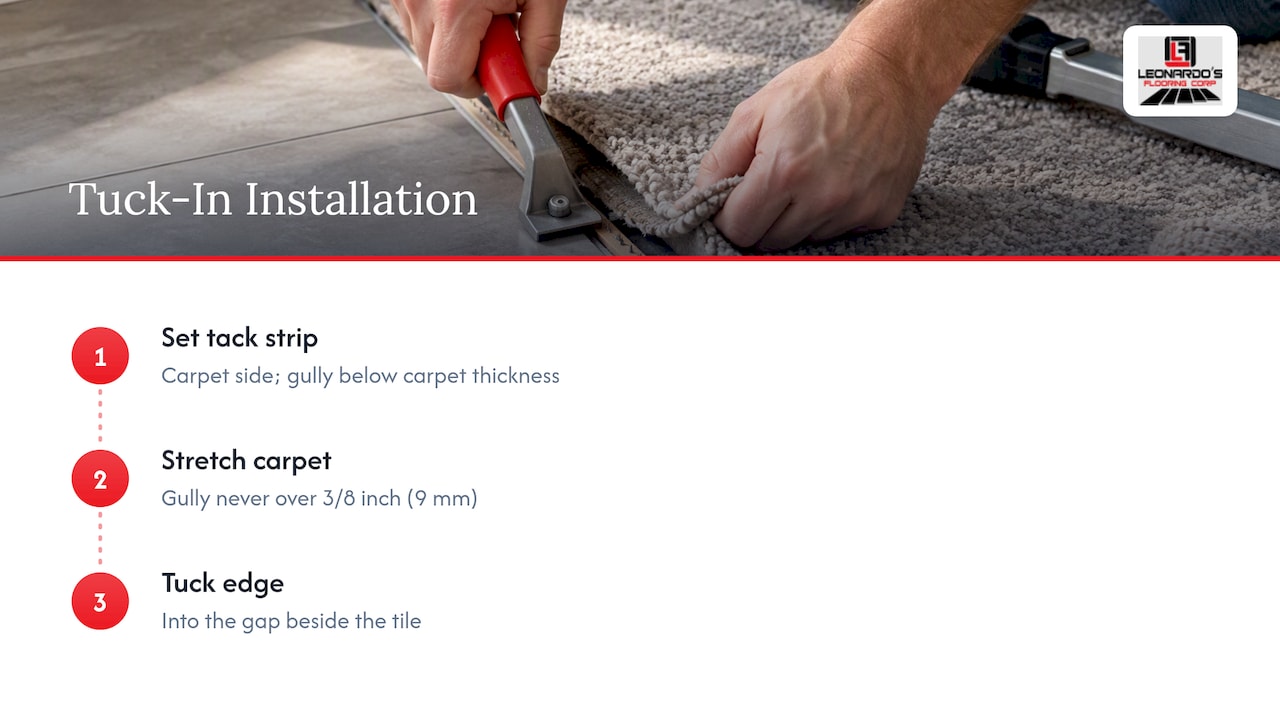
The installer sets a tack strip on the carpet side, stretches the carpet over it, and tucks the edge into the gap beside the tile. There is no visible hardware. It looks best when the carpet is dense and the tile edge is square and straight.
The gap between tack strip and the vertical edge matters. Installers call it the gully. For a stretch-in installation, per the CRI standards, it should be slightly less than the carpet thickness and never more than 3/8 inch (9 mm), or the carpet will not be held securely.
Best for: bathrooms and closets with low foot traffic and cut-pile or dense loop carpet.
Watch for: loose, high-pile carpet, which can lift and ripple at the edge. Without a strip, the exposed edge also relies on a sealer bead to resist fraying.
2. Metal carpet-edge channel
An aluminum or brass strip is screwed or glued to the subfloor along the tile edge. The carpet is stretched and pressed into the channel, and the lip is crimped down to hold it. This is the standard answer for hallways and bedroom doors because it protects the carpet edge from vacuum and foot wear.
Best for: high-traffic doorways, rental-grade durability, commercial offices.
Watch for: a strip that sits proud of the tile. Pick a height that fits your gap and fasten it into solid substrate, not just the tile.
3. Wood or vinyl reducer
Where tile stands higher than carpet, a reducer slopes down over the gap. Wood reducers can be stained to match nearby hardwood or trim. Vinyl is cheaper and more forgiving.
Best for: a visible step of 1/4 inch or more that you cannot or do not want to rework.
Watch for: a reducer that covers the tile edge but leaves no room for a movement joint. See below.
4. Flush carpet-bar with a tile edge profile
Some tile jobs use a finished metal profile at the tile edge, set into the thin-set as the tile is laid. The carpet then meets a clean, protected tile edge. This must be planned before the tile goes down, so it is a choice for new installs and remodels, not a quick retrofit.
Best for: kitchens, entryways and new tile with clear design lines.
The movement joint most people skip
Tile and carpet behave differently. Tile is rigid, the building moves, and the two do not agree. The TCNA Handbook requires movement joints where tile meets dissimilar flooring or restraining surfaces, as TileLetter explains. A related TileLetter article names the lack of a proper movement joint as a critical mistake, one that can crack tile even when the finished floor looks perfect.
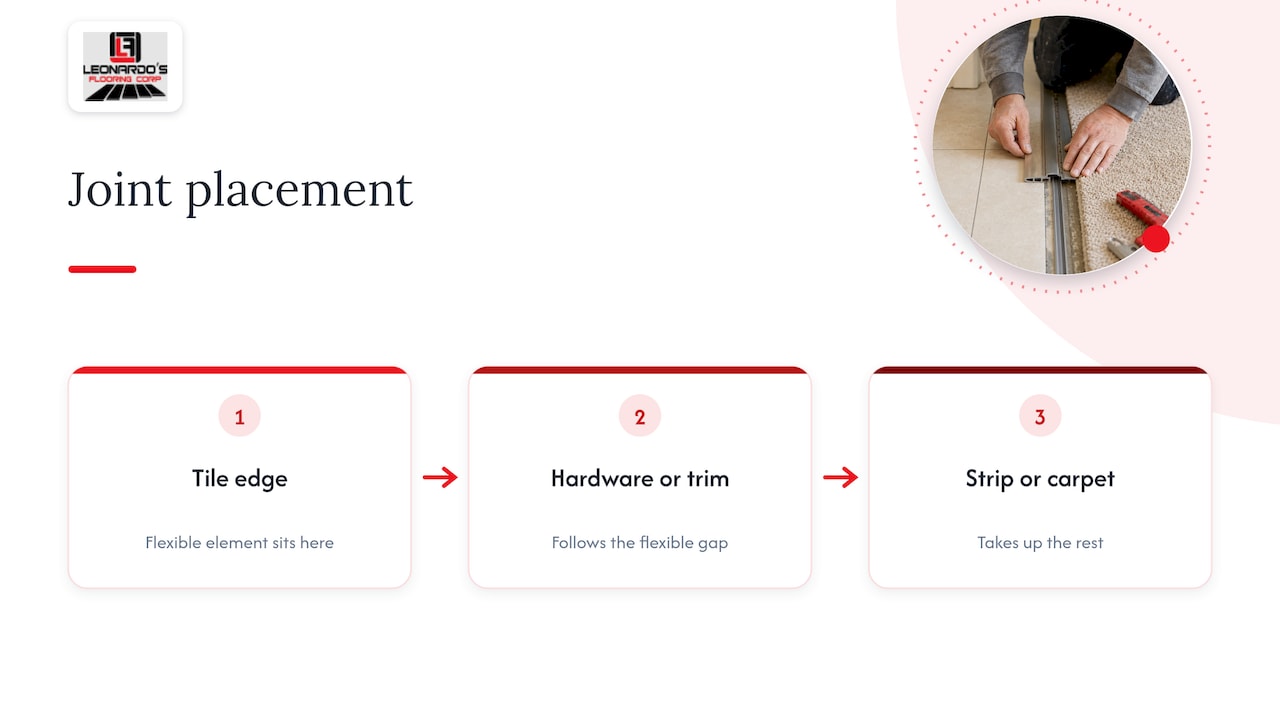
At a carpet transition, that usually means a small gap or flexible joint between the tile edge and whatever hardware or trim follows, not a rigid strip pressed hard against the tile. Carpet is the forgiving side, so the flexible element sits at the tile edge, and the strip or tucked carpet takes up the rest.
Denver has dry air and a wide seasonal swing, and homes shift as humidity changes. If you want a plain-language walk-through of where these joints go, our guide to tile expansion joints covers four rules for homeowners, and our piece on fitting baseboards with tile floors shows how a 1/4 inch movement gap works at the wall.
Step by step: how a clean transition gets built
- Check the subfloor. Flatten high spots, fill low spots and confirm it is dry and solid. If the tile room sits above the carpeted room, decide now whether to build up the carpet side or ramp the difference.
- Set the tile first. Tile goes down before carpet. Leave the movement gap at the edge, and keep the tile edge straight and chip-free. Grout lines should end cleanly at the doorway.
- Choose the strip. Match its height to your measured gap, not to a store sample. Pick material by traffic: metal for hallways, wood for visible thresholds.
- Fasten the strip or tack strip. Keep the correct gap from the vertical edge so the carpet grips. Do not crush the strip into the tile edge.
- Stretch and tuck the carpet. Power-stretch to the strip, trim cleanly and set the edge. Seal any exposed cut edges.
- Check door clearance. A deeper carpet and pad can make the door scrape. Per a Shaw Floors installation guide, trimming door bottoms is generally the homeowner’s task, not the carpet installer’s, so arrange it ahead of time.
- Walk it. Barefoot and in socks, walk the line in both directions. If you feel the edge, it can be adjusted. If you trip, it needs to be redone.
Mistakes we see most
- Buying the strip before measuring. Strips come in set heights, and the wrong one forces a ramp.
- Gluing a rigid strip tight to the tile. Without room for movement, the tile can crack or pop.
- Skipping the seam sealer when no molding is used, which leaves the carpet edge to fray.
- Ignoring the pad. Thick pad under thin carpet changes the finished height more than most people expect.
- Putting the transition under the door swing wrongly. The best line is usually directly under the closed door, so the strip is hidden when the door is shut.
- Treating a subfloor problem as a trim problem. A strip cannot make an uneven floor level.
Our perspective: fix the floor, then pick the trim
We install tile, carpet-adjacent finishes and trim across the Denver metro, and the transition is where our customers most often tell us a previous job went wrong. The strip is the visible part, but the problem is almost always upstream.
Our approach is simple. We measure the real height difference in each doorway before we quote, we plan the movement joint into the tile stage, and we match the strip to how the room is used. A guest bedroom and a main hallway do not need the same hardware. We would rather tell you that a 3/8 inch drop needs subfloor work than sell you a tall reducer that you will trip over in a year.
We also tell you early about the unglamorous parts: baseboards and quarter-round that need to be reset after the floor goes in, and door bottoms that need trimming. Nothing should surprise you on install day. That is how we run every project, tailored to your needs, budget and timeline.
— Jim
Cost and budgeting for transitions
Transition strips themselves are inexpensive compared with the floors they join. What drives the bill is labor and prep: the number of doorways, whether the subfloor needs leveling, and whether trim has to be removed and reset. A house with a bathroom, a laundry room and a kitchen entry meeting carpet has several transitions, while a single bedroom might have one.
We do not publish fixed prices because every doorway differs. For a framework on what shapes a quote in this area, see our floor installation cost factors for Denver, and for trim line items, our quarter-round cost breakdown. If the subfloor is the issue, our subfloor preparation guide explains what leveling involves.
Get the transition done right
If you are adding tile next to existing carpet, or replacing carpet next to tile, we handle the whole chain: subfloor prep, tile floor installation, trim and finish carpentry, for homes and businesses in Denver, Aurora, Lakewood, Arvada, Centennial, Thornton, Westminster, Highlands Ranch, Castle Rock, Littleton and Boulder. Browse everything we install on our services page, or reach out through our site for an on-site measurement and a quote with no hidden fees.
FAQ
What is the best transition from tile to carpet?
For most doorways, a metal carpet-edge channel gives the best balance of durability and clean looks. Where the carpet and tile are almost level and traffic is light, a tucked carpet edge is neater. If the tile sits higher, use a reducer that fits your measured gap.
Do you need a transition between carpet and tile?
The CRI standards call for carpet edges to be protected or covered with transition molding. If no molding is used, the carpet edge needs at least a 1/8 inch bead of seam sealer. Practically, almost every doorway benefits from a strip because it also protects the carpet and gives the tile a soft stop.
What is the transition from carpet to tile called?
The trim is usually called a carpet-edge strip, carpet transition strip or reducer. A tucked finish with no visible trim is called a turn-and-tack or tuck-in finish. The term depends on the profile, and the right one depends on the height gap.
Can I install a transition strip over uneven floors?
A strip can hide a very small difference, but it cannot fix an uneven subfloor. Differences beyond about 1/16 inch over the carpet thickness should be corrected at the subfloor, with leveling or a build-up, before you choose trim.
Why did the tile crack near the carpet edge?
The most common cause is a missing movement joint. Tile that is locked rigidly against another material cannot absorb the building’s normal expansion and contraction. Cracks can also come from a hollow spot or a weak subfloor, so have it inspected before replacing anything.
Sources
- Installation Standards, The Carpet and Rug Institute
- Movement joints, TileLetter
- The critical importance of movement joints in tile work, TileLetter
- What to Expect Carpet Installation, Shaw Floors
- Decoded: Thresholds, Door Security + Safety