
Proper floor installation is defined as the complete process of preparing, acclimating, and securing flooring materials according to manufacturer specifications, moisture standards, and structural requirements. The importance of proper floor installation goes far beyond aesthetics. A floor installed without moisture testing, correct subfloor preparation, or adequate expansion space will fail, and that failure voids most manufacturer warranties. Denver’s climate adds another layer of complexity. The city’s dry winters, humid summers, and dramatic temperature swings create conditions where installation shortcuts surface as warped boards, cracked grout, or buckled vinyl within months of project completion.
What makes floor installation proper and effective?
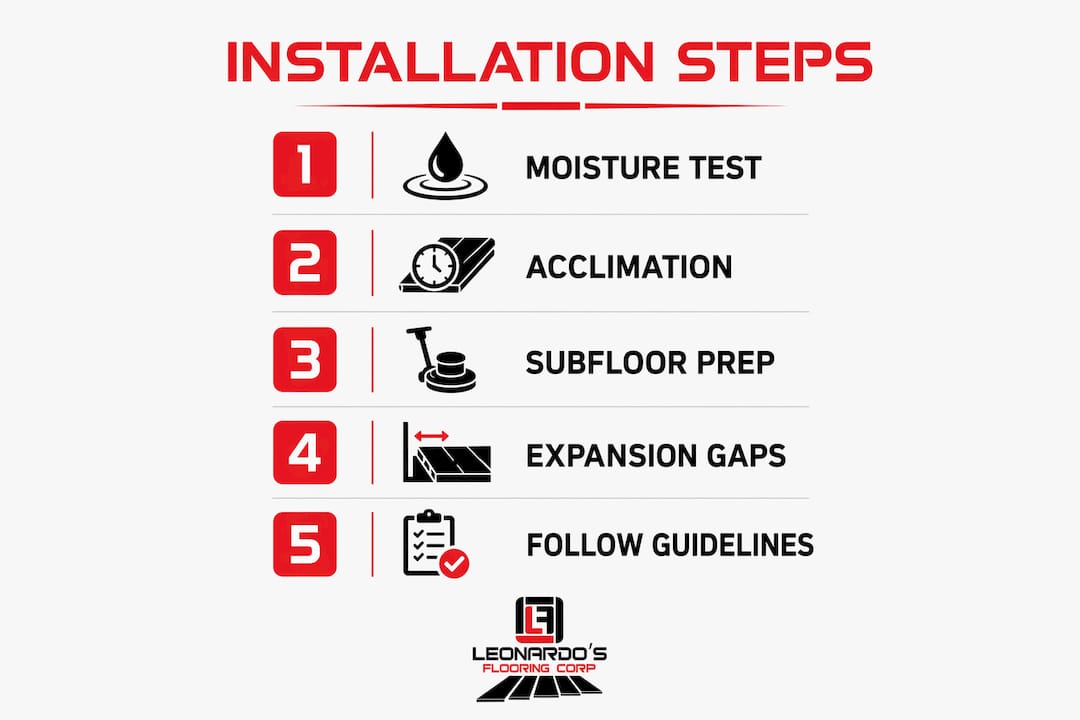
Proper flooring techniques rest on five non-negotiable factors. Get any one of them wrong and the floor’s performance, appearance, and warranty protection all suffer.
Moisture control is the starting point. Concrete subfloors must be tested using ASTM F1869 (calcium chloride) or ASTM F2170 (relative humidity probe) methods. Moisture levels must stay below 3 lbs per 1,000 sq ft per 24 hours and 75% RH before most hardwood manufacturers will honor a warranty claim. Skipping this test is the single most common reason flooring warranties are denied.
Acclimation comes next. Flooring materials need to adjust to the temperature and humidity of the space where they will live. HVAC conditions of 60 to 80°F and 35% to 60% relative humidity must be maintained for at least 48 hours before acclimation even begins. Hardwood typically requires 7 to 14 days of acclimation on site before installation starts.
Subfloor flatness is the factor most homeowners underestimate. The industry standard requires the subfloor to be flat within 3/16 inch per 10-foot span. High spots create pressure points that crack joints, while low spots allow flexing that loosens fasteners over time. Both problems degrade the floor silently before they become visible.
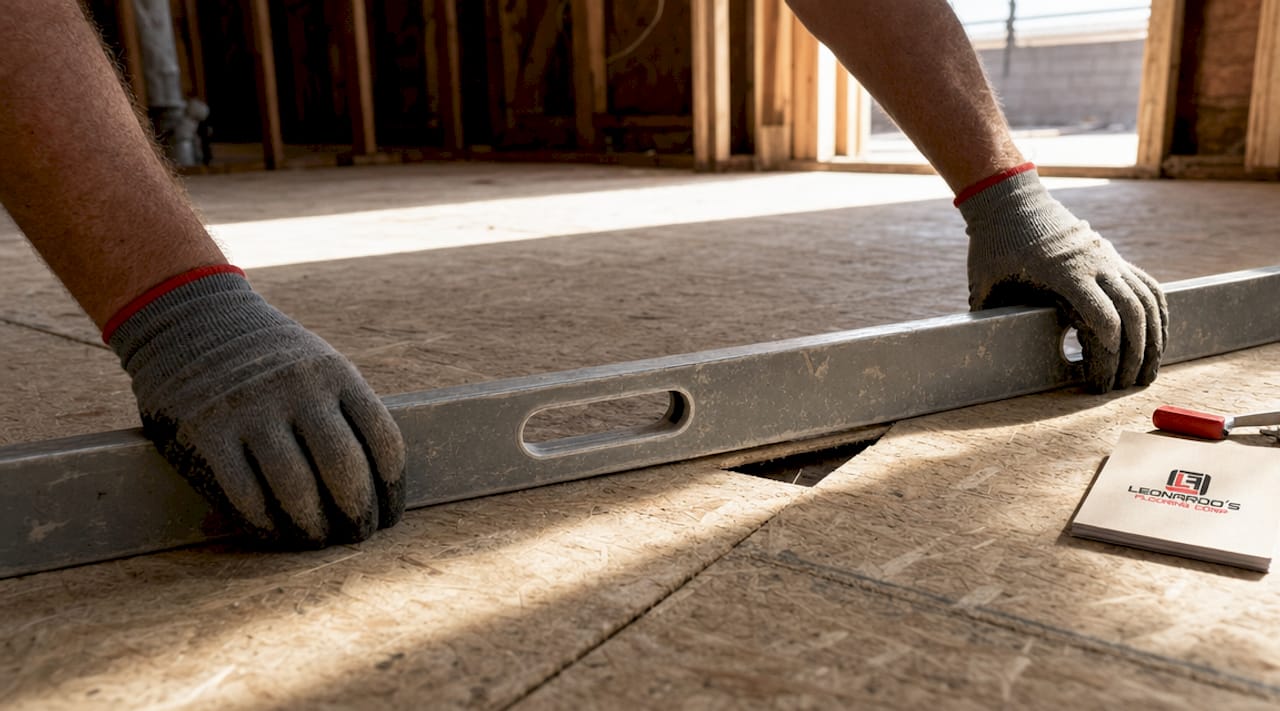
Expansion gaps allow flooring materials to move with seasonal humidity changes without buckling or cracking. Most hardwood and laminate installations require a minimum 1/2-inch gap at all walls and fixed objects.
Manufacturer guidelines tie everything together. Following the installation instructions specific to each product is not optional. Deviating from them, even slightly, gives manufacturers legal grounds to deny warranty claims.
Pro Tip: Before any flooring goes down, photograph your moisture readings and subfloor flatness measurements. That documentation protects you in a warranty dispute and proves the installation met manufacturer requirements from day one.
How do installation mistakes impact floor performance and warranty?
Warranty problems stem more often from installation failures than from material defects. The most damaging errors follow a predictable pattern.
-
Skipping acclimation. Hardwood installed without proper acclimation absorbs or releases moisture after installation, causing cupping, crowning, or gaps between boards. These problems appear within weeks and are almost never covered under warranty because the cause is traceable to the installation process.
-
Ignoring moisture testing. Excess moisture in a concrete subfloor migrates upward into flooring adhesives and materials. The result is bond failure, mold growth beneath the floor, and complete replacement costs that far exceed the original installation budget.
-
Inadequate subfloor preparation. A subfloor that is not flat within tolerance creates stress points across the entire floor. Subfloor flatness issues silently degrade floor appearance and durability over time, even when the floor looks acceptable on installation day.
-
Missing expansion and movement joints. Without proper movement space, flooring materials have nowhere to go when they expand. Hardwood buckles. Tile fields crack. Laminate planks pop up at seams. Movement joints in tile are engineered solutions, not optional decorative features, and omitting them is a code violation in many jurisdictions.
-
Ignoring manufacturer installation guidelines. Every flooring product comes with specific installation requirements. Deviating from those requirements, whether by using the wrong adhesive, skipping a primer coat, or installing over an unapproved substrate, gives the manufacturer grounds to void the warranty entirely.
“Many flooring problems emerge weeks or months post-installation due to seasonal environmental changes affecting material movement and bond integrity. Site conditions outside product tolerances cause seam problems and warranty issues that appear later, not immediately.”
This delayed timeline is what makes installation errors so costly. By the time the problem is visible, the installer may be long gone and the warranty window may have closed.
How do hardwood, tile, and resilient floors differ in installation requirements?
Each flooring category has its own set of technical standards. Treating them interchangeably is a reliable path to failure.
| Flooring type | Key installation requirements | Primary failure risk |
|---|---|---|
| Hardwood | 7 to 14 days acclimation; nail, staple, or glue-down method; 1/2-inch expansion gap at walls | Cupping, gapping, or buckling from moisture or skipped acclimation |
| Ceramic tile | Substrate deflection limit L/360; movement joints every 20 to 25 feet; full mortar coverage | Grout cracking and tile debonding from substrate flex |
| Natural stone tile | Substrate deflection limit L/720 (twice as strict as ceramic); pre-planned joint layout | Cracking from even minor substrate movement |
| Laminate | Subfloor flat within 3/16 inch per 10 feet; floating installation with perimeter gap | Peaking at seams from missing expansion space |
| Luxury vinyl plank | Moisture testing required; flatness within 3/16 inch per 10 feet; adhesive selection by substrate | Bubbling and edge lifting from moisture or adhesive failure |
Tile installations carry the strictest structural requirements. Ceramic tile requires substrate deflection no greater than L/360, meaning a 10-foot span can flex no more than 0.333 inches. Natural stone cuts that tolerance in half. Exceeding these limits causes grout to crack and tiles to debond, often within the first heating or cooling season.
For hardwood, the most critical installation stage is subfloor preparation, not the wood installation itself. Rushed prep work accounts for the majority of hardwood failures. If you want to understand what proper prep looks like in practice, the subfloor preparation process for lasting results covers the specific steps and tolerances that matter most.
Resilient floors, including luxury vinyl plank and sheet vinyl, are often marketed as forgiving products. They are not. They telegraph every subfloor imperfection through the finished surface and fail at adhesive bonds when moisture is present. Choosing the right adhesive for the substrate type is as important as the moisture reading itself.
For tile specifically, movement joint placement must be mapped before a single tile is set. Reworking joints after installation is impractical and expensive. This is a design decision, not an afterthought.
How does Denver’s climate affect floor installation and long-term performance?
Denver sits at 5,280 feet with an average annual relative humidity around 40%, but that number masks dramatic seasonal swings. Winter indoor humidity can drop below 20% when heating systems run continuously. Summer monsoon season pushes humidity up sharply. Those swings are exactly the conditions that expose every installation shortcut.
Denver’s seasonal humidity and temperature swings expose installation shortcut consequences weeks or months later, demanding cautious acclimation and moisture control. A hardwood floor installed in October, when indoor humidity is stable, may show gapping by February when the heating system drives humidity below 25%. That gapping is not a product defect. It is a predictable result of installing without accounting for the full seasonal range the floor will experience.
Concrete subfloors in Denver basements and ground-level slabs present a specific challenge. Moisture moves upward through concrete year-round, but the rate changes with seasons and soil conditions. A moisture test taken in August may not reflect conditions in April after snowmelt. Professional installers in Denver treat moisture testing as a go/no-go checkpoint, not a formality. Documented moisture and flatness testing before installation protects warranty claims by proving manufacturer instruction compliance.
Acclimation periods in Denver often need to run longer than manufacturer minimums. A product spec sheet written for a mid-Atlantic climate assumes 50% average humidity. In Denver’s dry winter months, that same product may need additional time to reach equilibrium with the actual site conditions.
Pro Tip: Run your HVAC system at the temperature and humidity levels you plan to maintain year-round for at least a week before flooring materials are delivered. This gives you an accurate picture of the real acclimation environment, not an idealized one.
Key takeaways
Proper floor installation requires moisture control, subfloor preparation, acclimation, expansion space, and strict adherence to manufacturer guidelines to protect both floor performance and warranty validity.
| Point | Details |
|---|---|
| Moisture testing is non-negotiable | Use ASTM F1869 or ASTM F2170 methods to confirm levels below 3 lbs per 1,000 sq ft and 75% RH before installation. |
| Subfloor flatness drives longevity | Floors must be flat within 3/16 inch per 10-foot span to prevent joint failure, squeaking, and surface degradation. |
| Each flooring type has unique standards | Tile, hardwood, and resilient floors each require different deflection limits, acclimation periods, and adhesive choices. |
| Denver’s climate demands extra caution | Seasonal humidity swings below 20% in winter require longer acclimation and conservative moisture readings taken across seasons. |
| Documentation protects your warranty | Photographs of moisture readings and flatness measurements before installation create a defensible record for warranty claims. |
What I’ve learned after a decade of Denver floor installations
After ten years of installing floors across the Denver metro, the pattern I see most often is this: the homeowner or business owner chose a beautiful product, paid a fair price for it, and then watched it fail within a year. Almost every time, the failure traces back to something that happened before the first plank or tile was ever set.
The uncomfortable truth is that most flooring failures are entirely preventable. Skipped acclimation, untested moisture, and a subfloor that was “close enough” to flat are the culprits in the vast majority of cases I have seen. The floor itself is rarely the problem. The process leading up to installation is where things go wrong.
What I tell every client is this: the upfront investment in proper preparation costs a fraction of what a full floor replacement costs 18 months later. A moisture mitigation system on a problem slab might add to your project budget. Replacing a buckled hardwood floor costs several times that. The math is not complicated.
I also encourage every homeowner and business owner to ask their installer direct questions before work begins. Ask what moisture testing method they use. Ask how they verify subfloor flatness. Ask how long they plan to acclimate the material on site. If the answers are vague, that is information worth having before the project starts, not after.
The floors we install at Leonardosflooringcorp go through documented pre-installation checks on every job. Not because it is required, but because it is the only way to stand behind the work with confidence. That standard is what professional installation lasting results actually looks like in practice.
— Jim
Get expert floor installation right the first time in Denver

Leonardosflooringcorp has served the greater Denver metro for over 10 years as a trusted Home Depot Contractor, handling hardwood floor installation, tile floor installation, laminate, vinyl, and full subfloor preparation for both residential and commercial properties. Every project starts with documented moisture testing and subfloor assessment, the same go/no-go checkpoints that protect your warranty and your investment. Our 125+ five-star reviews reflect what happens when installation is done correctly from the first day. If you are planning a flooring project in Denver and want it done right the first time, contact Leonardosflooringcorp for a consultation and honest quote tailored to your space, budget, and timeline.
FAQ
What is the importance of proper floor installation?
Proper floor installation protects the floor’s durability, appearance, and warranty validity by controlling moisture, subfloor flatness, acclimation, and expansion space. Skipping any of these steps leads to warping, cracking, bond failure, and warranty denial.
How long does hardwood flooring need to acclimate before installation?
Hardwood flooring typically requires 7 to 14 days of acclimation on site, with HVAC conditions maintained between 60 and 80°F and 35% to 60% relative humidity throughout the process.
What are the most common flooring installation errors?
The most common errors are skipping moisture testing, rushing acclimation, failing to flatten the subfloor, omitting expansion gaps, and deviating from manufacturer installation guidelines. Each of these mistakes can void the manufacturer warranty.
Does Denver’s climate require special flooring installation considerations?
Yes. Denver’s dry winters can push indoor humidity below 20%, which causes wood and laminate floors to contract and gap. Longer acclimation periods and moisture readings taken across multiple seasons give the most accurate picture of actual site conditions.
How does tile installation differ from hardwood installation?
Tile requires strict substrate deflection limits (L/360 for ceramic, L/720 for natural stone) and pre-planned movement joints, while hardwood focuses on acclimation time and subfloor flatness. Both require moisture testing, but the structural requirements for tile are more demanding.