

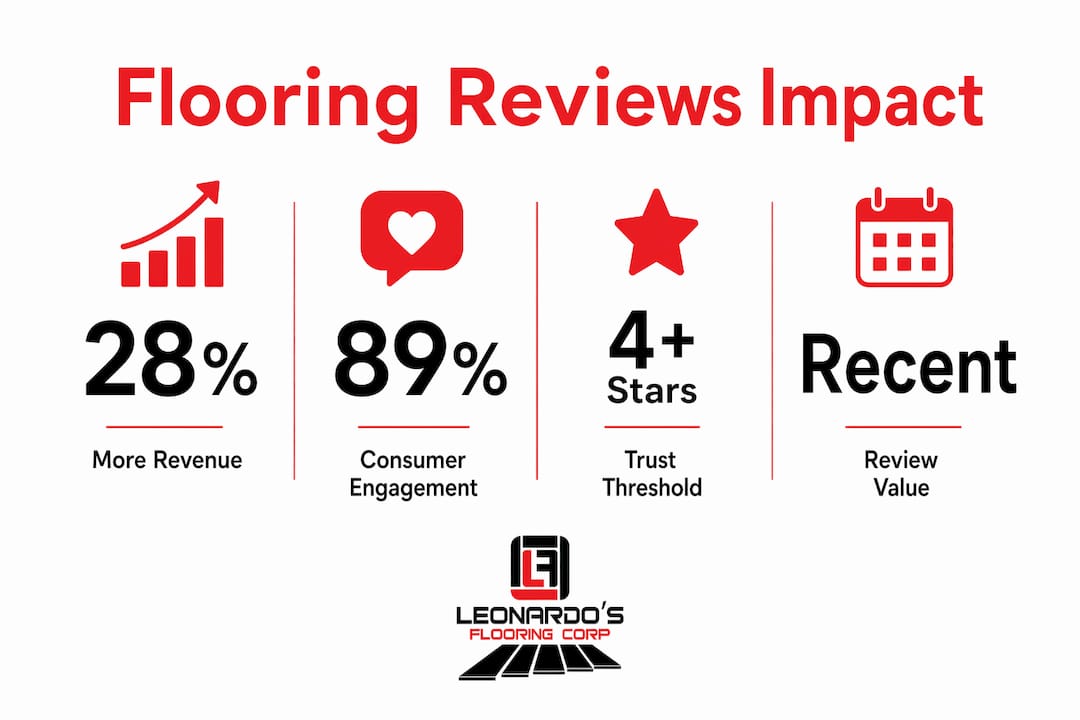
Flooring reviews are the most reliable trust signal available to homeowners and businesses before committing to a purchase. They cut through brand marketing to reveal what actually happens on the job: whether installers show up on time, how a product holds up after six months, and whether a company fixes problems or ignores them. The role of flooring reviews has grown far beyond simple star ratings. In 2026, 93% of consumers read reviews before choosing a flooring company, and 85% won’t consider any business rated below four stars. That number tells you everything about where buyer trust actually lives.
What is the real role of flooring reviews?
Flooring reviews function as the modern equivalent of word-of-mouth. They give you access to the unfiltered experiences of people who already made the decision you’re about to make. A product brochure tells you a floor is durable. A verified review tells you it buckled after one Denver winter.
The importance of flooring reviews goes beyond product specs. Reviews expose installation quality, communication habits, and how a company behaves when something goes wrong. Those are the details that determine whether your project ends well or becomes a costly headache. Leonardosflooringcorp has built its reputation on exactly this kind of transparency, earning 125+ five-star reviews by treating accountability as a standard, not an exception.

Reviews also influence search rankings and lead generation directly. Businesses with 4+ star ratings earn 28% more revenue than competitors with lower scores. That gap reflects real buyer behavior, not just perception.
How do you read flooring reviews beyond star ratings?
Star ratings give you a quick signal, but they rarely tell the full story. A company can hold a 4.2-star average while hiding a pattern of late arrivals or poor subfloor prep. The depth and consistency of written comments matter far more than the number itself.
When reading reviews, focus on these specific indicators:
- Installation professionalism: Did the crew arrive on time, protect furniture, and clean up after the job?
- Communication quality: Were quotes clear? Did the company follow up without being chased?
- Problem resolution: When something went wrong, how fast did the company respond and fix it?
- Timeliness: Were project timelines honored, or did delays pile up without explanation?
- Review response behavior: Does the business reply to negative reviews with solutions, or go silent?
Detailed comments about professionalism and problem resolution reveal far more about a company’s real operation than any aggregate score. A business that responds to a critical review within 24 hours with a genuine fix is a safer bet than one with a higher rating and zero engagement.
Watch for suspicious review patterns too. A sudden spike of five-star reviews posted within a single week, all with generic language and no photos, is a red flag. Authentic reviews tend to be specific, varied in tone, and spread across time.
Pro Tip: Sort reviews by “Most Recent” and “Lowest Rated” before reading the top reviews. This combination reveals how a company performs under pressure and whether its quality has changed recently.
What do reviews reveal about flooring product quality?
Reviews expose something that product pages never will: the quality gap within a single brand. The quality gap within a brand is often wider than the gap between competing manufacturers. A premium specialty collection and a big-box exclusive sold under the same brand name can perform completely differently in real homes.
One of the most telling findings from recent research involves product documentation. A sentiment analysis of 1,500+ reviews across seven product categories found that information disclosure completeness correlates more strongly with user-reported product failures than price or material thickness. That means a cheaper floor with clear installation instructions often outperforms a pricier one with vague guidance. Buyers who skip the reviews miss this entirely.
Here is a breakdown of common failure points that reviews consistently flag:
| Failure Point | What Reviews Reveal | Why It Matters |
|---|---|---|
| Incomplete installation instructions | High DIY failure rates | Predicts problems before purchase |
| Thin wear layer (under 6 mil) | Scratching within 12 months | Spec sheets often omit real-world context |
| Big-box exclusive collections | Lower quality control than specialty lines | Same brand, different standards |
| No warranty documentation in listing | Disputes after damage | Reviews flag missing info upfront |
Manufacturer-hosted reviews are often filtered or biased toward positive outcomes. Independent platforms and complaint-driven forums give you a far more accurate picture of long-term performance. Sites like Google Reviews, Houzz, and contractor forums capture the dissatisfaction that brand pages quietly remove.
Pro Tip: When evaluating engineered hardwood or luxury vinyl, search the product name plus “problems” or “complaints” on Google. You’ll find the reviews that didn’t make it onto the manufacturer’s page.
Why does review recency and responsiveness matter?
The age of a review changes its value significantly. A glowing review from three years ago tells you how a company performed before a staff change, a supply chain disruption, or a shift in product sourcing. Reviews posted within the last 3 days most directly influence whether a consumer picks up the phone and calls.
Here is how to use review recency and responsiveness effectively:
- Filter for the last 90 days. This gives you the most accurate picture of current service quality and product availability.
- Check response time on negative reviews. Businesses that respond within 24–48 hours to critical feedback signal genuine accountability.
- Look for photo and video evidence. Video testimonials are 10x more persuasive than text alone. A 30-second walkthrough of a finished hardwood installation tells you more than five written paragraphs.
- Count the response rate. A company that replies to 80% of reviews, positive and negative, takes its reputation seriously. One that never responds is telling you something.
- Compare review volume over time. Steady growth in reviews over 12 months is a healthy sign. A flat line followed by a sudden burst is worth questioning.
89% of consumers read business responses to reviews, expecting replies within 24–48 hours. That expectation has become a baseline standard, not a bonus. Companies that meet it earn more trust and more calls.
How to use flooring reviews to choose products and installers
The most effective approach to using user reviews on flooring is to cross-reference multiple platforms before making any decision. No single source gives you the complete picture.
Start with Google Reviews and Houzz for installation companies. Then check contractor forums and complaint-driven platforms for product-specific feedback. For flooring in home renovations, the combination of installer reviews and product reviews together gives you the clearest view of total project risk.
Use this comparison when evaluating review sources:
| Review Source | Best For | Watch Out For |
|---|---|---|
| Google Reviews | Installer reputation, recency | Fake review spikes |
| Houzz | Project photos, design context | Less focus on pricing disputes |
| Manufacturer website | Product specs | Filtered or moderated content |
| Reddit and forums | Long-term product performance | Anecdotal, not always verified |
| Complaint platforms (BBB) | Dispute resolution patterns | Only captures unhappy customers |
When reviewing installers specifically, prioritize these signals:
- Consistent mention of clean job sites and respectful crews
- Transparent pricing with no surprise charges noted in reviews
- Specific references to warranty handling and follow-up visits
- Evidence that the company handled a difficult situation well
Professional flooring installation reviews that mention subfloor preparation, moisture testing, and acclimation periods are the most credible. Those details show the reviewer understood what quality work looks like, and that the installer actually did it.
Key takeaways
Flooring reviews are the most reliable tool for evaluating both product quality and installer professionalism before you spend a dollar.
| Point | Details |
|---|---|
| Go beyond star ratings | Read detailed comments about professionalism, timeliness, and problem resolution for real insight. |
| Recency drives decisions | Reviews from the last 90 days reflect current service quality far better than older feedback. |
| Product quality varies within brands | Verified independent reviews reveal wide performance gaps between product lines under the same brand name. |
| Response behavior signals accountability | Companies that reply to negative reviews within 24–48 hours are safer, more reliable choices. |
| Cross-reference multiple platforms | Combining Google, Houzz, forums, and complaint sites gives the most accurate picture of real performance. |
What i’ve learned after a decade of flooring projects
After 10 years of working on flooring projects across Denver, I can tell you the biggest mistake buyers make is trusting the brand logo over the review thread. A well-known manufacturer name does not protect you from a bad batch of laminate or an installer who cuts corners on subfloor prep.
The reviews that tell me the most are the negative ones and how the company responded. A one-star review answered within 24 hours with a genuine resolution attempt tells me more about a company’s character than 50 perfect five-star posts. Any business can collect good reviews during good times. How they handle a complaint under pressure is the real test.
I also see homeowners skip installer reviews entirely and focus only on product reviews. That is a costly mistake. The best floor in the world fails if it is installed incorrectly. Moisture barriers skipped, expansion gaps ignored, subfloor not leveled. These are installer decisions, and reviews are where you find out whether a company takes them seriously.
My honest advice: spend 30 minutes reading reviews before you spend $5,000 on a floor. Sort by lowest rated, filter for the last six months, and look for patterns. One bad review is noise. Three reviews mentioning the same issue is a pattern you cannot afford to ignore.
— Jim
See what verified reviews look like in practice
If you want to see what consistent, verified customer feedback looks like from a Denver flooring company, Leonardosflooringcorp is a strong example. With 125+ five-star reviews across residential and commercial projects, the feedback covers everything from hardwood floor installation to vinyl, tile, and epoxy work across the Denver metro.
Every project at Leonardosflooringcorp is tailored to your specific space, budget, and timeline. No surprises, no cookie-cutter approaches. Whether you are updating a single room or managing a full commercial renovation, the team listens first and installs right the first time. Explore your flooring installation options and see what real customer feedback looks like when quality and accountability are the standard.
FAQ
Why do flooring reviews matter more than product specs?
Product specs describe materials under ideal conditions. Reviews describe real performance in real homes, including installation quality, durability over time, and how companies handle problems.
What makes a flooring review trustworthy?
Trustworthy reviews are specific, include photos or project details, and appear consistently across multiple independent platforms rather than only on manufacturer-hosted pages.
How recent should flooring reviews be?
Reviews from the last 90 days are the most reliable indicator of current service quality. Reviews posted within 3 days of a job are the strongest driver of consumer calls and conversions.
Should i trust reviews on a flooring company’s own website?
No. Manufacturer and company-hosted reviews are often filtered. Use Google Reviews, Houzz, and independent forums for a more accurate and unbiased picture of real performance.
What should i look for in installer reviews specifically?
Look for mentions of subfloor preparation, clean job sites, transparent pricing, on-time completion, and how the company handled any problems that came up during the project.