
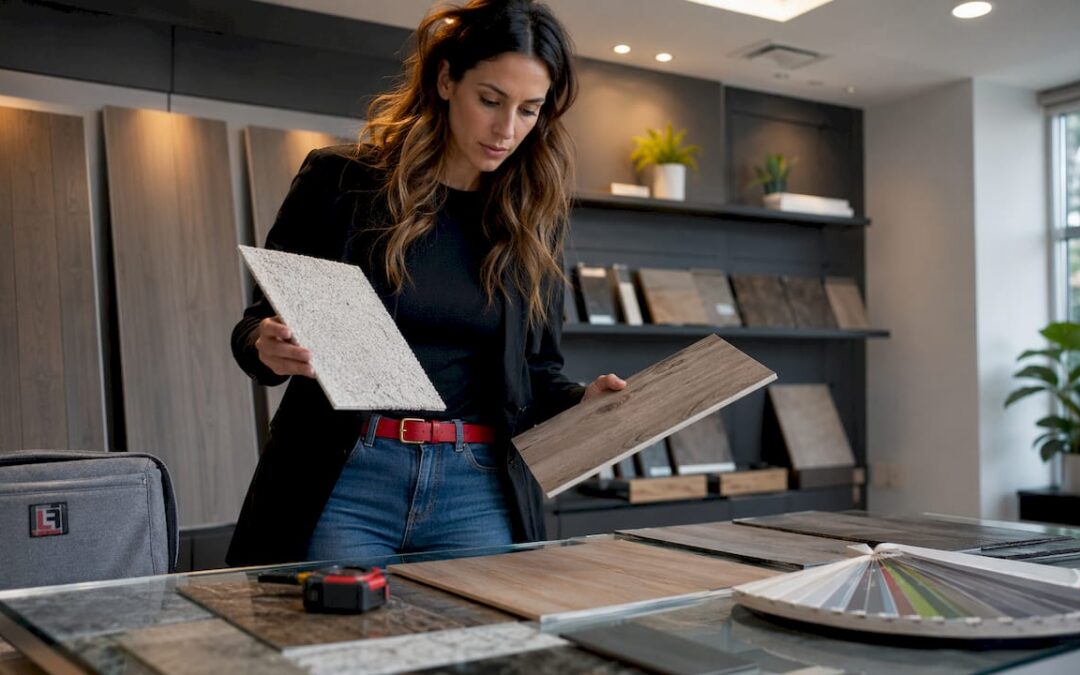
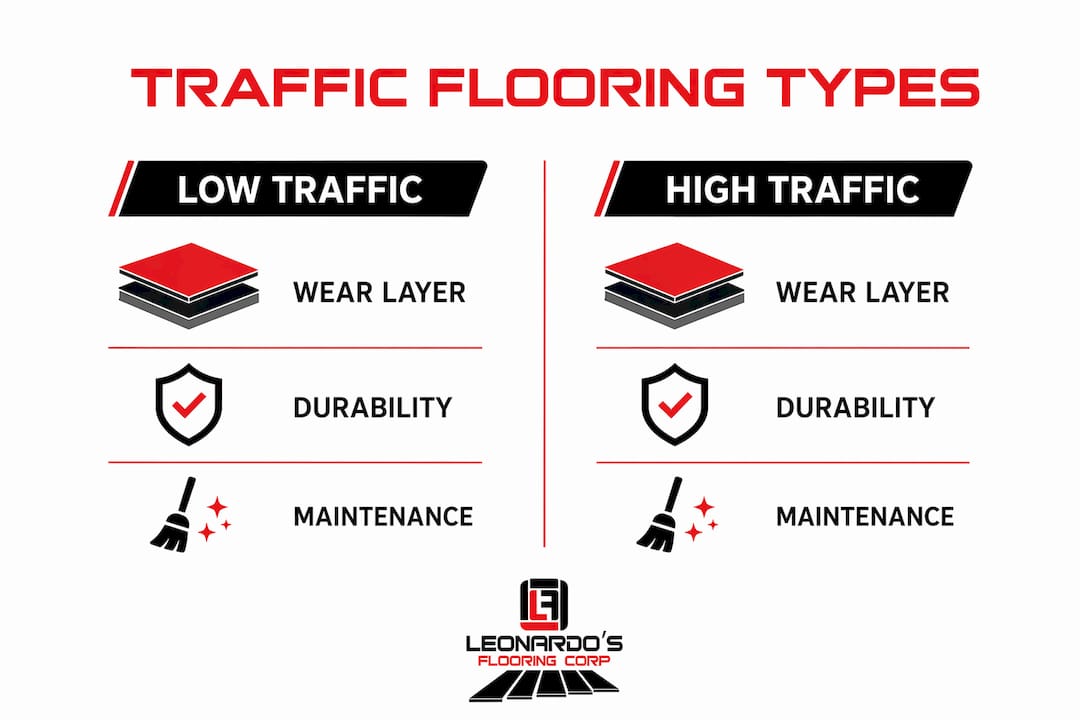
Low-traffic flooring is specified for appearance and comfort. High-traffic flooring is specified for wear resistance, slip safety, and lifecycle cost. That single distinction drives every material choice, spec threshold, and installation decision in this guide.
Quick recommendations by traffic level:
- Low traffic (bedrooms, guest rooms, formal dining): hardwood, engineered wood, mid-grade LVP at 12 mil wear layer, quality laminate (AC3)
- High traffic (entryways, kitchens, corridors, retail, commercial lobbies): 20+ mil LVT/SPC, PEI 4–5 porcelain tile, rubber, epoxy, or polished concrete
- Wet high-traffic zones: target DCOF 0.42 minimum per ANSI A326.3; 0.50+ for kitchens and entryways
Spec thresholds to remember:
- Wear layer (LVP/LVT): 12 mils is suitable for light residential use; 20 mils is the practical commercial baseline; higher wear layers are specified for heavy-duty or healthcare settings.
- PEI tile rating: 3 covers most residential floors; 4 is for moderate commercial traffic; 5 is intended for the most demanding environments such as airports and malls.
- DCOF: A minimum value of 0.42 is recommended for commercial wet-prone surfaces; a higher threshold is advised for high-traffic wet areas.
Table of Contents
- What counts as low traffic vs. high traffic?
- Which specs actually determine how a floor handles traffic?
- How do different materials perform in low vs. high traffic?
- What’s the best flooring choice for each room?
- How do you pick the right flooring for your traffic needs?
- What lifespan and maintenance should you realistically expect?
- How can finish and design choices hide wear and extend appearance?
- Why does installer expertise matter as much as the material you choose?
- Key Takeaways
- The spec sheet doesn’t tell you everything
- Leonardo’s Flooring Corp: Denver’s flooring installation specialists
- Useful sources and standards
What counts as low traffic vs. high traffic?
Traffic classification is less about square footage and more about how many people cross a surface, how often, and with what loads. A private bedroom sees one or two people in socks. A restaurant entry sees hundreds of guests in wet shoes, plus staff pushing carts. Those are fundamentally different engineering problems.
Low-traffic spaces (private, occasional use):
- Bedrooms and guest rooms
- Formal dining rooms
- Home offices used by one person
- Closets and storage areas
High-traffic spaces (frequent, multi-person, or load-bearing use):
- Entry halls, mudrooms, and foyers
- Kitchens and laundry rooms
- Living rooms and family rooms with children or pets
- Commercial lobbies, corridors, and retail aisles
- Healthcare hallways, school classrooms, and restaurant floors
A useful rule of thumb: if the space is private and used by fewer than three people daily, it qualifies as low traffic. If it’s shared, public-facing, or sees rolling loads (carts, wheelchairs, dollies), spec it as high traffic. When in doubt, go one level up. Underspecifying costs far more to fix than overspecifying costs upfront. For a deeper look at what separates durable floors from decorative ones, the must-have features guide covers the key durability requirements by room type.
Which specs actually determine how a floor handles traffic?
Material type gets most of the attention, but the specs behind the material are what determine whether a floor lasts 10 years or 30. Here are the factors that matter most.
Wear layer thickness for vinyl and LVT/LVP
The wear layer is the clear protective coating on top of vinyl, LVT, and LVP. It’s the only thing standing between the decorative layer and foot traffic. Wear layer thickness breaks down as follows: 12 mil (approximately 0.3 mm) suits light residential use; 20 mil (approximately 0.5 mm) is the practical commercial baseline; 28–40 mil (approximately 0.7–1.0 mm) is specified for hospitals, airports, and heavy public corridors.
Marketing terms like “commercial-grade” mean nothing without a mil number on the spec sheet. Always ask for the actual mil thickness.
PEI rating for tile
The Porcelain Enamel Institute (PEI) rating measures how well a tile’s glaze resists abrasion. PEI 3 covers most residential floors; PEI 4 handles moderate to heavy commercial traffic; PEI 5 is built for the most demanding environments, including airports and shopping malls. PEI 1–2 tiles belong on walls or in very light-use residential areas only.
Slip resistance: DCOF and ANSI A326.3
Spec callout: ANSI A326.3 sets a wet DCOF (Dynamic Coefficient of Friction) minimum of 0.42 for wet-prone commercial surfaces. High-traffic kitchens and entryways should target 0.50 or higher for meaningful slip safety margin.
Polished large-format porcelain can test below 0.42 DCOF even when it looks non-slip. Always request third-party ANSI A326.3 test reports for the specific finish and glaze you plan to install, not just the product line.
Core type and format
SPC (stone plastic composite) cores resist thermal expansion better than flexible LVT, making them the preferred choice for large open commercial floors. For spaces with rolling loads (hospital gurneys, pallet jacks, heavy carts), check ASTM F2055 static load limits. Many standard LVT products are not rated for that kind of impact and will fail at the edges or seams.
Subfloor flatness and moisture
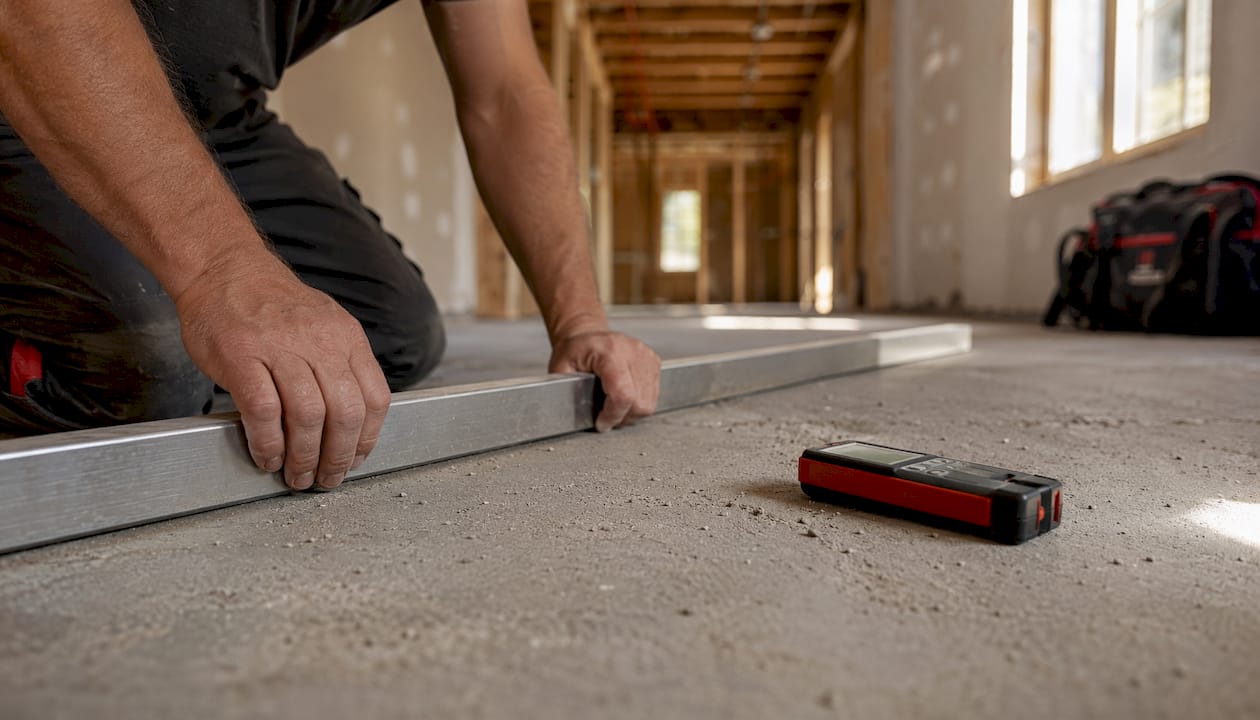
A subfloor deviation greater than 1/4 inch over 10 feet will cause premature failure in almost any flooring system. Moisture vapor emission rate (MVER) testing is mandatory before installing vinyl or wood over concrete. If MVER exceeds product limits, a moisture barrier is required to prevent delamination. No amount of premium material compensates for a skipped moisture test.
Key numeric thresholds at a glance:
| Spec | Low-Traffic Threshold | High-Traffic Threshold |
|---|---|---|
| LVP/LVT wear layer | 12 mil (light residential) | 20 mil minimum; 28–40 mil heavy-duty |
| PEI tile rating | PEI 3 (residential) | PEI 4 (commercial); PEI 5 (heavy) |
| DCOF (wet) | Not typically tested | 0.42 minimum; 0.50+ for wet zones |
| Subfloor flatness | 1/4 in. over 10 ft. | 1/4 in. over 10 ft. (stricter for large tile) |
| MVER (concrete) | Test and document | Test; mitigate if over product limit |
How do different materials perform in low vs. high traffic?
Each material has a sweet spot. The mistake most buyers make is choosing by appearance and assuming durability follows. It doesn’t.
Porcelain and ceramic tile
Porcelain is the highest-rated flooring in Consumer Reports’ abrasion and durability tests. It doesn’t scratch, stain, or fade, and it’s fully waterproof. For high-traffic wet zones, it’s the default choice. The weak link is grout: use epoxy grout in food service and healthcare settings, and seal standard grout annually. Ceramic is less dense than porcelain and better suited to moderate residential traffic. Installation is more complex and expensive than vinyl, and neither forgives a dropped cast-iron pan.
Specs to verify: PEI rating (4+ for commercial), DCOF test report for the specific finish, grout type.
LVT and LVP (luxury vinyl)
LVT has displaced VCT in many commercial applications because it eliminates the strip-and-wax maintenance cycle entirely. SPC-core LVT with a 20+ mil wear layer is the standard commercial spec for retail, corporate offices, and hospitality. It’s waterproof, quieter underfoot than tile, and far easier to repair (individual planks replace without disturbing the whole floor). For heavy rolling loads, sheet vinyl with heat-welded seams outperforms plank LVT because it eliminates seam failure points. For a detailed look at waterproof vinyl options, the waterproof vinyl plank guide covers wear-layer selection and installation considerations.
Specs to verify: Actual mil thickness (not marketing tier), SPC vs. flexible core, ASTM F1700 Class III or ASTM F1303 Type II for heavy commercial use.
Hardwood and engineered wood
Solid hardwood is warm, refinishable, and adds resale value, but it dents and scratches faster than LVP in high-traffic conditions. Consumer Reports’ abrasion tests found that most prefinished solid wood and engineered wood products score only satisfactory or below when subjected to high-traffic simulation. Engineered wood handles humidity swings better than solid hardwood because of its cross-ply construction, making it a reasonable choice for living rooms and hallways, but not kitchens or mudrooms. A wire-brushed or hand-scraped finish hides everyday scratches far better than a smooth, high-gloss surface.
Specs to verify: Janka hardness rating (species), veneer thickness for engineered (4 mm+ for refinishability), finish type.
Laminate
Laminate is tougher than it looks. Its AC (Abrasion Class) rating runs from AC1 (light residential) to AC5 (heavy commercial). AC3 covers most residential high-traffic areas; AC4 handles light commercial. The limitation is moisture: laminate swells when water gets under the joints, which rules it out for kitchens, bathrooms, and entryways in wet climates. It also can’t be refinished, so once the wear layer is gone, the floor is gone.
Specs to verify: AC rating, core density, moisture warranty terms.
Carpet and carpet tile
Carpet belongs in bedrooms, private offices, and conference rooms. In corridors or retail aisles, it stains, crushes, and fails fast. For commercial carpet, TARR (Texture Appearance Retention Rating) is a more reliable guide than vague labels like “high-traffic carpet.” Solution-dyed nylon is the preferred fiber for any commercial application because it resists fading, staining, and crushing better than other options. Carpet tile has one major advantage over broadloom: you replace only the worn tiles, not the whole floor.
Specs to verify: TARR rating, fiber type (solution-dyed nylon preferred), tile vs. broadloom format.
Rubber and epoxy/polished concrete
Rubber flooring excels in gyms, healthcare corridors, and schools because it absorbs impact, reduces fatigue, and resists rolling loads. Epoxy and polished concrete are the right call for garages, warehouses, and industrial kitchens where chemical resistance and seamless surfaces matter. Polished concrete can last the life of a building when properly maintained, with lifecycle costs as low as $0.10–$0.55 per square foot per year, making it one of the most cost-effective choices for large public spaces over a 20–30 year horizon.
Specs to verify: Shore hardness for rubber, epoxy coating thickness and chemical resistance rating, concrete surface hardness (Mohs).
Material comparison by traffic use:
| Material | Best for | Durability | Water tolerance | Maintenance | Typical lifespan | Installation complexity |
|---|---|---|---|---|---|---|
| Porcelain tile (PEI 4–5) | High-traffic wet zones, commercial | Excellent | Fully waterproof | Low (grout needs sealing) | 30+ years | High |
| LVT/SPC (20+ mil) | Commercial, kitchens, retail | Very good | Waterproof | Very low | — | Moderate |
| Engineered hardwood | Living rooms, hallways | Good | Low | Moderate | 20–30 years | Moderate |
| Solid hardwood | Low-traffic rooms | Fair in traffic | Poor | Moderate–high | 30 years (refinishable) | High |
| Laminate (AC3–AC4) | Residential high-traffic (dry) | Good | Poor | Low | — | Low–moderate |
| Carpet tile (nylon) | Offices, conference rooms | Moderate | Poor | Moderate | 10 years | Low |
| Rubber | Gyms, healthcare, schools | Excellent | Good | Low | 20–30 years | Moderate |
| Epoxy/polished concrete | Garages, warehouses, industrial | Exceptional | Excellent | Very low | 25+ years | High |
What’s the best flooring choice for each room?
Room-by-room picks based on traffic intensity and moisture exposure:
- Bedroom: Best: hardwood or engineered wood. Acceptable: quality laminate (AC3), mid-grade LVP (12 mil). Not recommended: tile (cold, hard underfoot with no benefit in low traffic).
- Living room: Best: engineered hardwood, LVP (12–20 mil). Acceptable: laminate (AC3). Not recommended: carpet in homes with pets or heavy use.
- Hallway: Best: LVP (20 mil), engineered hardwood with wire-brushed finish. Acceptable: porcelain tile (PEI 3–4). Not recommended: solid hardwood (dents fast in corridors).
- Entry/mudroom: Best: porcelain tile (PEI 4+, textured finish, DCOF 0.50+). Acceptable: LVP (20 mil). Not recommended: solid hardwood, laminate, polished tile (slip hazard).
- Kitchen: Best: porcelain tile (PEI 4+) or LVP (20 mil waterproof). Acceptable: engineered hardwood with moisture-resistant finish. Not recommended: laminate, solid hardwood, carpet.
- Laundry room: Best: porcelain tile or sheet vinyl. Acceptable: LVP (waterproof). Not recommended: laminate, hardwood.
- Commercial lobby: Best: porcelain tile (PEI 5), terrazzo, or LVT (20+ mil SPC). Acceptable: polished concrete. Not recommended: carpet, laminate.
- Commercial corridor: Best: LVT (28 mil+), rubber, or porcelain tile (PEI 4–5). Acceptable: VCT with maintenance program. Not recommended: hardwood, laminate.
- Retail floor: Best: LVT (20+ mil) or polished concrete. Acceptable: porcelain tile (PEI 4–5). Not recommended: carpet in aisles, solid hardwood.
- Healthcare room: Best: sheet vinyl (heat-welded seams), rubber, or LVT (28–40 mil). Acceptable: porcelain tile with epoxy grout. Not recommended: carpet, laminate, floating LVT without glue-down.
Pro Tip: Specify 20 mil or higher for any LVT going into a commercial lobby or retail aisle. In a busy retail environment, a 12 mil product will show visible wear within two to three years. The extra cost per square foot is a fraction of an early replacement.
For family-specific room picks, the family-friendly flooring guide covers durable options with kids and pets in mind.
How do you pick the right flooring for your traffic needs?
Follow this sequence before you commit to any product or quote.
Step-by-step decision checklist:
- Define traffic type. Count daily users, identify rolling loads, and flag wet or moisture-prone conditions.
- Set a replacement strategy. Are you planning to be in this space for 5 years or 25? A shorter horizon favors LVP; a longer one favors tile or polished concrete.
- Match material to traffic. Use the room-by-room picks above as your starting point.
- Verify specs on the product data sheet. Confirm actual wear-layer mil for vinyl, PEI rating for tile, AC rating for laminate, TARR for carpet.
- Test the subfloor. Confirm flatness (within 3/16 inch over 10 feet for most products) and run MVER testing on any concrete slab.
- Confirm installation method. Glue-down or heat-welded seams for heavy commercial; floating is acceptable for light residential only.
- Review warranty terms. A warranty that excludes commercial use on a product you’re installing commercially is worthless.
Questions to ask your installer or product rep:
- What is the exact wear-layer mil thickness on the spec sheet?
- Can you provide a third-party ANSI A326.3 DCOF test report for this specific finish?
- What is the PEI rating, and is it tested for this glaze color?
- What subfloor prep is included, and will you perform MVER testing?
- What maintenance does the warranty require, and what voids it?
- Is this product rated for rolling loads, and what’s the static load limit?
Red flags on quotes and spec sheets:
- Wear layer listed as “commercial-grade” with no mil number
- No DCOF test report available for a wet-zone tile
- PEI rating missing or listed as “suitable for residential”
- Floating installation recommended for a space with rolling equipment
- No mention of subfloor prep or moisture testing in the scope of work
The flooring selection guide expands on these decision steps with additional product-specific guidance.
What lifespan and maintenance should you realistically expect?
Lifespan estimates vary by material and how well the floor is maintained. The table below reflects typical ranges under appropriate traffic conditions.
| Material | Low-traffic lifespan | High-traffic lifespan | Key maintenance task |
|---|---|---|---|
| Porcelain tile | 30+ years | 30+ years | Seal grout annually; clean with pH-neutral cleaner |
| LVT/LVP (20 mil) | 20–25 years | — | Daily dust mop; damp mop with neutral cleaner |
| Engineered hardwood | 25–30 years | — | Refinish surface every 7–10 years; avoid wet mopping |
| Solid hardwood | 30+ years | 20–30 years | Refinish 3–5 times over life; avoid moisture |
| Laminate (AC3) | — | 10 years | Dry mop only; replace when wear layer is gone |
| Carpet tile (nylon) | 12 years | 7–10 years | Vacuum daily; replace worn tiles individually |
| Rubber | 20–30 years | 20–30 years | Damp mop; avoid oil-based cleaners |
| Epoxy/polished concrete | — (epoxy) | 25+ years (concrete) | Dust mop daily; recoat epoxy every 5–10 years |
Matching the material to the actual load can add 5–10 years to a floor’s lifecycle. A 20 mil LVT in a bedroom will outlast its rated lifespan. That same product in a busy retail corridor may not reach it.
Maintenance by traffic intensity:
- Low traffic: Sweep or vacuum weekly; damp mop monthly; inspect finish annually.
- High traffic (residential): Sweep or dust mop daily; damp mop weekly with a neutral pH cleaner; inspect wear layer every two years.
- High traffic (commercial): Daily dust mopping is non-negotiable. Grit is the primary abrasive that degrades surface finish. Periodic recoating (for hardwood and epoxy) or grout resealing (for tile) extends appearance and structural life significantly.
For lifecycle cost planning, hard seamless systems like polished concrete and terrazzo tend to deliver the lowest cost per square foot per year in large public spaces, despite higher upfront installation costs. The savings come from near-zero replacement cycles and minimal maintenance labor over decades. For home improvement ideas that pair well with flooring upgrades, low-cost sustainable home upgrades offers practical guidance on coordinating improvements.
How can finish and design choices hide wear and extend appearance?
The right finish choice can make a floor look good for years longer than a poor one, even under identical traffic.
Surface texture and finish:
- Low-sheen and matte finishes hide micro-scratches that high-gloss surfaces telegraph immediately. A satin or matte polyurethane on hardwood, or a matte LVP surface, stays looking fresh far longer in active households.
- Embossed-in-register (EIR) textures on LVP and LVT align the surface texture with the printed wood grain, which conceals scuffs and surface wear in the texture valleys rather than on a flat, reflective plane.
- Hand-scraped and wire-brushed visuals on engineered hardwood serve the same purpose: the intentional surface variation absorbs everyday scratches into the aesthetic rather than fighting them.
Color and pattern strategy:
- Mid-tone colors (warm grays, natural tans, medium browns) hide both dirt and wear better than very light or very dark floors. Light floors show every footprint; dark floors show every dust particle and scratch.
- Varied grain patterns and multi-tone planks break up the visual monotony that makes wear patterns obvious. In corridors and entryways, a wood-look plank with natural color variation outperforms a uniform stone-look tile for hiding traffic paths.
- In commercial entryways, a patterned tile border or a darker inset zone near the door absorbs the heaviest wear visually while protecting the main field.
Pro Tip: Pair a wire-brushed or matte finish with a weekly dry-mop routine instead of wet mopping. Wet mopping a matte floor with the wrong cleaner leaves a film that dulls the finish and actually makes wear more visible over time. Use a neutral pH cleaner diluted to the manufacturer’s spec, and you’ll preserve the surface texture that’s doing the concealment work.
For more on scratch-resistant flooring options, the 2026 guide covers finish types and material comparisons in detail.
Why does installer expertise matter as much as the material you choose?
Flooring is a system. The material is only one component. Subfloor prep, adhesive selection, moisture testing, and installation method determine whether a floor performs as specified or fails in year three.
Where installation-dependent failures happen:
- Subfloor flatness: A deviation greater than 1/4 inch over 10 feet causes tile to crack at grout lines and LVT to flex and separate at seams. This is one of the most common causes of premature failure, and it’s entirely preventable with proper prep.
- Moisture testing: Skipping MVER testing on a concrete slab before installing hardwood or vinyl is a gamble that frequently loses. Moisture migrates upward, traps under the floor, and causes delamination, warping, and mold.
- Adhesive selection: For glue-down vinyl installations, the adhesive must match the product, the subfloor, and the expected load. The wrong adhesive fails under rolling equipment or temperature cycling.
- Seam strategy: In heavy commercial applications, heat-welded seams or full glue-down are required. Floating installations are not appropriate where rolling loads or heavy foot traffic will stress seam edges.
Leonardo’s Flooring Corp brings over 10 years of installation experience across residential and commercial projects in the Denver metro, with 125+ five-star reviews and Home Depot contractor status. Every project includes subfloor evaluation, moisture testing where applicable, and a clear scope of work before a single plank goes down.
Installer evaluation checklist for buyers:
- Does the bid include subfloor flatness assessment and any required leveling?
- Is MVER testing included for slab installations?
- Is the adhesive specified by product name and matched to the flooring manufacturer’s requirements?
- For commercial vinyl: is glue-down or heat-welded seam specified, or is floating proposed?
- Does the installer provide a maintenance handoff (cleaning products, recoat schedule, warranty terms)?
- Is the installation warranty separate from the product warranty, and what does each cover?
For localized guidance on durability factors specific to Colorado’s climate, the Denver homeowner’s durability guide covers subfloor and moisture considerations relevant to the region.
Key Takeaways
Matching flooring to traffic level, not just appearance, is the single decision that most determines whether a floor lasts 10 years or 30.
| Point | Details |
|---|---|
| Wear layer drives vinyl lifespan | Specify 12 mil for light residential, 20 mil for commercial baseline, 28–40 mil for heavy-duty zones. |
| PEI rating determines tile durability | Use PEI 3 for residential floors; PEI 4 for moderate commercial; PEI 5 for airports, malls, and heavy retail. |
| DCOF 0.42 is the wet-zone minimum | Per ANSI A326.3, target 0.42 DCOF for commercial wet surfaces and 0.50+ for high-traffic kitchens and entries. |
| Installation is part of the spec | Subfloor flatness, MVER testing, and correct adhesive or seam method determine whether any material performs as rated. |
| Leonardosflooringcorp covers the full scope | Leonardo’s Flooring Corp handles subfloor prep, moisture testing, and installation for residential and commercial projects across the Denver metro. |
The spec sheet doesn’t tell you everything
Here’s what most flooring guides won’t say: the biggest specification mistakes aren’t made by people who don’t know the specs. They’re made by people who know the specs but trust the wrong source for them.
A product marketed as “commercial-grade” with a 12 mil wear layer is not a commercial product. A polished porcelain tile with a beautiful DCOF number on the manufacturer’s website may test below 0.42 when you request the third-party report for the specific glaze color you’re actually buying. These gaps between marketing claims and verified performance are where floors fail, and where replacement budgets get blown.
The other thing worth saying plainly: floating installations are oversold. They’re faster and cheaper to install, which is why they get proposed more often than they should. For a bedroom or a low-traffic home office, floating LVP is perfectly appropriate. For a commercial corridor, a retail floor, or any space with rolling loads, floating installation is a liability. Glue-down or heat-welded seams aren’t optional in those environments. They’re the spec.
Finally, don’t optimize for day-one appearance. The floors that look best after five years of real use are almost never the ones that looked most impressive in the showroom. A wire-brushed engineered oak in a medium tone will outperform a high-gloss smooth finish in any honest before-and-after comparison. Spec for year five, not day one.
Leonardo’s Flooring Corp: Denver’s flooring installation specialists
When you’ve worked through the specs and know what your space needs, the next step is getting it installed correctly. Leonardosflooringcorp handles the full scope: vinyl and LVT installation, porcelain and ceramic tile setting, epoxy floor coating, hardwood installation, laminate, and subfloor preparation for both residential and commercial properties throughout the Denver metro.
What separates a good installation from one that fails in year three is the prep work: subfloor assessment, moisture testing, correct adhesive selection, and a clear maintenance handoff. That’s standard practice at Leonardosflooringcorp, not an add-on. With 125+ five-star reviews and over a decade of experience as Home Depot contractors, the team brings the same attention to a single-room update as to a full commercial build-out.
Ready to match the right floor to your space? Request a flooring evaluation and get a spec-specific recommendation for your traffic needs, budget, and timeline.
Useful sources and standards
The spec numbers in this guide come from the following primary sources. Request product data sheets and third-party test reports to verify DCOF and wear-layer claims before purchasing.
- ANSI A326.3 — The Tile Council of North America’s standard for measuring dynamic coefficient of friction (DCOF) in wet conditions. Sets the 0.42 minimum for commercial wet-prone surfaces.
- Porcelain Enamel Institute (PEI) ratings — The industry standard for tile abrasion resistance. PEI 3 = residential; PEI 4–5 = commercial and heavy-use environments.
- Wear-layer mil guidance for vinyl — Industry thresholds: 12 mil (light residential), 20 mil (commercial baseline), 28–40 mil (heavy-duty/healthcare).
- ASTM F-710 subfloor flatness guidance — Defines acceptable subfloor deviation tolerances and MVER testing requirements for resilient flooring installations.
- Heavy-duty commercial vinyl spec guide — Covers ASTM F1700 Class III, ASTM F1303 Type II, and EN ISO 10874 Class 33/34 certifications, plus seam and installation method guidance.
- TARR ratings for commercial carpet — Texture Appearance Retention Rating: a more reliable guide for carpet selection than general “high-traffic” labeling.
- Consumer Reports flooring durability testing — Independent abrasion and impact testing across laminate, porcelain tile, vinyl, hardwood, and engineered wood.
Always request third-party ANSI A326.3 DCOF test reports for the specific finish and glaze you plan to install. Manufacturer-published numbers may not reflect the exact product configuration you’re buying.